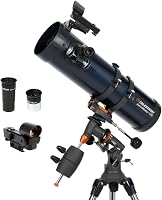
5 Best Long Focal Length Telescopes (November 2026)
The best long focal length telescopes include the Explore Scientific Focal Extender Barlow Lens for extending focal length, the SVBONY SV520 Telescope for Adults (best complete refractor setup), and the NEEWER Zoom Telescope Eyepiece with 7-21mm Focal for flexible magnification.
On this page (7 sections)
- How we chose long focal length telescopes and accessories
- Long focal length telescope picks for lunar and planetary views
- What does long focal length change when viewing planets?
- How should you choose between a longer tube and a focal extender?
- Is a longer focal length telescope best for every target?
- What should you check before buying a long focal length telescope?
- Which long focal length telescope setup should you choose?
The best long focal length telescope for most beginners here is the SVBONY SV520, a 90 mm refractor with an 800 mm focal length and two included eyepieces. The HSL 203EQ offers a much larger aperture at the same stated focal length, while a focal extender or zoom eyepiece can change the magnification of a compatible telescope.
Long focal length is useful when you want to examine the Moon and planets at higher magnification. But focal length alone does not decide how much detail you'll see.
Aperture gathers light, eyepieces set magnification, and a stable mount helps keep the view steady.
For a direct comparison of complete planetary setups, see our best telescope for planets guide. If lunar observing is your main goal, our best telescope to view the moon guide focuses on that use.
Our picks at a glance
-
1
 Best for extending focal length
Explore Scientific Focal Extender Barlow Lens
9.7/10 our score
See it on Amazon -
2

-
3
 Best for flexible magnification
NEEWER Zoom Telescope Eyepiece with 7-21mm Focal
9.2/10 our score
See it on Amazon
- 4
 Check it
HSL 203EQ Astronomical Reflector Telescope for Adults
Best for a large aperture - 5
 Check it
SVBONY SV157 1.25” Telescope Extension Tube Optical
Best for reaching focus
How we chose long focal length telescopes and accessories
We compared focal length, aperture, included optical accessories and mount type against the needs of lunar and planetary viewing. We also included accessories that change effective focal length or help with eyepiece and camera focus, since not every buyer needs a new telescope.
The listed scores reflect how well each option fits this search, based on its stated specifications and features. Our score weighs specs, features and buyer feedback against what you're shopping for.
| Product | Best for | Extension | Design | Coating | Our score |
|---|---|---|---|---|---|
| Explore Scientific Focal Extender Barlow Lens | extending focal length | 2x | Four lens telecentric | Fully coated | 9.7 |
| SVBONY SV520 Telescope for Adults | complete refractor setup | 9.5 | |||
| NEEWER Zoom Telescope Eyepiece with 7-21mm Focal | flexible magnification | 9.2 | |||
| HSL 203EQ Astronomical Reflector Telescope for Adults | a large aperture | 9.0 | |||
| SVBONY SV157 1.25” Telescope Extension Tube Optical | reaching focus | 8.8 |
Long focal length telescope picks for lunar and planetary views
The SVBONY SV520 is the most balanced complete beginner kit in this group, while the Explore Scientific extender is the strongest pick for changing a compatible telescope's effective focal length. The HSL is the aperture-first choice, though its 800 mm focal length is paired with a much larger mirror.
Explore Scientific Focal Extender Barlow Lens: Best for extending focal length
- 2x focal length extension
- Four lens telecentric design
- Fully coated optics
A 2x telecentric focal extender for observers who want to increase effective focal length while keeping a longer focal length eyepiece in the setup.
Pros
- 2x extension factor
- Four lens design
- Blackened lens edges
Cons
- Requires a compatible telescope and eyepiece
- Does not replace a stable mount or suitable seeing
The Explore Scientific focal extender is the best fit if you already have a telescope and want more magnification from your existing eyepieces. Its 2x extension factor doubles effective focal length, so a telescope with an 800 mm focal length behaves like a 1,600 mm system for the eyepiece and magnification calculation.
The four lens telecentric design and fully coated optics are intended to maintain image quality across the field. Blackened lens edges help limit stray reflections.
These features make it a more specialized option than a basic telescope kit.
Use a focal extender thoughtfully. Doubling magnification also makes focusing more demanding and narrows the field, so atmospheric turbulence and mount shake become easier to notice.
Choose it if your telescope and eyepieces are compatible and you want a flexible way to raise magnification. For a broader discussion of magnification choices, see our best high power telescope guide.
SVBONY SV520 Telescope for Adults: Best complete refractor setup
- 90 mm aperture
- 800 mm focal length
- Altazimuth mount
- PL10 and K25 eyepieces
A complete refractor kit with a 90 mm aperture, 800 mm focal length, two eyepieces and a moon filter, suited to a beginner seeking lunar and planetary views.
Pros
- 90 mm aperture
- 800 mm focal length
- Includes two eyepieces and a moon filter
Cons
- Included mount is altazimuth
- High magnification depends on conditions and eyepiece choice
The SVBONY SV520 is the simplest complete telescope setup here for someone starting with the Moon and planets. Its 90 mm aperture and 800 mm focal length are paired with a PL10 eyepiece, K25 eyepiece and moon filter.
The two eyepieces give you different starting magnifications without an extra purchase. The altazimuth mount moves horizontally and vertically, which is an intuitive arrangement for finding objects, though it does not track the sky in the same way as an equatorial mount.
SVBONY describes the telescope as having a metal construction and a helical manual focusing system. The supplied 5x24 finderscope is intended to help locate targets, and the kit includes a smartphone holder.
This is a practical pick if you want one box with the main parts for beginning observations. If you are comparing brand-specific planetary options, see our best Celestron telescope for planets guide.
NEEWER Zoom Telescope Eyepiece with 7-21mm Focal: Best for flexible magnification
- 7–21 mm focal length range
- 40°–57° field of view
- 15 mm eye relief
- 1.25 in barrel
A zoom eyepiece that changes focal length from 7 mm to 21 mm without swapping eyepieces, for telescopes that accept 1.25 in accessories.
Pros
- Adjustable 7–21 mm range
- 15 mm eye relief
- Works with 1.25 in telescope focusers
Cons
- Compatibility depends on a 1.25 in focuser
- Zooming changes the field of view
The NEEWER zoom eyepiece suits observers who want to adjust magnification without swapping between several eyepieces. Its 7–21 mm focal length range offers a high-magnification end for lunar and planetary detail and a lower-magnification end for wider views.
The eyepiece has a stated 40°–57° field of view and 15 mm eye relief. It uses a 1.25 in barrel, so check that your focuser accepts that size before choosing it.
Changing the zoom changes both magnification and the field you see. Start at the 21 mm setting to find and center a target, then turn toward 7 mm only as far as focus, mount steadiness and sky conditions allow.
This accessory makes sense for a compatible 1.25 in telescope when convenience matters more than owning several fixed eyepieces. It won't change the telescope's aperture or make the atmosphere steadier.
HSL 203EQ Astronomical Reflector Telescope for Adults: Best for a large aperture
- 203 mm aperture
- 800 mm focal length
- EQ4 equatorial mount
- Five color filters
A 203 mm reflector with an 800 mm focal length and EQ4 equatorial mount, for buyers who prioritize aperture and have room for a larger setup.
Pros
- 203 mm primary mirror
- EQ4 equatorial mount
- Includes five color filters
Cons
- 800 mm focal length is not especially long for its aperture
- The larger mirror and mount need more setup space
The HSL 203EQ is the aperture-first option, with a 203 mm primary mirror and an 800 mm focal length. Its large mirror gathers more light than the 90 mm SV520, but its relatively short focal ratio means the word “long” is less descriptive of this telescope's overall design.
The manual EQ4 equatorial mount is designed to carry the tube and accessories, and the package includes five color filters and a 3x Barlow lens. HSL gives example magnifications for several eyepiece and Barlow combinations, but those figures are not a promise of sharp views in every location.
A 203 mm reflector and equatorial mount call for more space and careful setup than a small refractor kit. Check the room you have for storage and observing, and expect to spend time aligning the mount.
Choose this model if aperture matters more to you than a long focal ratio and you have room for a substantial setup. For a smaller, simpler refractor approach, the SV520 is easier to compare as a complete starter kit.
SVBONY SV157 1.25” Telescope Extension Tube Optical: Best for reaching focus
- 40 mm optical length
- 1.25 in fit
- Threaded for standard 1.25 in filters
A 1.25 in extension tube that can help an eyepiece or camera reach focus when the focuser needs more outward travel.
Pros
- 40 mm optical length
- Threaded for standard 1.25 in filters
- Brass compression ring
Cons
- Does not increase magnification by itself
- Only fits compatible 1.25 in accessories
The SVBONY SV157 extension tube is a focus aid, not a magnification booster. Its 40 mm optical length adds space between a compatible 1.25 in focuser and eyepiece or camera, which can help when the optical path needs more outward travel to reach focus.
The tube is metal and accepts standard 1.25 in filters on its threaded end. A brass compression ring helps hold accessories without the direct contact of a set screw against their barrels.
An extension tube and a focal extender solve different problems. Use an extension tube when an eyepiece or camera can't reach focus; choose a Barlow or focal extender when you want more effective focal length and magnification.
This accessory is a useful fit only if your telescope's focuser and accessories use the 1.25 in format. Confirm the focus position with your setup before relying on it.
What does long focal length change when viewing planets?
A longer focal length raises magnification with the same eyepiece, because magnification equals telescope focal length divided by eyepiece focal length. For example, an 800 mm telescope with a 10 mm eyepiece gives 80x magnification before any Barlow or extender is added.
That can make a long focal length instrument convenient for lunar and planetary observing, but it does not create extra detail by itself. If magnification is pushed beyond what the aperture, mount or atmosphere can support, the image grows dimmer and softer rather than clearer.
A slower focal ratio often comes with a longer focal length relative to aperture. Read our explanation of [What Is a Slow Focal Ratio Telescope?
Explained](/what-is-a-slow-focal-ratio-telescope/) for how that relationship shapes observing choices.
How should you choose between a longer tube and a focal extender?
Choose a telescope with a longer native focal length if you want a complete optical setup designed around that focal length. Choose a focal extender if you already have a suitable telescope and want to raise magnification with the eyepieces you own.
A zoom eyepiece offers another path: it changes eyepiece focal length across a range, letting you adjust magnification without removing the eyepiece. The NEEWER 7–21 mm zoom is the only variable focal length eyepiece in this group.
Accessories can't overcome poor seeing or a shaky mount. Before increasing power, make sure your target is centered, focus carefully and let the telescope adjust to the outdoor temperature.
Is a longer focal length telescope best for every target?
No. A long focal length often suits small, bright targets such as the Moon and planets, while a shorter focal length and wider field can make large star fields and extended deep-sky objects easier to frame.
A telescope's focal ratio helps explain the tradeoff between focal length and aperture. An 800 mm telescope with a 90 mm aperture has a different focal ratio from an 800 mm telescope with a 203 mm mirror, even though both share the same stated focal length.
For wide-field observing, a faster focal ratio may be useful; our What Is a Fast Focal Ratio Telescope? Explained guide covers that side of the choice.
Decide what you want to observe most often, then compare focal length and aperture together.
What should you check before buying a long focal length telescope?
Check the telescope's aperture and focal length as separate specifications, then look at the mount and included eyepieces. A long focal length can deliver higher magnification with a given eyepiece, but high-power viewing is much easier when the mount stays steady and the focuser allows fine adjustments.
Make sure any eyepiece, Barlow or extension tube fits the focuser. The NEEWER eyepiece and SVBONY extension tube are for 1.25 in systems, while the Explore Scientific extender needs a compatible telescope and eyepiece.
If solar observing is also on your list, use equipment specifically designed for safe solar viewing. Our best telescope for solar viewing and best beginner solar telescope guides cover that separate equipment choice.
Which long focal length telescope setup should you choose?
Choose the SVBONY SV520 for a complete beginner refractor kit with an 800 mm focal length, or the HSL 203EQ if you want a much larger aperture and can manage its larger mount and tube. Pick the Explore Scientific extender to double effective focal length on a compatible telescope, and the NEEWER zoom eyepiece if you want to adjust magnification without changing eyepieces.
Our top 3 picks at a glance
-
1
Best for extending focal length
Explore Scientific Focal Extender Barlow Lens
9.7/10 our score
See it on Amazon -
2
-
3
Best for flexible magnification
NEEWER Zoom Telescope Eyepiece with 7-21mm Focal
9.2/10 our score
See it on Amazon
Frequently asked questions
Does a longer focal length telescope always give more magnification?
No. Telescope focal length works with eyepiece focal length to determine magnification.
Divide the telescope's focal length by the eyepiece's focal length, so a shorter eyepiece raises magnification on the same telescope.
A 2x Barlow or focal extender can also increase effective focal length, but useful magnification still depends on aperture, focus, mount stability and sky conditions.
Is a long focal length telescope better for planets?
A longer focal length can make higher magnification easier to reach with common eyepieces, which can help with lunar and planetary viewing. It does not guarantee more detail by itself.
Aperture, optical quality, steady tracking, careful focus and atmospheric steadiness all affect the view.
Compare complete setups in our best telescope for planets guide.
What is the difference between focal length and focal ratio?
Focal length is the distance over which the telescope brings light to focus. Focal ratio is focal length divided by aperture, so a telescope with a long focal length can still have a relatively fast focal ratio if its aperture is large.
See [What Is a Slow Focal Ratio Telescope?
Explained](/what-is-a-slow-focal-ratio-telescope/) and [What Is a Fast Focal Ratio Telescope?
Explained](/what-is-a-fast-focal-ratio-telescope/) for how the ratio affects observing.
Can I use a Barlow lens to make my telescope act longer?
Yes. A Barlow lens or focal extender increases effective focal length and magnification with a given eyepiece.
This can help you reach a useful lunar or planetary magnification without buying a very short focal length eyepiece.
It cannot add detail beyond what the telescope, atmosphere and mount can support.
Can long focal length telescopes be used for solar viewing?
Only with a solar filter designed for safe viewing and installed over the telescope's front aperture. Never point an unfiltered telescope at the Sun, and don't use an eyepiece solar filter.
Choose equipment and instructions made for solar observation, such as options in our best telescope for solar viewing guide or beginner solar telescope guide.