Celestron StarSense Explorer vs AstroMaster: Which to Pick? (November 2026)
Choose StarSense Explorer for phone guided target finding, or AstroMaster for traditional manual aiming. Your best fit depends on whether you want app guidance, a larger aperture, or a simpler way to point the telescope.
On this page (8 sections)
- Celestron StarSense Explorer vs AstroMaster: how do they differ?
- Which telescope has the larger aperture?
- Which mount is easier to learn?
- Which models fit your observing style?
- What should you know about the optics?
- Do you need a smartphone for StarSense Explorer?
- Which Celestron should you choose?
- How we scored these telescopes
Choose StarSense Explorer for phone guided target finding, or AstroMaster for traditional manual aiming. Your best fit depends on whether you want app guidance, a larger aperture, or a simple way to point the telescope.
The StarSense Explorer models use a smartphone dock and app that analyzes star patterns and guides you toward selected targets. AstroMaster models use a StarPointer red dot finderscope, with manual controls for pointing.
For the biggest aperture in this comparison, choose the AstroMaster 130EQ. For app guidance, pick the StarSense Explorer LT 114AZ or LT 80AZ; for straightforward Moon and daytime viewing, consider the AstroMaster 70AZ.
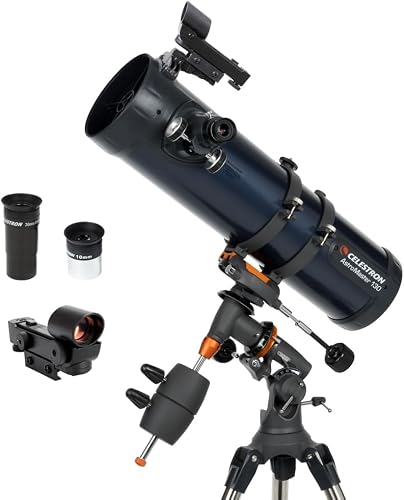 Best for manual deep-sky viewing
Celestron AstroMaster 130EQ Telescope for Deep-Sky Beginners
 Best for phone guided refractor viewing
Celestron StarSense Explorer LT 80AZ Smartphone Guided
Celestron StarSense Explorer vs AstroMaster: how do they differ?
StarSense Explorer adds smartphone guidance, while AstroMaster keeps target finding and pointing manual. The choice is about how you want to locate objects and which mount and optical design fit your observing plans.
StarSense Explorer's app generates a list of targets for your time and location, then shows arrows to guide you. When the bullseye turns green, the target should be in view through the eyepiece.
AstroMaster models include a StarPointer red dot finderscope to help you aim. The AstroMaster 130EQ also has slow-motion controls for right ascension and declination, while the AstroMaster 70AZ uses a panhandle on an altazimuth mount.
If you want a step-by-step walkthrough after choosing a StarSense model, see how to use Celestron StarSense. For the LT model specifically, how to use a Celestron StarSense Explorer LT telescope covers the app-guided setup.
Which telescope has the larger aperture?
The AstroMaster 130EQ has the largest aperture, at 130mm. The StarSense Explorer LT 114AZ follows at 114mm, while the refractor models are 80mm and 70mm.
A larger aperture gathers more light, which can help with faint objects, but it doesn't guarantee a particular view. Sky conditions, target selection and how steadily you can point the telescope all matter.
The 114AZ pairs its 114mm Newtonian reflector with StarSense app guidance. That makes it a useful middle ground if you want a larger reflector and help locating targets.
The 80AZ refractor has less aperture, but its design may suit you if you'd rather start with a refractor. The AstroMaster 70AZ is the smallest here and supports both night-sky and land-based viewing.
Which mount is easier to learn?
The altazimuth mounts are the most direct to point: move up, down and side to side. The AstroMaster 130EQ's German equatorial mount has a different control layout and rewards a little practice.
Both StarSense Explorer telescopes use a manual altazimuth mount. The phone guides you to the target, but you still move the telescope yourself.
The AstroMaster 70AZ also uses an altazimuth mount. Its panhandle is designed for straightforward pointing without app alignment.
The AstroMaster 130EQ's slow-motion knobs adjust right ascension and declination. That setup can help you make fine manual corrections, though the equatorial layout may take more getting used to than an altazimuth mount.
If you choose the 130EQ, read the AstroMaster 130EQ motor drive setup guide for help with that accessory. Its presence doesn't change the basic choice between phone-guided and manual target finding.
Which models fit your observing style?
Choose StarSense Explorer if you want app help finding targets; choose AstroMaster if you prefer manual aiming or want the 130mm model. Your comfort with the phone app and mount should shape the choice as much as aperture.
Choose the StarSense Explorer LT 80AZ for phone guided refractor viewing
The LT 80AZ combines an 80mm refractor with a StarSense phone dock and a manual altazimuth mount. It includes 25mm and 10mm eyepieces, plus an erect image diagonal.
Choose it if you want help selecting and locating objects without learning an equatorial mount first. Check that your phone is compatible with the app before you decide.
Choose the StarSense Explorer LT 114AZ for guided reflector viewing
The LT 114AZ has a 114mm Newtonian reflector and the StarSense app guidance found in the 80AZ. It uses a manual altazimuth mount and includes 25mm and 10mm eyepieces.
This model suits you if you want phone-guided target finding with more aperture than the 80AZ. The telescope remains manual, so you follow the arrows by moving it yourself.
Choose the AstroMaster 130EQ for a larger manual reflector
The 130EQ combines 130mm optics with a German equatorial mount. Its slow-motion knobs control right ascension and declination, and it includes 20mm and 10mm eyepieces.
Choose it if aperture and traditional manual controls matter more to you than app guidance. Be ready to learn the equatorial mount's motion and alignment.
Choose the AstroMaster 70AZ for straightforward pointing
The AstroMaster 70AZ has a 70mm refractor, a manual altazimuth mount and a panhandle. It also supports daytime viewing of land-based objects.
This is the simplest fit if you want a basic altazimuth mount and the option of daytime use. Its 70mm aperture is the smallest in this comparison, so it isn't the choice for the largest aperture.
What should you know about the optics?
The 2 StarSense models use different optical designs: an 80mm refractor and a 114mm Newtonian reflector. The AstroMaster options are a 130mm reflector and a 70mm refractor.
Refractors have a lens at the front, while Newtonian reflectors use mirrors. That difference affects the telescope's optical layout and may influence which one feels familiar or convenient to you.
The 80AZ and 70AZ refractors can show the Moon and planets, while the 70AZ also supports land viewing with a right-side-up image. The 114AZ and 130EQ are reflectors with larger apertures in this set.
Don't choose by magnification alone. The included eyepieces differ, and the view also depends on the target, sky and how well the telescope is aimed.
Do you need a smartphone for StarSense Explorer?
Yes, StarSense Explorer's guidance feature depends on a compatible smartphone. The phone docks on the telescope and the app uses sky recognition to guide you toward a chosen target.
If you prefer observing without a phone, an AstroMaster avoids the StarSense app workflow. Its StarPointer finder helps you point manually instead.
If app-guided choices appeal to you, read what to expect from Celestron StarSense before choosing. If you want a broader comparison of the brand's options, see which Celestron telescope to buy.
Which Celestron should you choose?
Pick StarSense Explorer if app guidance will help you find targets, and pick AstroMaster if you prefer manual aiming or want a larger aperture. Choose the LT 80AZ for a refractor, the LT 114AZ for a guided reflector, the 130EQ for the largest aperture, or the 70AZ for simple pointing and daytime use.
For more options in a similar budget range, see the best Celestron telescopes under 500 dollars. Measure your storage and setup space, check smartphone compatibility for StarSense, and choose the mount you feel ready to learn.
How we scored these telescopes
Our score weighs specs and features against what you're shopping for: aperture, target-finding approach, mount style and the type of viewing each model supports.
Frequently asked questions
What is the main difference between StarSense Explorer and AstroMaster?
StarSense Explorer uses a smartphone dock and app to guide you toward selected sky targets, while AstroMaster uses a traditional finderscope and manual aiming. The AstroMaster 130EQ has an equatorial mount with slow-motion controls; the other models here use manual altazimuth mounts.
Is StarSense Explorer easier for a beginner?
StarSense Explorer can make target finding easier because its app analyzes star patterns and shows arrows toward selected objects. You still move the telescope by hand, and you need a compatible smartphone.
AstroMaster models use a red dot finderscope instead of app guidance.
Which has the largest aperture?
The AstroMaster 130EQ has the largest aperture here at 130mm, followed by the StarSense Explorer LT 114AZ at 114mm, the LT 80AZ at 80mm and the AstroMaster 70AZ at 70mm. Aperture is one factor in viewing, alongside observing conditions and target choice.
Can I use an AstroMaster telescope without a phone?
Yes. The AstroMaster models in this comparison use a StarPointer red dot finderscope and manual mounts, with no StarSense phone dock.
The 130EQ adds slow-motion controls on an equatorial mount, while the 70AZ uses a manual altazimuth mount.
Should I choose the StarSense 80AZ or 114AZ?
Choose the 114AZ if you want StarSense app guidance with a 114mm Newtonian reflector. Choose the 80AZ if you prefer an 80mm refractor.
Both use manual altazimuth mounts and include phone guidance, so the optical design and aperture are the main differences.