How to See Nebulae With a Telescope
To see nebulae with a telescope, observe from a dark site, use low magnification, and let your eyes adapt to the dark. Find a bright nebula with a sky chart, then try a suitable filter if you have one.
On this page (8 sections)
- Can you see a nebula through a telescope?
- How do you choose a nebula and find it?
- What telescope setup helps you see faint nebulae?
- Why does a dark sky matter so much?
- Should you use a nebula filter?
- How do you observe a faint nebula at the eyepiece?
- Why can't you see the nebula you expected?
- How should you plan your next nebula session?
To see nebulae with a telescope, choose a dark sky, start at low magnification, and give your eyes time to adjust. Locate a bright target with a sky chart, center it carefully, and try a suitable nebula filter if the view is faint.
Most nebulae look like soft gray patches, not the colorful images from space telescopes. Your best chances come from a dark, clear night, a target high above the horizon, and patience at the eyepiece.
Can you see a nebula through a telescope?
Yes, many nebulae are visible through a telescope, but they often appear as faint gray shapes. What you can see depends on the nebula's brightness, your telescope's aperture, the sky conditions, and your observing technique.
Start with bright targets such as the Orion Nebula, which is an easy starting point for many observers. Larger and brighter objects are more forgiving than faint nebulae, especially if you're observing under suburban skies.
Your eyes detect light differently from a camera. Compare telescopes with the human eye to understand why their views differ.
Long-exposure photos collect light over time and can reveal colors and fine structure that you usually won't see by looking through an eyepiece.
How do you choose a nebula and find it?
Pick a bright nebula visible in your sky, then use a star chart or astronomy app to locate its surrounding stars. A finder scope or red-dot finder helps you point the telescope to the right area before you search through the eyepiece.
Check that the target is above the horizon and not hidden by buildings, trees, or haze. A nebula higher in the sky is viewed through less atmosphere, which can help preserve contrast.
Use a low-power eyepiece first. The wider field makes it easier to find the target and keeps more of the surrounding star pattern in view.
If you need help choosing a target, our guide to what to see with a telescope tonight can help you plan around the season and time of night. To set expectations for a modest scope, see what you can see with a 70mm telescope.
What telescope setup helps you see faint nebulae?
A steady mount, a well-aligned finder, and low magnification make faint nebulae easier to locate. Set the telescope on firm ground, let it adjust to the outdoor temperature, and avoid touching the tube while observing.
Begin with the eyepiece that gives the widest view. Once you have the target centered, you can try a little more magnification, but stop if the image becomes dim or hard to keep in view.
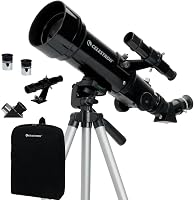
A 70mm refractor can show bright nebulae under suitable skies, though its view will be limited compared with larger telescopes. The Celestron Travel Scope 70 includes 20mm and 10mm eyepieces, a finder scope, and a full-height tripod for getting started.
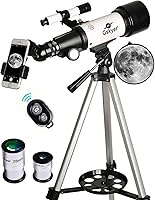
The Gskyer 70mm refractor also comes with two eyepieces, a 3x Barlow lens, and a finder scope. Use its low-power view first to find a nebula; the extra magnification from a Barlow is usually less useful for a faint, wide object.
For a child focused on the Moon, the Blue Marble NASA Lunar Telescope includes a finder scope and low- and high-power eyepieces. It's designed for lunar observing, so choose it for Moon viewing rather than as a dedicated deep-sky scope.
A product's included eyepieces don't guarantee a bright nebula view. Dark skies and a clear, steady setup matter more than pushing magnification.
Why does a dark sky matter so much?
A dark location makes faint nebulae easier to distinguish from the background sky. City lights, porch lights, and a bright Moon add glare that reduces the contrast you need to see a dim object.
If you can, choose a site away from direct lights and observe when the Moon is below the horizon. Keep a hood or a dark cloth around your head to block stray light, and avoid looking at a phone screen while your eyes adapt.
Give your eyes about 20 to 30 minutes to adjust to darkness. Use a dim red light only when you need to read a chart or adjust equipment.
Should you use a nebula filter?
A nebula filter can improve contrast for some emission nebulae, but it doesn't make every nebula brighter. Filters work by blocking selected wavelengths, which can help certain emission targets stand out against the sky.
First find and center the nebula without a filter. Then compare the view with the filter in place, keeping the same eyepiece and looking for a change in contrast or visible structure.
Filters vary by target and telescope, so check which type suits the nebula you're observing. Our guide to the best filter for emission nebulae explains common filter choices and when they help.
A filter won't compensate for heavy light pollution, a low target, or too much magnification. If the object is difficult to see, improve the viewing conditions before adding accessories.
How do you observe a faint nebula at the eyepiece?
Look slightly to the side of a faint object instead of staring directly at it. Peripheral vision can make dim details easier to notice, especially after your eyes have adapted to the dark.
Keep the target centered, then look for a change in brightness or shape. Averted vision may help reveal a soft edge, a brighter center, or a larger patch than you first noticed.
Take short breaks and return to the eyepiece. If you lose the target, go back to the finder and reacquire it at low power rather than sweeping randomly.
Nebulae are extended objects, so they don't behave like stars. If you want to understand what an eyepiece view can show in general, read what you can see through a telescope; for a bright point of light instead, see whether you can look at a star with a telescope.
Why can't you see the nebula you expected?
A nebula can be hard to see if the sky is bright, the target is low, or the telescope is using too much magnification. Start by checking those conditions before assuming the telescope is at fault.
Confirm that the finder is aligned with the main telescope during daylight on a distant land object, never the Sun. At night, use a bright star to check that the finder and eyepiece point to the same place.
If the finder is aligned, verify the target's position with a current chart or app. Nebulae can be large, so a high-power eyepiece may show only a small section or miss the object entirely.
Don't expect color or photographic detail. A subtle gray patch can still be a successful observation, especially from a light-polluted area.
How should you plan your next nebula session?
Choose one bright target, check its position and the Moon phase, and begin with low power under the darkest sky you can reach. Keep notes on the eyepiece and conditions so you can compare what worked on another night.
For a first session, the Orion Nebula is a practical target when it is visible in your evening sky. Once you've found it, spend time looking with averted vision before changing eyepieces or adding a filter.
Pick a portable beginner scope if easy setup matters and you mainly want bright targets. Pick a larger telescope if faint deep-sky objects are your main interest, and match any filter to the specific nebula.
For other targets during the same session, can telescopes see satellites explains why satellites move across the field while stars and nebulae stay in place.
Frequently asked questions
Can you see nebulae with a small telescope?
Yes, some nebulae are visible through small telescopes, especially from a dark location. They usually appear as faint gray patches rather than colorful photographs.
Start with a bright target, use low magnification, and give your eyes time to adjust; moonlight and city glow can hide faint detail.
What magnification is best for viewing nebulae?
Low magnification is usually the best starting point because it gives a wider view and keeps the nebula brighter. Center the target first, then increase magnification only if the image remains clear and the object still fits in view.
The best setting varies with the telescope and target.
Do telescope filters make nebulae visible?
A suitable nebula filter can improve contrast for some emission nebulae by reducing selected wavelengths of light. It cannot brighten the object or remove sky glow, and it won't help every kind of nebula.
First locate the target without a filter, then compare the view with one.
Why do nebulae look gray through a telescope?
Many nebulae look gray because they are too dim for the eye to show the color captured by long-exposure cameras. Dark adaptation, a dark observing site, and low power can help you detect more structure, but a visual telescope view usually won't resemble a vivid space photograph.