Blue Marble NASA Lunar Telescope Review: Worth It? (November 2026)
The Blue Marble NASA Lunar Telescope suits young beginners focused on the Moon, with a finder scope, two eyepieces, tabletop tripod and learning guide. Choose a 70mm refractor if you want a taller tripod and broader use.
On this page (9 sections)
- What does the NASA Lunar Telescope include?
- How well does it suit a young beginner?
- What are the trade-offs of its 25mm objective?
- How does it compare with 70mm alternatives?
- Is the tabletop tripod practical?
- How should you use it for a first Moon session?
- What should you check before buying?
- How does it compare with another child-focused telescope?
- Is the Blue Marble NASA Lunar Telescope worth choosing?
The Blue Marble NASA Lunar Telescope is a good fit for young beginners whose main target is the Moon. It includes a finder scope, two eyepieces, a tabletop tripod and a learning guide focused on lunar features.
Its 25mm objective and child-centered design make it a focused starter kit, rather than an all-purpose family telescope. If you want a larger aperture or full-height tripod, compare the 70mm alternatives below.
What does the NASA Lunar Telescope include?
The NASA Lunar Telescope comes with the basic pieces for lunar observing and a first lesson. The box includes the telescope, tabletop tripod, low- and high-power eyepieces, lens dust cap and learning guide.
Blue Marble NASA Lunar Telescope for Kids Ages: Best for first lunar observing

- 25mm objective lens
- Low- and high-power eyepieces
- Finder scope
- Tabletop tripod
- Learning guide
A child-focused kit for finding and viewing the Moon, with a compact tabletop tripod and guide for learning lunar features.
Pros
- Includes low- and high-power eyepieces
- Finder scope helps locate the Moon
- Smooth mount supports scanning the lunar surface
- Learning guide introduces lunar features
Cons
- Small 25mm objective lens
- Tabletop tripod needs a steady raised surface
- Main focus is lunar observing
The finder scope helps you locate the Moon before switching to the main eyepiece. The smooth mount is intended to let a young observer scan across the lunar surface.
Its learning guide adds context about the Moon and its features. That can make the telescope more engaging for a child who wants to connect what they see with what they are learning.
Is the NASA lunar telescope easy for kids to set up?
The kit is designed to be easy to assemble and use, with an included tabletop tripod and instructions. An adult can help a child attach the parts, set the telescope on a firm surface and learn how the finder scope lines up with the main view.
For a smoother first session, set up indoors before taking it outside. Keep the lens dust cap on until observing, and choose a stable table or bench at a height that lets the child reach the eyepiece comfortably.
How well does it suit a young beginner?
This telescope suits children age 8 and up who want a simple introduction to lunar observing. Its included finder scope and two eyepieces create a straightforward path from locating the Moon to viewing it at a closer setting.
The compact tabletop tripod can be easier to manage than a full-height tripod, but it needs a sturdy surface. A wobbly table makes aiming harder, so check stability before the child starts observing.
The NASA branding and learning guide may also help hold a child’s interest. The kit is most compelling when the Moon is the main goal, rather than daytime scenery or a broad range of targets.
Families comparing age ranges can also read our guides to best telescopes for kids ages 8–12 and best telescopes for kids who want to see planets.
What are the trade-offs of its 25mm objective?
The 25mm objective makes this a compact, focused beginner telescope, and it sets a limit on how much light the scope gathers compared with a 70mm telescope. The listed 90x highlight should not be the main reason to choose it; useful viewing depends on the whole optical system, target and conditions.
For the Moon, a child can start with the low-power eyepiece to find the target, then try the high-power eyepiece for a closer view. At higher magnification, the view can be harder to keep steady and focused.
A small telescope rewards patience. Let your eyes adjust to the dark, focus slowly and make small movements when scanning.
If the child wants to explore planets and daytime subjects too, a larger refractor offers more flexibility. The Gskyer includes a 70mm aperture and adjustable tripod, while Celestron’s Travel Scope 70 adds a full-height tripod and backpack.
How does it compare with 70mm alternatives?
The Blue Marble is the most focused option for a child learning the Moon, while both alternatives offer larger 70mm objectives and more varied use. Choose based on who will set up the scope and where you plan to observe.
| Telescope | Objective | Tripod and portability | Best fit |
|---|---|---|---|
| Blue Marble NASA Lunar Telescope | 25mm | Tabletop tripod | Young beginners focused on the Moon |
| Gskyer Telescope | 70mm | Adjustable tripod and carry bag | Beginners wanting broader lunar, planetary and daytime use |
| Celestron Travel Scope 70 | 70mm | Full-height tripod and backpack | Families wanting a portable scope for day and night |
The Gskyer Telescope is a 70mm refractor with two eyepieces, a 3x Barlow lens, phone adapter, wireless remote and carry bag. That wider set of accessories suits a family willing to spend more time on setup.
Gskyer Telescope: Best for broader beginner viewing
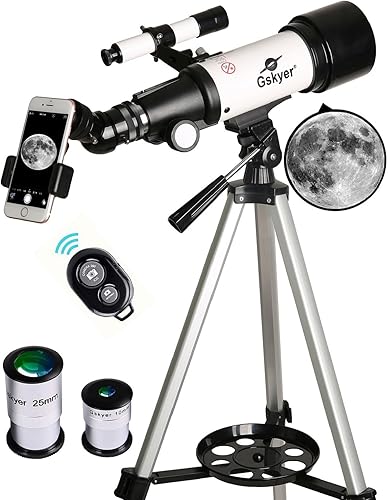
- 70mm aperture
- 400mm focal length
- Two eyepieces and 3x Barlow lens
- Adjustable tripod
- Carry bag
A portable refractor with a larger aperture, adjustable tripod and accessories for lunar, planetary and daytime viewing.
Pros
- 70mm aperture
- Adjustable aluminum tripod
- Carry bag, phone adapter and wireless remote included
- Designed for lunar and planetary viewing
Cons
- More components to set up than a simple tabletop kit
- Phone adapter adds setup steps
The Celestron Travel Scope 70 also has a 70mm objective, with a 20mm and 10mm eyepiece, full-height tripod, backpack and astronomy software. Its no-tool setup and travel case make it a practical fit for family outings.
Celestron Travel Scope 70mm Beginner Portable Telescope: Best for family travel

- 70mm aperture
- 20mm and 10mm eyepieces
- Full-height tripod
- Backpack
- Starry Night software
A portable family telescope with a 70mm aperture, full-height tripod and backpack for daytime or night observing.
Pros
- 70mm aperture and two eyepieces
- Full-height tripod included
- No-tool setup
- Backpack and astronomy software included
Cons
- Larger kit to carry than a tabletop telescope
- More features than a child needs for Moon-only viewing
For a child who mainly wants to find the Moon and learn its features, the Blue Marble kit keeps the goal simple. To compare more age-focused options, see our guides to telescopes for young kids and telescopes for kids ages 10 to 15.
Is the tabletop tripod practical?
The tabletop tripod is practical when you have a firm, raised surface ready before observing. It avoids the floor footprint of a full-height tripod, but it makes the telescope dependent on whatever table or bench is nearby.
Choose a surface that does not wobble when a child touches it. Place the telescope so the child can look through the eyepiece without leaning over the tripod or pushing the tube off target.
If you plan to observe away from home, consider how you will carry both the telescope and a stable support. A 70mm travel scope with a carry bag or backpack may be easier to bring along when you cannot count on a table.
How should you use it for a first Moon session?
Start with the low-power eyepiece and finder scope, then move to the high-power eyepiece after the Moon is centered. A child should make small, slow adjustments and refocus if the view looks soft.
Pick a clear evening when the Moon is easy to see, and give the telescope time to settle on a stable surface. Keep the session short enough for the child to stay comfortable and interested.
Our step-by-step guide explains how to use a Lunarscope tabletop telescope, including a simple sequence for finding and viewing the Moon.
Never point a telescope at the Sun. Keep the lens cap on when the telescope is not in use, and store the eyepieces where they will not collect dust.
What should you check before buying?
Check that the child is interested in Moon viewing and can use a tabletop setup. Those two details are more useful than choosing by a headline magnification number.
Think about where the telescope will live and where the child will use it. A small table can work well at home, while trips may call for a telescope and tripod that pack into a bag.
If the child expects to move the telescope independently, an adult should still help with setup and alignment at first. Learning to locate a target takes practice, even with a finder scope.
For help matching a telescope to a younger child, see our guide to telescopes for kids ages six to eight. If you are shopping for a very young child, compare the options in our guide to kids telescopes for 5-year-olds.
How does it compare with another child-focused telescope?
The Blue Marble kit emphasizes a tabletop setup and lunar learning, while the Educational Insights GeoSafari Omega is another child-oriented reflector to compare. The right pick depends on the included parts, the observing targets and how much setup your child can manage.
Read our Omega reflector telescope review to compare its design and intended use. If you are also considering a National Geographic kit, our National Geographic telescope setup guide can help you plan the first session.
Is the Blue Marble NASA Lunar Telescope worth choosing?
Choose the Blue Marble NASA Lunar Telescope if your child is ready to learn basic observing and wants to focus on the Moon with a simple tabletop kit. Its finder scope, two eyepieces and learning guide support that goal.
Pick the Gskyer or Celestron if a 70mm objective and a taller, portable setup matter more to your family. For Moon-first learning, the Blue Marble is the more direct choice; for broader observing, compare the 70mm refractors.
Frequently asked questions
Is the Blue Marble NASA Lunar Telescope good for beginners?
Yes, it is designed for young beginners and includes a finder scope, low- and high-power eyepieces, a tabletop tripod and a learning guide. The Moon is a practical first target because the guide and two eyepieces support locating and viewing lunar features.
An adult can help with assembly and aiming.
What can you see with the NASA Lunar Telescope?
The kit is designed for viewing the Moon, including its craters and surface features. Its 25mm objective and included eyepieces make it a focused starter choice; don't expect a small beginner telescope to show the same detail as close-up lunar photographs.
Clear skies and careful focusing matter.
Does the Blue Marble NASA Lunar Telescope need a table?
It comes with a tabletop tripod, so plan for a steady, level surface at a comfortable viewing height. A sturdy outdoor table or firm bench can work.
Avoid wobbly furniture, and check that the child can look through the eyepiece without straining or bumping the telescope.
Is a 70mm telescope a better choice than the NASA Lunar Telescope?
A 70mm refractor is a better fit if you want a larger objective, an adjustable or full-height tripod and more flexibility for daytime targets. The Blue Marble kit is simpler for a child whose main goal is learning to find and observe the Moon.
Choose based on the targets and setup your family will use.