What Is the Resolving Power Formula? A Simple Guide
On this page (8 sections)
The resolving power formula tells you how well two objects close together can be distinguished. It helps predict the smallest details your equipment can see. Think of it as the sharpness limit for your view.
Understanding this formula is key for anyone using microscopes, telescopes, or even cameras. It’s not just about seeing things; it’s about seeing them clearly and being able to tell them apart. This affects everything from scientific discovery to everyday photography.
- Resolving power is about distinguishing close objects.
- The formula predicts the smallest details you can see.
- It’s a limit on how sharp your view can be.
- This matters for microscopes, telescopes, and cameras.
Ready to see what the resolving power formula is all about and how it can help you get clearer images? Let’s break it down simply.
Understanding Image Sharpness: The Resolving Power Formula
Ever wondered why some photos look incredibly sharp while others seem a bit fuzzy, even when taken with good equipment? It often comes down to something called resolving power. This concept helps us understand the limits of our vision and the tools we use to see the world. Let’s break down what resolving power is and how a simple formula helps us predict it.
Essentially, resolving power is your equipment’s ability to show two separate points of light or detail as distinct entities. If two tiny dots are too close together, your lens or eye might merge them into one blurry smudge. The resolving power formula gives us a way to put a number on this ability. It’s like a predictive tool for clarity.
What Exactly Is Resolving Power?
Imagine you’re looking at two very small stars in the night sky through a telescope. If the telescope has good resolving power, you’ll see two distinct points of light. If its resolving power is poor, those two stars might look like a single, elongated blob. Resolving power is all about distinguishing fine details that are close to each other.
This isn’t just for astronomers. It applies to microscopes trying to show tiny cells, or cameras capturing intricate patterns. The core idea is the same: separating closely spaced objects so they appear distinct. A higher resolving power means you can see finer details.
It’s About Separation, Not Magnification
A common misconception is that more magnification automatically means better detail. While magnifying power is important, it’s not the whole story. You can magnify something blurry all you want, and it will just become a bigger blur. Resolving power is about the quality of that magnification – whether it can actually separate the details.
Think of it like trying to read a newspaper through a magnifying glass. If the magnifying glass has poor resolving power, the tiny print will still look smudged, even if you make it bigger. You need a magnifying glass that can actually make out the individual dots that form the letters to read them clearly. That’s the job of resolving power.
The Core Formula for Resolving Power
The most well-known formula for resolving power comes from scientific research, particularly in optics. It’s often based on the diffraction limit, which is the theoretical limit to resolution imposed by the wave nature of light. For telescopes and microscopes, a common form of this formula is:
Resolving Power (RP) = 1.22 * (Wavelength of Light) / (Aperture Diameter)
Let’s break down what each part means:
Understanding the Components of the Formula
Wavelength of Light
Light travels in waves, and different colors of light have different wavelengths. Shorter wavelengths allow for better resolution. This is why using blue light (shorter wavelength) in some microscopes can reveal finer details than red light (longer wavelength).
In practical terms, when we talk about visible light, we’re often using an average wavelength. For white light, a common average is around 0.55 micrometers (µm). However, the specific wavelength used can influence the outcome.
Aperture Diameter
The aperture is the opening that collects light. For a telescope, it’s the diameter of the main lens or mirror. For a microscope objective lens, it’s the diameter of the front lens element. A larger aperture allows the instrument to gather more light and also to resolve finer details.
This is why larger telescopes can see fainter and more distant objects with greater clarity. They have a bigger aperture, which directly improves their resolving power according to the formula. A bigger opening means a better view of small things.
The Constant (1.22)
The number 1.22 comes from mathematical analysis related to the diffraction pattern produced by a circular aperture. It’s a constant derived from the physics of how light waves behave when passing through an opening.
You don’t need to be a mathematician to use the formula. Just know that this number accounts for the physical optics involved in creating the image. It’s a standard part of the calculation for how light spreads out, or diffracts, after passing through your equipment’s opening.
How the Formula Translates to Practical Use
So, how does this formula actually help you? It helps you predict what your equipment is capable of. If you know the wavelength of light you’re working with and the diameter of your instrument’s aperture, you can calculate the smallest distance at which two objects can be distinguished.
Let’s say you have a telescope with a 100mm aperture. Using a simplified version of the formula for angular resolution (how small an angle two objects can make at your eye to be seen separately):
Angular Resolution (in arc-seconds) ≈ 100 / Aperture (in mm)
So, for your 100mm telescope, the theoretical angular resolution would be about 1 arc-second. This means it can distinguish two objects that are 1 arc-second apart in the sky. This is a helpful way to compare different instruments.
What This Means for Different Equipment
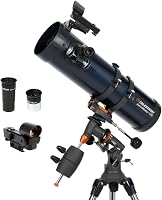
Telescopes
For telescopes, a larger aperture is king for resolving power. A 200mm telescope will have double the theoretical resolving power of a 100mm telescope, meaning it can split double stars that are twice as close together. This is why professional observatories invest in enormous mirrors and lenses – to see the most distant and detailed cosmic phenomena.
It’s important to remember that atmospheric conditions, called “seeing,” can also limit how well a telescope performs, often more than the telescope’s theoretical resolving power. But the formula gives you the best-case scenario.
Microscopes
In microscopy, the formula is often adapted to consider the Numerical Aperture (NA) of the objective lens. The NA is a measure of the lens’s ability to gather light and resolve detail. A common formula for microscopes is:
Resolution (in µm) ≈ Wavelength / (2 * NA)
Here, a higher NA directly leads to better resolution (smaller numbers mean finer detail). Higher NA objectives often use immersion oil to increase the NA, allowing you to see even smaller structures within cells. This is critical for biological and medical research where details are incredibly tiny.
Cameras and Lenses
For cameras, the concept of resolving power is related to the lens’s ability to render fine detail and the sensor’s pixel density. While there isn’t one single formula quite like for telescopes or microscopes, the principles of aperture size (lens diameter) and the wavelength of light still play a role in lens design.
Manufacturers often test lenses for their resolving power using special charts. They report this in line pairs per millimeter (lp/mm). A higher lp/mm rating means the lens can resolve more detail. The camera sensor’s pixels also have a limit; if the lens resolves detail smaller than a pixel can capture, you won’t see it.

Factors That Can Affect Actual Resolution
While the formula gives you a theoretical limit, real-world conditions can often prevent you from reaching it. It’s like knowing the speed limit on the highway – you might be able to go that fast, but traffic or road conditions could slow you down.
Light Quality and Conditions
The formula assumes a single, pure wavelength of light. In reality, we often use broadband light (like white light). This means the resolution for different colors might vary slightly. Also, the clarity and stability of the light source can impact what you can see. For telescopes, the twinkling of stars due to atmospheric turbulence is a major limiting factor.
Optical Aberrations
No lens or mirror is perfect. Optical aberrations are flaws in the way the optics focus light. These can include things like spherical aberration (where light rays don’t focus at a single point) or chromatic aberration (where different colors are focused at different points, causing color fringing).
These imperfections can blur the image and reduce the actual resolving power below the theoretical limit calculated by the formula. High-quality optics are designed to minimize these aberrations, bringing the actual performance closer to the theoretical potential.
Quality of Construction and Alignment
The precision with which an instrument is manufactured and aligned is also critical. Even a large aperture telescope won’t perform well if its mirrors are not perfectly shaped or if they are misaligned. Similarly, a microscope’s fine adjustments and the quality of its components matter.
Think of it like building a race car. You can have the best engine design (the formula), but if the car isn’t assembled perfectly or the wheels are out of alignment, it won’t perform as expected. The physical build and precise setup are just as important as the theoretical design.
Checklist: Key Takeaways for Resolving Power
- Resolving power is about telling apart two close objects.
- The formula helps predict the limit of this clarity.
- Larger apertures generally mean better resolving power.
- Shorter wavelengths of light allow for finer detail.
- Real-world conditions can affect actual resolution.
- It’s different from simple magnification.
Conclusion
You’ve now seen how the resolving power formula helps you understand the true sharpness of your equipment. It’s not just about making things bigger; it’s about seeing fine details clearly separated. Remember that a larger aperture and shorter light wavelengths generally mean better potential resolution. While the formula provides a theoretical limit, real-world factors like atmosphere and optical flaws can affect your final image. Use this knowledge to choose and appreciate your optical tools more effectively, and aim to improve your viewing experiences by understanding these core principles.
Frequently Asked Questions
Is resolving power the same as magnification?
No, resolving power and magnification are different. Magnification makes an object appear larger, but it doesn’t necessarily improve clarity. Resolving power is your equipment’s ability to distinguish two separate points as distinct, which is about image sharpness, not just size.
Why do larger telescopes have better resolving power?
Larger telescopes have a wider aperture, meaning their main lens or mirror is bigger. According to the resolving power formula, a larger aperture allows the telescope to gather more light and resolve finer details, meaning it can separate objects that are closer together.
Can I improve the resolving power of my existing camera lens?
You can’t change the physical design of a lens, but you can influence the results. Using the sharpest aperture setting (often not the widest or narrowest opening) and ensuring your camera sensor’s pixel density is sufficient for the lens’s capability can help. Also, shooting in good light and avoiding camera shake maximizes the lens’s inherent resolving power.
Does the type of light (color) affect resolving power?
Yes, the wavelength of light matters. Shorter wavelengths, like those found in blue or violet light, generally lead to better resolving power compared to longer wavelengths, like red light. This is why some specialized microscopes use specific light colors to see the smallest details.
How does atmospheric “seeing” affect telescope resolving power?
“Seeing” refers to the turbulence in Earth’s atmosphere, which causes stars to twinkle. This turbulence blurs the image and can limit your telescope’s actual resolving power, often more than the telescope’s theoretical capability. Even a large telescope struggles in poor seeing conditions.