Which Type of Reflecting Telescope Should You Choose?
The right reflecting telescope depends on what you want to view and how much setup you accept: Newtonians offer a flexible starting point, Dobsonians favor simple visual observing, and compact Cassegrain designs trade a shorter tube for more involved optics.
On this page (7 sections)
- What are the main types of reflecting telescopes?
- How does a Newtonian compare with other reflectors?
- Which type suits your viewing goals?
- How do mounting demands change the choice?
- How much maintenance does each design need?
- What should you check before choosing a reflector?
- Which reflecting telescope should you choose?
The best type of reflecting telescope depends on what you want to observe, how you plan to mount it and how much adjustment you accept. For beginner-friendly choices, compare the best reflector telescopes for beginners.
Newtonians are versatile, Dobsonians keep visual observing simple, and compact Cassegrain designs suit buyers who want a shorter tube.
A telescope's optical design is only part of the choice. Consider where you'll use it, how you'll find targets and whether you plan to observe by eye or attach a camera.
For a basic explanation of mirrors and the light path, start with What Is a Reflecting Telescope? A Simple Guide.
This guide compares the main designs by their practical trade-offs.
What are the main types of reflecting telescopes?
The main families are Newtonian, Dobsonian-mounted Newtonian, and folded Cassegrain designs. They all use mirrors, but their tube shapes, eyepiece positions and mounting needs differ.
| Design | Best fit | Main trade-off |
|---|---|---|
| Newtonian reflector | General visual use and some imaging setups | The open tube can need mirror alignment and careful handling |
| Dobsonian | Visual observing with a simple, steady base | The mount is simple, but tracking is usually manual |
| Schmidt-Cassegrain | Compact general-purpose telescope | More optical elements and setup choices |
| Maksutov-Cassegrain | Compact views of the Moon and planets | Often a narrower field than a short-focus design |
| Ritchey-Chrétien | Dedicated imaging systems | More demanding setup and supporting equipment |
These are broad categories, not guarantees of performance. Aperture, focal length, mirror quality, mount stability and accessories all affect what a specific telescope can do.
A Newtonian is often the clearest starting point because it has a direct optical path and a side-mounted eyepiece. A Dobsonian keeps the same basic optical design while using a simple mount that moves by hand.
How does a Newtonian compare with other reflectors?
A Newtonian offers a straightforward mirror-based design with a side eyepiece, making it a flexible choice for observing and some imaging. Its open tube is easier to inspect than a sealed design, but the mirrors may need alignment checks.
Newtonian telescopes come in many apertures and focal lengths. A wider, shorter-focus model can show more sky at once, while a longer focal length can make smaller objects easier to frame with a suitable eyepiece.
The eyepiece sits near the front of the tube, so its position changes as you move across the sky. On a German equatorial mount, the eyepiece can rotate into an awkward position; rings that let you rotate the tube can help.
Choose a Newtonian if you want a capable general-purpose reflector and are comfortable learning basic collimation. Compare specific apertures in our best 8 newtonian telescope guide.
When does a Dobsonian make sense?
A Dobsonian makes sense when your priority is visual observing and simple movement across the sky. It usually pairs a Newtonian tube with a low, hand-operated mount.
The base sits on the ground and moves in altitude and azimuth. That keeps the mechanics simple, although you'll need to nudge the telescope along as objects drift out of view.
Larger Dobsonians gather more light, but their tubes and bases take up more space and can be harder to carry. Check the full assembled dimensions and the weight of each part before deciding where you'll store it.
Pick a Dobsonian for direct visual use, especially if you want to spend less time arranging a mount. For long-exposure imaging, look at an equatorial mount and the telescope's camera focus requirements instead.
What does a Cassegrain design change?
A Cassegrain telescope folds the light path so it can fit a longer focal length into a shorter tube. Schmidt-Cassegrain and Maksutov-Cassegrain models use a front corrector plate along with their mirrors.
The shorter tube can be easier to store and handle than a long Newtonian of similar focal length. The trade-off is a more complex optical system, and the corrector plate needs protection from dust, dew and fingerprints.
These designs often work well for lunar and planetary viewing, where high magnification and a compact setup can be useful. Their narrower view can make large star fields or extended deep-sky objects harder to fit in one eyepiece.
Choose a Cassegrain when compact size matters and its field of view matches your targets. Confirm how the telescope focuses and what accessories or mount it needs for your observing plans.
Which type suits your viewing goals?
Choose by the objects you expect to view most often, then check whether the telescope and mount can support that use. No design is equally convenient for wide star fields, planets, portability and camera work.
| Your priority | Design to consider | What to check |
|---|---|---|
| General visual observing | Newtonian or Dobsonian | Aperture, eyepiece access and collimation |
| Wide views of star fields | Short-focus Newtonian | Focal length and eyepiece field of view |
| Moon and planets | Longer-focus Newtonian or Cassegrain | Mount stability and useful eyepiece choices |
| Compact storage | Schmidt-Cassegrain or Maksutov-Cassegrain | Setup time, corrector care and field of view |
| Long-exposure imaging | Newtonian or Cassegrain on a tracking mount | Tracking, camera focus and imaging accessories |
A bright object such as the Moon can look good through many designs. For faint galaxies and nebulae, aperture and dark skies matter more than a telescope's label.
If you're new to finding targets, a guided mount or app can ease the first steps. The Celestron StarSense Explorer LT 114AZ Newtonian Smartphone is an example of a Newtonian paired with smartphone sky guidance.
How do mounting demands change the choice?
The mount determines how steadily the telescope holds a target and how much effort it takes to follow it. Match the mount to the tube's size and your observing style, not just to the telescope's optical design.
A Dobsonian base is a simple option for visual observing, but it relies on your hand to keep an object in view. An altazimuth mount also moves up, down and side to side; some include slow-motion controls to make small adjustments easier.
An equatorial mount can track the sky by turning around an axis aligned with Earth's rotation. It takes more setup than a basic altazimuth mount, and balancing and alignment are part of the process.
For photography, the mount becomes a core part of the system. Long exposures need accurate tracking, so a telescope that works well for visual viewing may still need a different mount and additional equipment for imaging.
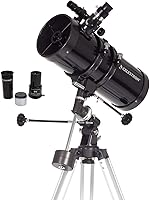
The Celestron PowerSeeker 127EQ Reflector Telescope for Home pairs a Newtonian reflector with a manual German equatorial mount and slow-motion controls. That style can suit someone ready to learn equatorial setup and tracking.
How much maintenance does each design need?
Reflectors need occasional checks of optical alignment and sensible protection from dust and moisture. How often depends on the design, transport and storage conditions.
Newtonian mirrors can shift during transport, so check collimation when images seem soft or after moving the telescope over rough ground. Use the adjustment method recommended for your model, and avoid turning screws until you understand which mirror they move.
A laser tool can help with alignment on compatible telescopes, but it also needs to be aligned and used according to its instructions. The {{product B00LX34ZH2 | SVBONY's laser collimator is designed for aligning Newtonian reflectors and includes a removable 2 in adapter.}}
Cassegrain corrector plates can collect dew, which may interrupt an observing session. A dew shield and dry storage help reduce exposure, but follow the telescope maker's cleaning instructions rather than wiping optics casually.
Most maintenance is about careful handling, alignment and storage. Keep dust caps on when the telescope is not in use, and let damp equipment dry before storing it in a closed case.
What should you check before choosing a reflector?
Check aperture, focal length, mount, tube size and care needs together. Those details say more about a telescope's fit than the reflector name alone.
- Aperture: A larger primary mirror gathers more light, but also tends to mean a larger and heavier setup.
- Focal length: This affects the view with a given eyepiece and helps determine whether the telescope suits wide fields or smaller targets.
- Mount: Confirm how it moves, whether it tracks, and whether it can carry the tube steadily.
- Eyepiece position: Newtonian eyepieces sit at the side of the tube; folded designs place them at the rear.
- Storage and transport: Measure the full tube and base, including how each part passes through doors and into your vehicle.
- Collimation: Find out whether the design needs alignment checks and what tools its maker recommends.
- Imaging needs: Confirm camera focus, tracking and accessory compatibility before buying for astrophotography.
Do not choose by magnification claims alone. The eyepiece and observing conditions affect the usable view, and high power cannot replace aperture or a steady mount.
If a Newtonian suits your plans, our best reflector telescopes for adults astronomy roundup compares models aimed at adult observers. For imaging-specific options, see best imaging newtonian telescope choices.
Which reflecting telescope should you choose?
Choose a Newtonian for flexibility, a Dobsonian for simple visual observing, or a Cassegrain when a shorter tube matters. Then check the mount, storage space and care needs against how you will actually use it.
If you want guided target finding, consider the SVBONY SV48P 102mm Telescope Review for a refractor comparison. You can also compare a telescope with a spotting scope or a spyglass if portability or terrestrial viewing is part of your decision.
Frequently asked questions
What are the main types of reflecting telescopes?
The main types include Newtonian reflectors, Dobsonian-mounted Newtonians, and folded designs such as Schmidt-Cassegrain and Maksutov-Cassegrain telescopes. Newtonians use a side eyepiece and a secondary mirror, while folded designs use additional optics to shorten the tube.
Choose by viewing goals, mount, portability and care.
Which reflecting telescope is easiest for a beginner?
A Newtonian on a simple altazimuth mount can be straightforward for visual observing, especially when it has a stable base and an easy way to locate targets. A Dobsonian is a common version of this setup.
If finding objects is the main hurdle, smartphone guidance can help.
Do reflecting telescopes need collimation?
Many reflecting telescopes need their mirrors aligned, a process called collimation. The frequency depends on how the telescope is transported and used.
Check alignment when views seem soft or after a bumpy trip, and follow the telescope maker's instructions before adjusting anything.
Can you use a reflector for astrophotography?
Yes, but imaging adds requirements beyond the optical design. You need a mount that tracks the sky accurately, a camera setup that reaches focus, and a telescope suited to the target and sensor.
A visual Dobsonian may be excellent for observing while being a poor fit for long exposures.
Are Cassegrain telescopes reflectors?
Schmidt-Cassegrain and Maksutov-Cassegrain telescopes use mirrors to gather and focus light, along with corrector optics at the front. Their folded light path makes the tube shorter than a Newtonian with a similar focal length, though the design and collimation needs differ.