5 Best Imaging Newtonian Telescopes (November 2026)
The best imaging Newtonian telescopes include the Celestron Advanced VX 8" Newtonian EQ GoTo for tracked imaging, the SOLOMARK Telescope 130EQ Newtonian Reflector Telescopes for a camera-ready starter kit, and the Celestron StarSense Explorer DX 130AZ Smartphone Guided for finding targets before imaging.
On this page (11 sections)
- Which imaging Newtonian telescopes fit each setup?
- How we compared imaging Newtonian telescopes
- Compare imaging Newtonian telescopes by mount and aperture
- 1. Celestron Advanced VX 8-inch Newtonian: Best for tracked imaging
- 2. SOLOMARK 130EQ: Best for a camera-ready starter kit
- 3. Celestron StarSense Explorer DX 130AZ: Best for finding targets before imaging
- 4. Celestron StarSense Explorer LT 114AZ: Best for guided visual observing
- 5. SVBONY Laser Collimator: Best for checking alignment
- What should you check before buying an imaging Newtonian?
- Which imaging Newtonian should you choose?
- Frequently asked questions
The best imaging Newtonian telescope in this group is the Celestron Advanced VX 8-inch, because its equatorial GoTo mount is designed for tracking and its f/5 optical design suits wide-field viewing. Confirm camera focus travel and the complete imaging load before choosing any Newtonian for deep-sky photography.
Imaging suitability depends on the whole setup. A camera needs to reach focus, the mount needs to track, and the tube must stay aligned as you aim across the sky.
This roundup compares the supplied telescope models by how closely their stated design and mount fit those needs. The included laser collimator supports reflector alignment, but it is an accessory rather than an imaging telescope.
Our picks at a glance
-
1
 Best for tracked imaging
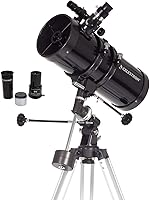
Celestron Advanced VX 8" Newtonian EQ GoTo
8.9/10 our score
See it on Amazon -
2
 Best for a camera-ready starter kit
SOLOMARK Telescope 130EQ Newtonian Reflector Telescopes
9.2/10 our score
See it on Amazon -
3
 Best for finding targets before imaging
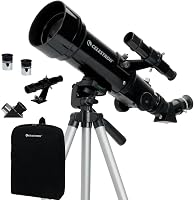
Celestron StarSense Explorer DX 130AZ Smartphone Guided
9.2/10 our score
See it on Amazon
- 4
 Check it
Celestron StarSense Explorer LT 114AZ Newtonian Smartphone
Best for guided visual observing - 5
 Best for checking alignmentCheck it
Which imaging Newtonian telescopes fit each setup?
The Celestron Advanced VX is the closest match for tracked imaging, while the other telescopes are better suited to guided visual observing or basic experiments with a smartphone. A laser collimator supports alignment across reflector setups.
Celestron Advanced VX 8" Newtonian EQ GoTo: Best for tracked imaging
- 8 in (200 mm) aperture
- f/5 optical design
- 1000 mm focal length
- GoTo equatorial mount
The equatorial GoTo mount and f/5 optical design make this the clearest imaging-oriented choice in this group. Its 8-inch tube and 103.1 lb listed weight call for careful space and setup planning.
Pros
- Equatorial GoTo mount
- f/5 optical design
- Parabolic primary mirror
Cons
- Listed weight is 103.1 lb
- Camera focus travel is not specified
SOLOMARK Telescope 130EQ Newtonian Reflector Telescopes: Best for a camera-ready starter kit
- 130 mm aperture
- 650 mm focal length
- German equatorial mount
- Smartphone adapter included
The equatorial mount and included smartphone adapter give beginners a way to explore basic imaging alongside visual observing. The camera adapter does not confirm compatibility with dedicated astronomy cameras.
Pros
- German equatorial mount
- Smartphone adapter included
- 130 mm aperture
Cons
- No motor tracking specified
- Dedicated camera focus compatibility is unclear
Celestron StarSense Explorer DX 130AZ Smartphone Guided: Best for finding targets before imaging
- 130 mm Newtonian reflector
- 650 mm focal length
- Smartphone sky guidance
- Manual altazimuth mount
StarSense guidance helps locate objects for visual sessions, and the 130 mm reflector can serve as an introduction to telescope imaging. Its manual altazimuth mount is not a tracking mount.
Pros
- Smartphone-guided target finding
- 130 mm reflector
- Dual-axis slow-motion controls
Cons
- Manual altazimuth mount
- No camera adapter specified
Celestron StarSense Explorer LT 114AZ Newtonian Smartphone: Best for guided visual observing
- 114 mm Newtonian reflector
- 1000 mm focal length
- Smartphone sky guidance
- Manual altazimuth mount
This model prioritizes guided visual observing with smartphone target finding. Its manual altazimuth mount and lack of a specified camera adapter make it a less direct fit for deep-sky imaging.
Pros
- Smartphone target guidance
- 114 mm Newtonian reflector
- Includes 25 mm and 10 mm eyepieces
Cons
- Manual altazimuth mount
- No camera adapter specified
SVBONY Laser Collimator: Best for checking alignment
- For Newtonian and reflector collimation
- Fits 1.25 in and 2 in focusers
- Removable 2 in adapter
- 7 laser brightness levels
A laser collimator can help check optical alignment, a useful setup step for a Newtonian. It is an accessory, not a telescope or a way to improve mount tracking.
Pros
- Removable 2 in adapter
- Seven brightness levels
- Metal body
Cons
- Does not provide camera tracking
- Alignment still requires careful adjustment
How we compared imaging Newtonian telescopes
We compared stated aperture, focal length, mount type, tracking features and camera-related accessories against the needs of deep-sky imaging. For optical design context, see types of reflecting telescopes.
The mount is a major dividing line in this group. Only the Advanced VX has a GoTo equatorial mount, while the SOLOMARK has a manual German equatorial mount and both StarSense models use manual altazimuth mounts.
Camera focus is another key check. These product details do not confirm whether a dedicated astronomy camera reaches focus, so contact the manufacturer or verify compatibility for your exact camera before buying.
Newtonian mirrors also need alignment. A collimator can help with that setup task, but it cannot make a manual mount track or correct a camera focus problem.
Compare imaging Newtonian telescopes by mount and aperture
The Advanced VX stands apart for its tracking mount, while the 130 mm models offer larger stated apertures than the 114 mm LT. Compare mount behavior and camera fit first, then decide which optical tube suits your targets.
| Product | Best for | Aperture | Focal length | Mount | Our score |
|---|---|---|---|---|---|
| Celestron Advanced VX 8" Newtonian EQ GoTo | tracked imaging | 8 in (200 mm) | 1000 mm | Equatorial GoTo | 8.9 |
| SOLOMARK Telescope 130EQ Newtonian Reflector Telescopes | a camera-ready starter kit | 130 mm | 650 mm | German equatorial | 9.2 |
| Celestron StarSense Explorer DX 130AZ Smartphone Guided | finding targets before imaging | 130 mm | 650 mm | Manual altazimuth | 9.2 |
| Celestron StarSense Explorer LT 114AZ Newtonian Smartphone | guided visual observing | 114 mm | 1000 mm | Manual altazimuth | 9.3 |
| SVBONY Laser Collimator | checking alignment | 9.7 |
1. Celestron Advanced VX 8-inch Newtonian: Best for tracked imaging
Celestron Advanced VX 8" Newtonian EQ GoTo: Best for tracked imaging
- 8 in (200 mm) aperture
- f/5 optical design
- 1000 mm focal length
- GoTo equatorial mount
The equatorial GoTo mount and f/5 optical design make this the clearest imaging-oriented choice in this group. Its 8-inch tube and 103.1 lb listed weight call for careful space and setup planning.
Pros
- Equatorial GoTo mount
- f/5 optical design
- Parabolic primary mirror
Cons
- Listed weight is 103.1 lb
- Camera focus travel is not specified
The Celestron Advanced VX combines an 8-inch (200 mm) aperture with an f/5 optical design and a 1000 mm focal length. Its parabolic primary mirror is intended to minimize spherical aberration, and the GoTo equatorial mount is the most imaging-oriented mount in this roundup.
The mount includes integer gear ratios and permanently programmable periodic error correction, which Celestron describes as eliminating recurring worm-gear tracking errors. It also has motors designed for improved tracking performance and more power to handle load imbalances.
The listed weight is 103.1 lb, so plan for transport, storage and setup before buying. The camera compatibility field names a camera, hand controller and eyepiece, but camera focus travel is not specified.
Choose it if you want a Newtonian with an equatorial GoTo mount and are ready to confirm camera focus and load limits for your setup. For a smaller visual telescope, compare our best 8-inch Newtonian telescope picks.
2. SOLOMARK 130EQ: Best for a camera-ready starter kit
SOLOMARK Telescope 130EQ Newtonian Reflector Telescopes: Best for a camera-ready starter kit
- 130 mm aperture
- 650 mm focal length
- German equatorial mount
- Smartphone adapter included
The equatorial mount and included smartphone adapter give beginners a way to explore basic imaging alongside visual observing. The camera adapter does not confirm compatibility with dedicated astronomy cameras.
Pros
- German equatorial mount
- Smartphone adapter included
- 130 mm aperture
Cons
- No motor tracking specified
- Dedicated camera focus compatibility is unclear
The SOLOMARK 130EQ pairs a 130 mm aperture and 650 mm focal length with a German equatorial mount. It includes a smartphone adapter, two eyepieces, a 1.5x Barlow lens and a Moon filter.
That package gives you accessories for visual use and smartphone experiments, but the mount's stated controls are manual. The information does not specify motor tracking or dedicated astronomy-camera focus compatibility, so treat it as a learning setup rather than a ready-made deep-sky rig.
The maker describes the 130 mm aperture as suited to deep-sky observing. That speaks to light gathering for visual use, while long-exposure imaging still depends on tracking and camera focus.
Choose this model if the equatorial layout and included smartphone adapter appeal to you, and you are comfortable with manual adjustments. For general reflector choices, see best reflector telescopes for adults astronomy.
3. Celestron StarSense Explorer DX 130AZ: Best for finding targets before imaging
Celestron StarSense Explorer DX 130AZ Smartphone Guided: Best for finding targets before imaging
- 130 mm Newtonian reflector
- 650 mm focal length
- Smartphone sky guidance
- Manual altazimuth mount
StarSense guidance helps locate objects for visual sessions, and the 130 mm reflector can serve as an introduction to telescope imaging. Its manual altazimuth mount is not a tracking mount.
Pros
- Smartphone-guided target finding
- 130 mm reflector
- Dual-axis slow-motion controls
Cons
- Manual altazimuth mount
- No camera adapter specified
The StarSense Explorer DX 130AZ has a 130 mm Newtonian reflector with a 650 mm focal length and smartphone-guided target finding. Its app analyzes star patterns and uses on-screen arrows to guide you toward selected objects.
Its manual altazimuth mount has dual-axis slow-motion controls. That can help you center targets for viewing, but it does not provide motorized tracking for long exposures.
The DX 130AZ includes 25 mm and 10 mm eyepieces, a red-dot finderscope and a smartphone dock. No camera adapter is specified, so check whether your camera can attach and reach focus before considering it for imaging.
Choose it if locating objects for visual astronomy is your first goal and you want to learn the sky before adding camera gear. Compare reflector telescopes for beginners for entry-level options.
The smartphone guide is useful for finding targets, while a separate tracking mount would be needed for deep-sky exposures.
4. Celestron StarSense Explorer LT 114AZ: Best for guided visual observing
Celestron StarSense Explorer LT 114AZ Newtonian Smartphone: Best for guided visual observing
- 114 mm Newtonian reflector
- 1000 mm focal length
- Smartphone sky guidance
- Manual altazimuth mount
This model prioritizes guided visual observing with smartphone target finding. Its manual altazimuth mount and lack of a specified camera adapter make it a less direct fit for deep-sky imaging.
Pros
- Smartphone target guidance
- 114 mm Newtonian reflector
- Includes 25 mm and 10 mm eyepieces
Cons
- Manual altazimuth mount
- No camera adapter specified
The StarSense Explorer LT 114AZ combines a 114 mm reflector with a 1000 mm focal length and smartphone-guided target finding. Celestron says the app uses sky recognition to calculate the telescope's position and guide you toward selected objects.
The manual altazimuth mount has an altitude slow-motion adjustment. Its included pieces are 25 mm and 10 mm eyepieces, a 2x Barlow lens, a StarPointer finderscope and a smartphone dock.
This model is a visual observing pick, not a deep-sky tracking system. The product details do not specify camera focus compatibility or motor tracking, so check those requirements before attaching a camera.
Choose it for guided observing of the Moon, planets and brighter deep-sky objects. If you're new to reflector optics, start with [What Is a Reflecting Telescope?
A Simple Guide](/what-is-a-reflecting-telescope/) and What Is a Newtonian Telescope? A Simple Guide.
5. SVBONY Laser Collimator: Best for checking alignment
SVBONY Laser Collimator: Best for checking alignment
- For Newtonian and reflector collimation
- Fits 1.25 in and 2 in focusers
- Removable 2 in adapter
- 7 laser brightness levels
A laser collimator can help check optical alignment, a useful setup step for a Newtonian. It is an accessory, not a telescope or a way to improve mount tracking.
Pros
- Removable 2 in adapter
- Seven brightness levels
- Metal body
Cons
- Does not provide camera tracking
- Alignment still requires careful adjustment
The SVBONY Laser Collimator is an alignment tool for Newtonian and other reflector telescopes. It fits 1.25-inch and 2-inch focusers using a removable adapter, and its red laser has seven brightness levels.
Collimation matters because a misaligned Newtonian can show a less clean image. The collimator can help you check and adjust the optical axis, but it does not address tracking, camera attachment or focus travel.
The unit has a metal body and includes instructions for aligning a reflecting telescope. Use it as part of setup and maintenance, especially after moving the telescope.
Choose it if your reflector needs a laser-based alignment tool with both focuser sizes covered. For more on the optical layout, read [How Does a Newtonian Telescope Work?
What to Know](/how-does-a-newtonian-telescope-work/).
What should you check before buying an imaging Newtonian?
Before buying, confirm that your camera can reach focus, the mount tracks the sky, and the complete imaging load falls within the mount's capacity. A telescope described for visual deep-sky viewing may still lack the features needed for long exposures.
Does the focuser reach camera focus?
A camera sensor sits in a different position from your eye, so some visual Newtonians may not bring it to focus without changes. Ask whether your exact camera and any adapter can reach focus with the telescope as supplied.
The available focuser position and travel are not specified for these five products. A guide to best focusers for Newtonian telescopes can help you understand what to compare if a focuser change may be needed.
Can the mount track the sky?
Long exposures need the telescope to follow a target as Earth rotates. An equatorial mount with tracking is a stronger starting point for this than a manual mount, but the tracking system still needs to match your exposure plans.
The Advanced VX has a GoTo equatorial mount with tracking features. The SOLOMARK mount is manual equatorial, and the two StarSense mounts are manual altazimuth.
Is the telescope in collimation?
Newtonian reflectors use mirrors that need to stay aligned. Check collimation as part of setup, particularly after transport, because the optical axis can shift.
The SVBONY laser collimator fits 1.25-inch and 2-inch setups with its adapter. Learn the basics of the telescope design in [What Is a Schmidt Newtonian Telescope?
The Key Facts](/what-is-a-schmidt-newtonian-telescope/), which explains a related optical layout.
Does the aperture fit your targets?
Aperture affects how much light a telescope gathers, while focal length and camera sensor size influence how much sky fits in a frame. Match those choices to your intended targets instead of assuming the largest aperture is automatically best.
The two 130 mm options have shorter listed focal lengths than the 114 mm LT, but their mounts and use cases differ. A camera system also adds weight, so consider the whole setup rather than the tube alone.
Which imaging Newtonian should you choose?
Choose the Celestron Advanced VX if tracked imaging is your priority and its weight and camera focus requirements fit your setup. Pick the SOLOMARK for manual equatorial practice with a smartphone adapter, or a StarSense model for guided visual observing; add the SVBONY collimator if you need help checking reflector alignment.
For telescope fundamentals, continue with How Does a Newtonian Telescope Work? What to Know.
Frequently asked questions
Can a Newtonian telescope take deep-sky photos?
Yes, a Newtonian can be used for deep-sky imaging when its camera reaches focus and the mount tracks accurately for the exposure. The telescope's optical design and camera framing also need to suit your target.\n\nCheck focus compatibility, mount capacity and tracking features for the exact setup before buying.
Is a manual equatorial mount enough for astrophotography?
A manual equatorial mount lets you point and adjust the telescope by hand, but it does not provide motorized tracking for long exposures. That makes it better suited to visual observing or brief experiments than sustained deep-sky photography.\n\nFor imaging, confirm that the mount has tracking and can carry the complete camera setup.
Do you need a coma corrector for a Newtonian?
A coma corrector can address edge distortion in some Newtonian imaging setups, especially when a wide field shows stars stretching toward the frame edges. Whether you need one depends on the telescope's optical design, camera sensor and framing.\n\nNone of the five products here specifies an included coma corrector, so verify compatibility separately.
What does f/5 mean for imaging?
The f-number describes focal length relative to aperture. An f/5 telescope is often considered a relatively fast optical system, which can frame broad targets and collect light efficiently for imaging, depending on the camera and conditions.\n\nField of view still depends on the sensor size and the telescope's focal length, so use a framing tool for your target.
Does a laser collimator align the mount?
No. A laser collimator helps align the mirrors in a reflector telescope, while mount alignment and tracking are separate tasks.\n\nThe SVBONY tool fits 1.25-inch and 2-inch telescope setups with its removable adapter.
Follow its instructions and check the mount's own alignment procedure for tracking.
Our top 3 picks at a glance
-
1
Best for tracked imaging
Celestron Advanced VX 8" Newtonian EQ GoTo
8.9/10 our score
See it on Amazon -
2
Best for a camera-ready starter kit
SOLOMARK Telescope 130EQ Newtonian Reflector Telescopes
9.2/10 our score
See it on Amazon -
3
Best for finding targets before imaging
Celestron StarSense Explorer DX 130AZ Smartphone Guided
9.2/10 our score
See it on Amazon
Frequently asked questions
What makes a Newtonian telescope suitable for imaging?
For deep-sky imaging, prioritize a focuser that reaches camera focus, a mount that tracks the sky, and an optical design suited to your camera and target. A short focal ratio can frame wide targets, but camera focus travel and tracking quality must be confirmed for the exact setup.
A Newtonian's mirror alignment also needs regular attention.
Can you use a visual Newtonian for astrophotography?
Sometimes, but visual Newtonians may not bring a camera sensor into focus without changes to the focuser or optical setup. A manual mount also cannot track a target across long exposures.
Check camera focus compatibility and mount tracking before buying for deep-sky imaging.
Is an equatorial mount better for deep-sky imaging?
An equatorial mount is designed to follow the sky's apparent rotation when aligned and tracking. That makes it a more suitable starting point for long-exposure deep-sky work than a manual altazimuth mount.
The mount's payload capacity and tracking performance still need to suit the tube, camera and accessories.
Does a laser collimator help with imaging?
A laser collimator helps you check and adjust the alignment of a Newtonian reflector's optics. Good alignment supports a clean image, but collimation does not add tracking or make a camera reach focus.
Recheck alignment after transport or if stars appear uneven across the frame.