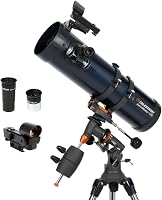
Which Telescope Brand Should You Choose?
A good telescope brand is one that offers a scope suited to your observing goals, a mount you can use, and support you can reach. Compare specific models and warranty terms instead of choosing by brand name alone.
On this page (7 sections)
A good telescope brand gives you models that fit your goals, a mount you can manage, and support for setup and questions. Celestron is one option across entry-level and computerized scopes, but compare the exact telescope, mount and warranty before you decide.
The phrase “best telescope brands” can hide a more useful question: which model fits what you want to see and how you want to find it? For a model-level example, read the StarSense Explorer vs AstroMaster comparison.
Look at product range, support, portability and the effort required to use the mount.
What makes a good brand of telescope?
A good brand of telescope offers a scope that matches your observing habits and clear support terms. The name alone cannot tell you whether a particular model is a practical fit.
Compare the brand and model across these points:
| What to compare | Why it matters |
|---|---|
| Telescope types and sizes | A broad range can give you choices for different targets and budgets |
| Mount and controls | Manual and computerized mounts ask different things of you during setup and observing |
| Support and warranty | Clear support channels and written coverage can help if setup questions come up |
| Accessories and compatibility | Included eyepieces and upgrade options affect what you can do next |
| Portability | The scope and mount need to work for your observing location |
The best brands for telescopes are not automatically the ones with the most expensive models or the longest feature lists. A beginner who wants to learn the sky manually may prefer a different setup from someone who wants a computerized mount to locate targets.
Which telescope brands should you compare?
Start with brands that make the kind of telescope you want, then compare specific models and support. Celestron, Explore Scientific and Meade are names worth checking, but availability, product lines and warranty details can vary by model and market.
Celestron
Celestron spans entry-level reflectors and computerized Schmidt-Cassegrain telescopes in the examples here. Its PowerSeeker 127EQ has a manual German equatorial mount with slow-motion controls, while the NexStar 6SE and 8SE use computerized GoTo mounts.
The models also differ in how they help you find objects. The PowerSeeker is a manual scope with included eyepieces and a Barlow lens; the NexStar models have a hand control with a database of more than 40,000 objects and SkyAlign.
Celestron describes a 2-year warranty and US-based technical support for these models. Check the warranty terms for the exact model and place where you plan to buy it.
For model-specific comparisons, see what is the best Celestron telescope to buy and our best Celestron telescopes under 500 dollars.
Explore Scientific
Explore Scientific is another brand to compare if its available models match the telescope type and features you want. Check the specific product range, included accessories and support terms before choosing.
Our Explore Scientific telescope reviews can help you compare models, and this guide explains where Explore Scientific telescopes are made. Manufacturing location alone does not tell you whether a telescope will fit your needs, so weigh the mount, optics, portability and support too.
Meade
Meade is a familiar name to telescope shoppers, but a brand name does not confirm that a particular model is currently available or supported. Verify the model, seller, warranty and service options before buying.
See our guide on whether Meade still makes telescopes for more context. Compare any Meade model you find with current alternatives that offer the observing style and support you need.
How do you match a brand to your observing needs?
Choose the brand and model by how you plan to observe, then check whether the mount and support fit your experience. Your targets, viewing location and willingness to align or move the telescope matter more than a brand’s reputation alone.
If you are weighing a telescope against a handheld option, read telescope vs monocular.
For a first telescope
A first scope should have controls and setup steps you feel ready to learn. The PowerSeeker 127EQ is a manual reflector with slow-motion controls, two eyepieces and a 3x Barlow lens; it may suit someone who wants to practice locating and tracking objects.
Manual mounts can teach you how objects move across the sky, but they require you to locate and follow targets yourself. Read how to choose a telescope before deciding whether that approach fits your first observing sessions.
For easier object finding
A computerized GoTo mount can locate and track selected targets after alignment. The NexStar 6SE and 8SE include SkyAlign and a hand control with a database of more than 40,000 objects.
The NexStar 6SE is the smaller-aperture option of these two computerized models. Consider it if guided object finding matters and you want to compare it with a larger model before choosing.
For a larger aperture and computerized control
The NexStar 8SE combines an 8-inch Schmidt-Cassegrain optical tube with a computerized GoTo mount. Its hand control selects targets from the object database, and the mount automatically slews to and tracks them after alignment.
This model may suit an observer who wants a larger aperture and automated tracking in one system. Check the space, setup and support needs for the complete telescope before you choose.
Which Celestron model fits your needs?
Choose between these Celestron models by comparing mount style, aperture and the amount of automation you want. Each one serves a different kind of observing routine.
| Model | Main fit | What to weigh |
|---|---|---|
| PowerSeeker 127EQ | Manual observing and learning to track objects | You locate and follow targets yourself |
| NexStar 6SE | Computerized finding with 6-inch optics | You align the system before using GoTo |
| NexStar 8SE | Computerized finding with 8-inch optics | You want a larger aperture and automated tracking |
The PowerSeeker 127EQ includes a manual German equatorial mount and slow-motion controls. The NexStar models instead use computerized altitude-azimuth mounts and SkyAlign.
The 6SE and 8SE share the computerized approach, so compare their aperture and the space needed for your setup. For broader options by observing goal, browse the best telescopes for stargazing.
How much should you spend on a telescope?
Set a budget after deciding what features matter, since brand names alone do not predict the cost or value of a particular model. Compare the full setup, including its mount and any accessories you may need.
An entry-level manual scope can suit someone learning to find targets, while a computerized telescope adds guided alignment and tracking. A more capable setup may cost more, but extra features help only when you plan to use them.
Use our guide to how much a good telescope costs to set expectations. If you want to keep spending down, compare best telescopes under 300 dollars and best budget-friendly telescopes.
At the other end, premium instruments may offer more aperture or advanced features, but they also need suitable storage and setup space. See premium telescopes for home use and professional telescopes for astronomy if you are comparing high-end options.
How should you compare brand support?
Compare written warranty coverage and support access for the exact model and region where you will buy. Support details can differ across products, sellers and countries.
Celestron describes a 2-year warranty and US-based technical support for the three models covered here. Confirm the current terms and support route before ordering, especially if you live outside the United States.
For any brand, check what the warranty covers, how to contact support and whether replacement parts or accessories are available. A clear answer to those questions is more useful than a broad promise about quality.
Which telescope brand should you choose?
Choose the brand whose specific model fits your targets, setup preferences and support needs. Celestron offers examples here from a manual entry-level reflector to computerized Schmidt-Cassegrain scopes, while Explore Scientific and Meade are worth comparing when their current models fit your requirements.
Pick the PowerSeeker 127EQ if you want manual controls, the NexStar 6SE if you want computerized finding with 6-inch optics, or the NexStar 8SE if you want the larger aperture of these three. Before deciding, compare best budget telescopes and the setup guidance in how to choose a telescope.