What Can You See Through a 10-Inch Dobsonian Telescope?
A 10-inch Dobsonian can show detailed lunar craters, the planets, and many deep-sky objects under a dark, steady sky. Views through the eyepiece are mostly gray and less vivid than long-exposure photographs.
On this page (10 sections)
- What do 10-inch Dobsonian telescope images show in real life?
- Why do telescope photos look different from the eyepiece view?
- What can you see on the Moon with a 10-inch Dobsonian?
- Can you see planets clearly through a 10-inch Dobsonian?
- Which deep-sky objects are realistic targets?
- How do 8-inch, 10-inch, and 12-inch Dobsonians compare?
- Does magnification determine how much detail you'll see?
- What helps you get a better view?
- Which beginner telescope products suit different needs?
- Is a 10-inch Dobsonian right for you?
A 10-inch Dobsonian telescope can show lunar craters in sharp relief, planetary details when conditions allow, and faint deep-sky objects as dim, often gray shapes. It gathers far more light than a small beginner refractor, but what you see depends on the sky, the telescope's alignment and cooling, and your observing experience.
Images online can set unrealistic expectations. Many show long exposures, stacked frames, or processing that reveal color and detail the eye won't see in a quick look through an eyepiece.
What do 10-inch Dobsonian telescope images show in real life?
Expect bright, crisp views of the Moon and subtler views of planets, star clusters, nebulae, and galaxies. A photograph may show more color or structure because a camera can collect light over time.
The Moon is usually the easiest target. You can follow crater rims, mountains, valleys, and the boundary between lunar day and night, where shadows make surface features stand out.
Jupiter may show its cloud bands and the four largest moons as points of light. Saturn's rings are a distinct feature when the planet is high enough and the air is steady; the view won't usually resemble the detailed, colorful images made with cameras.
A 10-inch aperture can reveal many deep-sky targets from a dark site. Depending on the object and sky, a galaxy might appear as a faint oval, while a nebula may show a hazy patch rather than the bright colors in a photograph.
For a broader overview of what the view through a telescope can look like, start with familiar targets and compare what you see over several nights. The first view can be subtle, especially when you're still learning to focus and use averted vision.
Why do telescope photos look different from the eyepiece view?
A camera records light over time, while your eye sees a live view. Long exposures and image stacking can make faint color and fine structure stand out in photos that look muted through an eyepiece.
A camera can combine multiple exposures and adjust contrast, brightness, and color. That makes it useful for showing detail, but it is not a direct preview of what your eye will see in real time.
The Moon and planets are bright enough to look detailed by eye, but they still appear smaller than many close-up images suggest. Deep-sky objects are often more challenging: galaxies and nebulae may look gray or low contrast, even when a processed image shows vivid color.
A phone snapshot through the eyepiece is also different from a carefully captured astronomy image. Holding a phone in place can be tricky, and a single quick photo won't necessarily reproduce the view you saw.
What can you see on the Moon with a 10-inch Dobsonian?
The Moon is one of the strongest targets for a 10-inch Dobsonian. Its craters, ridges, and shadowed edges are easier to pick out when the Moon is not full.
Near the boundary between lunar day and night, called the terminator, long shadows emphasize surface relief. Try observing the same area on different nights as the terminator moves across it.
A full Moon is bright and easy to locate, but its flatter lighting can make craters look less three-dimensional. A lunar filter can reduce glare for some viewers, though you can also lower magnification or observe when the Moon is not full.
A small beginner telescope can also show lunar features. For a more modest aperture comparison, see what you can see with a 70mm telescope.
Can you see planets clearly through a 10-inch Dobsonian?
Yes, a 10-inch telescope can show major planetary features, but clarity changes with atmospheric steadiness and the planet's height above the horizon. More magnification won't help if the air is turbulent or the planet is low.
Jupiter can show cloud bands and its four largest moons. Saturn's rings are visible when the planet is well placed, while Mars may reveal surface markings during favorable appearances.
Venus shows phases, but its bright cloud tops don't usually reveal surface detail. Mercury is difficult because it stays close to the Sun in the sky, so observe it only when it is safely separated from the Sun and never point a telescope near the Sun.
Use moderate magnification first, then increase it only while the image remains sharp. If the view turns soft or wobbly, back off and try again when the air steadies.
For practical planning across planets and other nearby targets, read our guide to the solar system through a telescope.
Which deep-sky objects are realistic targets?
A dark sky makes more difference to faint galaxies and nebulae than a bright city does. A 10-inch aperture gathers useful light, but it cannot remove the glow from streetlights, the Moon, or poor transparency.
Star clusters are often rewarding because their individual stars can stand out against the background. Bright nebulae may appear as pale, cloudlike regions, while galaxies often look like faint smudges whose shape becomes easier to notice with careful viewing.
Try averted vision: look slightly beside a faint object rather than directly at it. Your peripheral vision can sometimes detect dim features more readily, and spending a few minutes at the eyepiece helps your eye adapt.
Cloud cover blocks the view, and thin haze or moisture can reduce contrast. Our explainer on whether telescopes can see through clouds covers what to expect when the sky isn't clear.
How do 8-inch, 10-inch, and 12-inch Dobsonians compare?
A 10-inch Dobsonian sits between an 8-inch model that's easier to handle and a 12-inch model that gathers more light but is typically larger. Aperture helps with faint targets, while weight, storage, and setup affect how often you'll use the telescope.
An 8-inch can show the Moon, planets, and many bright deep-sky targets. Compare its typical views with our guide to 8-inch Dobsonian telescope images.
A 12-inch aperture gathers more light than a 10-inch, which can help reveal dimmer objects under similar conditions. It also takes more room and effort to move, so consider the whole setup, not only the aperture; see 12-inch Dobsonian telescope images.
The Dobsonian design uses a simple alt-azimuth mount that moves up, down, left, and right. Learn how the Dobsonian telescope design works before deciding what size and setup suit your space.
Does magnification determine how much detail you'll see?
Magnification changes how large an object looks, but aperture, focus, sky conditions, and optical quality set practical limits on detail. High power can make a fuzzy view larger without making it clearer.
Start with a lower-power eyepiece to find and center the target. Switch to higher power only if the object stays sharp and the atmosphere looks steady.
The best magnification changes from night to night and target to target. A large, bright lunar feature can tolerate more power than a faint galaxy, which may become harder to see as the image darkens.
Don't judge a telescope by a single advertised maximum-power number. Clear, stable views at useful magnifications matter more than pushing the image until it blurs.
What helps you get a better view?
Choose a clear, dark location and let the telescope adjust to outdoor temperatures before judging its performance. Start with bright targets, use a star chart or astronomy app to find them, and give your eyes time to adapt to darkness.
Avoid observing through a closed window. Glass can distort the image, and indoor air meeting cold outdoor optics can contribute to condensation.
Keep bright lights and phone screens out of your direct view. If the Moon is bright, expect less contrast on faint deep-sky objects and plan those targets for a darker night.
A Dobsonian mount is moved by hand, so keep the target centered with small adjustments. If an object drifts out of view, guide it back gently instead of making a large sudden movement.
Which beginner telescope products suit different needs?
These three telescopes are smaller beginner options, not substitutes for a 10-inch Dobsonian. They can suit readers who want a compact lunar or general-purpose scope, or who are choosing a first telescope for a child.
The Blue Marble NASA Lunar Telescope for Kids Ages is a child-focused option with a finder scope, low- and high-power eyepieces, and a tabletop tripod for lunar viewing.
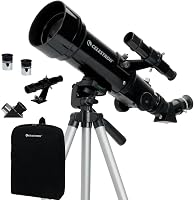
The Celestron Travel Scope 70mm Beginner Portable Telescope includes a 70mm aperture, two eyepieces, a full-height tripod, and a backpack. It suits readers prioritizing a portable setup for lunar viewing and daytime scenery.
The Gskyer Telescope is a 70mm refractor with two eyepieces, a 3x Barlow lens, a finder scope, and a phone adapter with wireless remote. Those features suit a beginner curious about trying simple phone snapshots through the telescope.
Is a 10-inch Dobsonian right for you?
Choose a 10-inch Dobsonian if you want strong visual views of the Moon, planets, and deep-sky objects and have room to store and move a large telescope. Pick a smaller scope if portability and a lighter setup matter more than faint-object reach.
If your main goal is visual observing, expect the Moon to show the most obvious detail and deep-sky objects to take patience. If you want bright, colorful images, plan for camera equipment and image processing, and remember that photos show more than the eye sees live.
Before choosing, compare 8-inch Dobsonian telescope images with 12-inch Dobsonian telescope images. The right aperture is the one you'll be comfortable setting up under a clear, dark sky.