What Can You See Through a 12-Inch Dobsonian Telescope?
A 12-inch Dobsonian shows brighter, more detailed views of the Moon, planets, star clusters, nebulae, and galaxies under a dark, steady sky. Through the eyepiece, most deep-sky objects still look faint and gray, not like long-exposure photographs.
On this page (9 sections)
- What do 12-inch Dobsonian telescope images look like through the eyepiece?
- What can you see on the Moon with a 12-inch Dobsonian?
- What do planets look like through a 12-inch Dobsonian?
- What deep-sky objects can a 12-inch Dobsonian show?
- Can you photograph what you see through a 12-inch Dobsonian?
- How does a 12-inch Dobsonian compare with a 10-inch or 8-inch?
- What conditions help a 12-inch telescope show its best views?
- What portable telescope is easier for casual viewing?
- Is a 12-inch Dobsonian the right telescope for you?
A 12-inch Dobsonian telescope can show bright lunar detail, planetary features, star clusters, nebulae, and many galaxies when the sky is dark and steady. Its large mirror gathers more light than smaller Dobsonians, but visual views of faint objects still look subdued compared with long-exposure photographs.
The image depends on what you're viewing and how high it is above the horizon. The Moon can look crisp and bright; galaxies often appear as gray patches with a brighter center or uneven outline.
What do 12-inch Dobsonian telescope images look like through the eyepiece?
A 12-inch Dobsonian shows a small, bright field of view through the eyepiece, not a full-frame color photograph. The Moon and planets can reveal clear edges and surface detail, while faint deep-sky objects need a dark-adapted eye and patience.
The image also changes with magnification. Lower power gives a wider view and makes it easier to find objects; higher power enlarges the target but can make it dimmer and more affected by shaky air.
For a broader overview of what an eyepiece view can show, see what you can see through a telescope. A 12-inch aperture helps with dim objects, but it cannot remove clouds, haze, or turbulence.
What can you see on the Moon with a 12-inch Dobsonian?
The Moon is one of the easiest targets for seeing fine detail through a 12-inch Dobsonian. Craters, mountain ridges, and the boundary between lunar day and night can stand out, especially when that boundary crosses the terrain.
A bright Moon can be uncomfortable to view through a large telescope. Use an appropriate lunar filter if needed, and avoid looking at the Sun through any telescope unless you have a properly designed solar filter secured over the front aperture.
For younger beginners focused on the Moon, the Blue Marble NASA Lunar Telescope is a small, simple alternative with a finder scope, two eyepieces, and a tabletop tripod. Its described use is lunar viewing and learning together.
What do planets look like through a 12-inch Dobsonian?
Jupiter and Saturn can show recognizable detail, but steady air matters as much as aperture. Jupiter may reveal cloud bands and its largest moons; Saturn may show its rings when the planet is well placed and the view is sharp.
Mars can show a small disk and, under favorable conditions, surface markings. Venus usually appears as a bright crescent or partial disk rather than a richly detailed world.
Don't expect every night to deliver a sharp view. Planetary detail can blur when the atmosphere is turbulent, the telescope has not reached outdoor temperature, or the optics need collimation.
What deep-sky objects can a 12-inch Dobsonian show?
A 12-inch Dobsonian can reveal many star clusters, nebulae, and galaxies, with the best views under a dark sky. It gathers more light than smaller apertures, helping faint targets become easier to detect and some structures more apparent.
Open clusters can show many individual stars. Globular clusters may appear as dense balls of light, while nebulae show as hazy patches that can grow more distinct with a suitable filter and careful observing.
Galaxies are usually the hardest category. Their visible appearance ranges from faint smudges to elongated shapes with brighter cores, and photographic color is uncommon in direct vision.
Do 12-inch telescope views show color in galaxies and nebulae?
Most galaxies and many nebulae look gray to the eye, even in a large telescope. Your eyes are less sensitive to color in dim light than a camera sensor collecting light over a long exposure.
Some bright nebulae may show a hint of color to some observers, but this varies with conditions and individual vision. Photographs can show vivid color because cameras record more light over time and often use image processing.
Can you photograph what you see through a 12-inch Dobsonian?
You can capture simple Moon and planet images, but a standard Dobsonian is not built for long-exposure tracking. A phone held to the eyepiece can record a snapshot, and short videos can help capture brief steady moments.
The mount usually moves by hand, so the sky drifts across the eyepiece as Earth turns. This makes long exposures of galaxies and nebulae challenging, since stars trail unless the telescope tracks the sky.
The Gskyer Telescope includes a phone adapter and wireless remote for capturing images through its eyepiece. It's a portable 70 mm refractor, so it serves as a simple phone-photography option rather than a substitute for the light-gathering reach of a 12-inch Dobsonian.
How does a 12-inch Dobsonian compare with a 10-inch or 8-inch?
A 12-inch aperture gathers more light than an 8-inch or 10-inch aperture, which can make faint objects easier to see. The improvement is most useful on deep-sky targets under dark skies; it won't guarantee better detail when seeing or setup is poor.
An 8-inch Dobsonian view can still show the Moon, planets, star clusters, and brighter nebulae. A 12-inch scope may reveal dimmer targets and more structure, but it is also larger and heavier to handle.
The 10-inch Dobsonian comparison sits between those apertures. Choose based on where you observe, how often you can transport the telescope, and whether you have room to store it.
Dobsonian design uses a simple alt-azimuth mount that moves up, down, left, and right. Learn what a Dobsonian telescope design means before deciding whether that setup suits your observing space.
What conditions help a 12-inch telescope show its best views?
Dark skies, steady air, correct collimation, and allowing the telescope to cool outdoors all help reveal detail. Light pollution affects faint galaxies and nebulae most, while atmospheric turbulence can soften the Moon and planets.
Give your eyes time to adjust to darkness, and avoid bright phone screens while observing. Keep the target high above the horizon when possible, where you look through less atmosphere.
Clouds block targets, and thin haze can reduce contrast. Read whether telescopes can see through clouds before planning a session around a cloudy forecast.
What portable telescope is easier for casual viewing?
A smaller portable telescope can be more convenient when you want quick lunar or daytime views. It won't gather as much light as a 12-inch Dobsonian, but it can be easier to carry and set up.
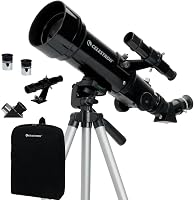
The Celestron Travel Scope 70 is a 70 mm refractor with a backpack, full-height tripod, finderscope, and two eyepieces. Celestron describes it for beginner views of the Moon, planets, and daytime scenery.
Is a 12-inch Dobsonian the right telescope for you?
A 12-inch Dobsonian suits you if you want to see faint deep-sky targets and can manage a large telescope at your observing site. It can show more than smaller apertures under favorable conditions, but the view remains a direct visual one unless you add imaging equipment and tracking.
Choose an 8-inch or 10-inch model if storage, transport, or frequent setup matters more than the extra light gathering. For occasional Moon viewing or travel, a compact refractor may be easier to use.
For the clearest comparison, decide which targets you care about most and where you'll observe them. Dark skies and regular use often matter more than increasing aperture alone.
Frequently asked questions
What can you see with a 12-inch Dobsonian telescope?
A 12-inch Dobsonian can show lunar craters, planetary details when conditions are steady, star clusters, nebulae, and many galaxies. The Moon and planets are bright, while most galaxies and nebulae appear as faint gray shapes.
The view depends on the sky, object height, your eyes, and the telescope's collimation.
Can a 12-inch Dobsonian take pictures?
You can photograph the Moon and planets with a phone or camera, but a basic Dobsonian mount does not track the sky as Earth turns. Long exposures of galaxies and nebulae are therefore difficult.
Expect simple snapshots or short video captures rather than the colorful, detailed images made with tracked astrophotography equipment.
Do galaxies look colorful through a 12-inch telescope?
Usually not. Most galaxies appear as faint gray smudges because their light is too dim for your eyes to see much color, even through a large telescope.
A dark sky and careful viewing can reveal structure, such as a brighter core or an elongated shape, while photographs collect light over time.
Does a 12-inch telescope always show more detail than a 10-inch?
A 12-inch mirror gathers more light than a 10-inch mirror, which can help reveal dimmer objects and subtle detail. The difference is not guaranteed on every night: poor seeing, light pollution, low object altitude, or miscollimation can hide detail.
Compare the 10-inch Dobsonian view for context.