6 Best Reflector Telescopes for Astronomy (November 2026)
The best reflector telescopes for astronomy include the Celestron PowerSeeker 127EQ Reflector Telescope for Home for a portable family setup, the MEEZAA Telescope for a 150 mm aperture kit, and the SOLOMARK Telescope 130EQ Newtonian Reflector Telescopes for a 130 mm reflector kit.
On this page (4 sections)
The best reflector telescopes for astronomy pair a useful mirror aperture with a mount you can learn to track by hand. The Celestron PowerSeeker 127EQ is our top pick, while MEEZAA offers a 150 mm mirror and HSL a larger 203 mm option.
Reflectors use mirrors to gather light, and aperture is a key part of choosing one for visual observing. These six models range from 114 mm to 203 mm and include manual equatorial mounts, so consider both the optical tube and the time you can give to setup and tracking.
For a plain-language overview of what a reflecting telescope is, start there before comparing specific models. If you're choosing between mirror and lens designs, see whether a refractor or reflector telescope is better.
Our picks at a glance
-
1
 Best for a portable family setup
Celestron PowerSeeker 127EQ Reflector Telescope for Home
9.6/10 our score
See it on Amazon -
2
-
3
 Best for a 130 mm reflector kit
SOLOMARK Telescope 130EQ Newtonian Reflector Telescopes
9.2/10 our score
See it on Amazon
- 4
 Check it
Celestron PowerSeeker 114EQ Reflector Telescope for Backyard
Best for a lighter 114 mm option - 5
 Check it
HSL 203EQ Astronomical Reflector Telescope for Adults
Best for a large 203 mm mirror - 6
 Check it
Koolpte 130EQ Reflector Telescope
Best for phone-assisted Moon viewing
Which reflector telescopes for astronomy stand out?
The Celestron PowerSeeker 127EQ leads this group for its 127 mm mirror, slow-motion controls and included eyepieces. MEEZAA and SOLOMARK offer larger or similarly sized Newtonian setups with useful accessories for visual observing.
We compared the stated aperture, mount style, included optics and practical accessories against the needs of visual astronomy. Our score weighs specs, features and buyer feedback against what you're shopping for.
| Product | Best for | Aperture | Mount | Included optics | Our score |
|---|---|---|---|---|---|
| Celestron PowerSeeker 127EQ Reflector Telescope for Home | a portable family setup | 127 mm | Manual German equatorial | 20 mm and 4 mm eyepieces, 3x Barlow lens | 9.6 |
| MEEZAA Telescope | a 150 mm aperture kit | 150 mm | Equatorial | 25 mm and 10 mm eyepieces, 2x Barlow lens | 9.3 |
| SOLOMARK Telescope 130EQ Newtonian Reflector Telescopes | a 130 mm reflector kit | 130 mm | German equatorial | Two eyepieces, 1.5x Barlow lens | 9.2 |
| Celestron PowerSeeker 114EQ Reflector Telescope for Backyard | a lighter 114 mm option | 114 mm | Manual German equatorial | 20 mm and 4 mm eyepieces, 3x Barlow lens | 9.0 |
| HSL 203EQ Astronomical Reflector Telescope for Adults | a large 203 mm mirror | 203 mm | Manual EQ4 equatorial | 25 mm, 20 mm and 6.5 mm eyepieces, 3x Barlow lens | 9.0 |
| Koolpte 130EQ Reflector Telescope | phone-assisted Moon viewing | 130 mm | Equatorial | 25 mm and 6.5 mm eyepieces, 2x Barlow lens | 8.6 |
Best reflector telescopes for different observing needs
The right pick depends on mirror size, included accessories and the physical space you can give a telescope. Each of these models has a manual equatorial mount, so plan to learn its setup and tracking controls.
1. Celestron PowerSeeker 127EQ Reflector Telescope for Home: Best for a portable family setup
Celestron PowerSeeker 127EQ Reflector Telescope for Home: Best for a portable family setup
- 127 mm Newtonian reflector
- Manual German equatorial mount
- 20 mm and 4 mm eyepieces
- 3x Barlow lens
The 127 mm mirror and slow-motion controls suit shared backyard or campsite observing. Two eyepieces and a 3x Barlow lens offer several viewing combinations.
Pros
- 127 mm mirror
- Slow-motion mount controls
- Includes two eyepieces and a Barlow lens
Cons
- Manual equatorial mount takes practice to use
- No carry bag is specified
The 127 mm Newtonian mirror makes this a balanced choice for shared observing at home or a campsite. Celestron describes it for viewing the Moon, planets, distant stars and the Orion Nebula.
Its manual German equatorial mount includes a slow-motion altitude rod to help you follow objects across the sky. The kit includes 20 mm and 4 mm eyepieces plus a 3x Barlow lens, giving you several combinations to try as you learn.
Celestron describes the telescope as compact and portable, but the 13 lb weight and assembled dimensions still merit a storage check. No carry bag is specified, so think through how you'll protect the tube during transport.
Choose this model if you want a moderate aperture and the basic optics in one package. Read our guide to the best reflector telescopes for adults for more options aimed at adult observers.
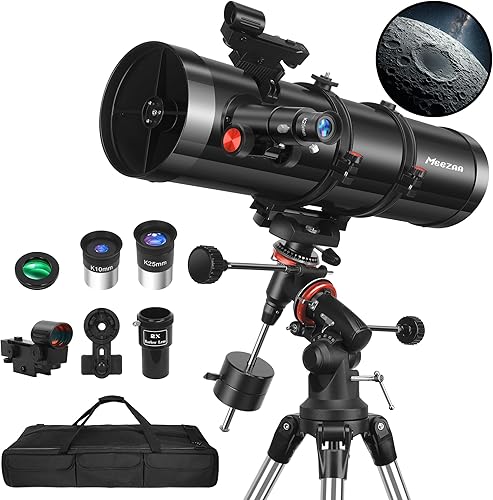
2. MEEZAA Telescope: Best for a 150 mm aperture kit
MEEZAA Telescope: Best for a 150 mm aperture kit
- 150 mm aperture
- 650 mm focal length
- 26x to 130x magnification range
- Carry bag and Moon filter
A 150 mm mirror, equatorial mount and slow-motion controls make this a capable all-round visual setup. The carry bag and Moon filter add practical extras.
Pros
- 150 mm aperture
- Carry bag included
- Moon filter and phone adapter included
Cons
- Equatorial mount needs setup and practice
- No tripod weight is specified
MEEZAA combines a 150 mm aperture with a 650 mm focal length and an equatorial mount. Its stated magnification range is 26x to 130x, with 25 mm and 10 mm eyepieces and a 2x Barlow lens.
The kit also includes a Moon filter, phone adapter and carry bag. Those accessories make it a practical choice if you want a storage option and a way to try phone-assisted observing without assembling a separate accessory set.
The mount has slow-motion controls for manual tracking. As with other equatorial mounts here, expect to learn alignment and control adjustments before tracking feels natural.
Choose MEEZAA if 150 mm aperture and a carry bag matter more to you than keeping the tube small. For a first setup, compare our picks for the best reflector telescope for beginners.
3. SOLOMARK Telescope 130EQ Newtonian Reflector Telescopes: Best for a 130 mm reflector kit
SOLOMARK Telescope 130EQ Newtonian Reflector Telescopes: Best for a 130 mm reflector kit
- 130 mm aperture
- 650 mm focal length
- German equatorial mount
- Phone adapter and Moon filter
This 130 mm Newtonian pairs its aperture with fine-adjustment cables on a German equatorial mount. A phone adapter and 13% Moon filter come in the kit.
Pros
- 130 mm aperture
- Fine-adjustment mount cables
- Phone adapter and Moon filter included
Cons
- Manual equatorial tracking has a learning curve
- No carry case is specified
The SOLOMARK 130EQ has a 130 mm aperture and a 650 mm focal length. Its German equatorial mount uses a dial and fine-adjustment cables, which let you make small manual pointing changes while following an object.
The accessory set includes two eyepieces, a 1.5x Barlow lens, a 13% Moon filter and a smartphone adapter. That mix suits observers who want to try lunar viewing and basic phone capture with the telescope.
The adjustable aluminum alloy tripod has an accessory tray for small items. The 130 mm tube is a middle ground in this lineup, but the equatorial mount still needs setup and practice.
Choose this model if the mount controls and Moon-viewing accessories fit your plans. Our guide on how to use a reflector telescope for beginners covers the basics of getting started.
4. Celestron PowerSeeker 114EQ Reflector Telescope for Backyard: Best for a lighter 114 mm option
Celestron PowerSeeker 114EQ Reflector Telescope for Backyard: Best for a lighter 114 mm option
- 114 mm Newtonian reflector
- Manual German equatorial mount
- 20 mm and 4 mm eyepieces
- 3x Barlow lens
The 114 mm mirror offers a smaller-aperture alternative with slow-motion mount controls. Its eyepieces and Barlow lens provide several magnification combinations.
Pros
- 114 mm Newtonian mirror
- Slow-motion tracking controls
- Includes two eyepieces and a Barlow lens
Cons
- Manual equatorial mount takes practice to use
- No carry bag is specified
The PowerSeeker 114EQ is the smaller-aperture Celestron choice here, with a 114 mm Newtonian mirror and 900 mm focal length. Its slow-motion rod and manual German equatorial mount support small adjustments as objects drift.
Two eyepieces, 20 mm and 4 mm, come with a 3x Barlow lens. Celestron describes this model for the Moon, planets, distant stars and the Orion Nebula, making it a fit for someone who wants a smaller mirror than the 127EQ.
The included tripod and accessory tray give you places for setup and small observing items. It is still a complete telescope and mount, so check where the parts will live between sessions.
Choose it if you want a 114 mm reflector with manual tracking controls. For a closer look at one of the brand's other reflector options, see our Celestron Omni XLT 150 telescope review.
5. HSL 203EQ Astronomical Reflector Telescope for Adults: Best for a large 203 mm mirror
HSL 203EQ Astronomical Reflector Telescope for Adults: Best for a large 203 mm mirror
- 203 mm primary mirror
- 800 mm focal length
- Manual EQ4 equatorial mount
- Five color filters
The 203 mm primary mirror is the largest aperture in this group, while the EQ4 mount is designed for a larger tube and accessories. This is a substantial setup to plan around.
Pros
- Largest aperture in this group
- EQ4 mount
- Five color filters and phone holder included
Cons
- Large tube and mount need more storage space
- No tube weight is specified
HSL has the largest aperture in this group, with a 203 mm primary mirror and 800 mm focal length. Its manual EQ4 equatorial mount is described as having a thicker structure than EQ2 and EQ3 mounts, with more room for heavier tubes and accessories.
The kit includes 25 mm, 20 mm and 6.5 mm eyepieces, a 3x Barlow lens, five color filters, an adjustable phone holder and a wireless remote. These extras provide options for visual use and simple phone capture.
A 203 mm reflector can gather more light than the smaller mirrors here, but the tube and mount need a suitable storage and setup area. Confirm that you can manage the footprint before choosing the largest aperture.
Pick HSL if mirror size is your main priority and you have space for the larger setup. Its accessory set is extensive, though the mount and tube make it less suited to buyers who need a compact kit.
6. Koolpte 130EQ Reflector Telescope: Best for phone-assisted Moon viewing
Koolpte 130EQ Reflector Telescope: Best for phone-assisted Moon viewing
- 130 mm aperture
- 650 mm focal length
- Manual equatorial tracking
- Phone adapter and wireless remote
This 130 mm Newtonian includes a phone adapter and wireless remote for simple Moon photos and videos. Slow-motion control cables help track objects manually.
Pros
- 130 mm aperture
- Phone adapter and wireless remote included
- Moon filter included
Cons
- Manual equatorial tracking takes practice
- No carry bag is specified
Koolpte pairs a 130 mm aperture with a 650 mm focal length and manual equatorial tracking. Slow-motion cables help you follow an object as it moves across the sky.
The kit includes 25 mm and 6.5 mm eyepieces, a 2x Barlow lens and a Moon filter. Its phone adapter and wireless remote are intended to make simple Moon photos and videos easier to capture through the eyepiece.
The reflex finder helps with initial aiming, and the accessory set covers common starter needs. The brand describes the scope as portable, but no carry bag is specified, so plan how you'll store the tube.
Choose Koolpte if phone-assisted lunar viewing is a priority and you want a 130 mm mirror. Compare its included kit with SOLOMARK's 130EQ before deciding which accessories matter most.
How should you choose a reflector telescope for astronomy?
Choose by aperture, mount handling and the accessories you'll actually use. A larger mirror can gather more light, but the whole setup also needs storage room and time to align.
How much aperture do you need?
Aperture is the mirror's diameter, and all else being equal, a larger mirror gathers more light. This group spans 114 mm, 127 mm, 130 mm, 150 mm and 203 mm, giving you options from smaller backyard setups to a larger tube.
For a broader explanation of how aperture relates to detail, read what angular resolution means in astronomy. Real views also depend on sky conditions and careful focus, so aperture alone doesn't promise a specific view.
What does an equatorial mount change?
An equatorial mount is designed to track the sky with adjustments around an axis aligned to Earth's rotation. The models here are manual, with rods, dials or cables for slow-motion movement.
That tracking style takes practice to set up and use. If you prefer to begin with simple pointing, allow time to learn the alignment process before expecting smooth tracking.
Which accessories are useful?
A Barlow lens changes the effective magnification when paired with an eyepiece, while a Moon filter can reduce glare during lunar viewing. A phone adapter helps align a smartphone with the eyepiece, though taking steady photos still takes practice.
Included accessories vary: the Celestron models provide two eyepieces and a 3x Barlow, MEEZAA includes a carry bag and Moon filter, and Koolpte adds a phone adapter and remote. Compare the kit with your actual observing plans instead of treating a longer accessory list as automatically better.
Which reflector telescope should you choose?
Pick the Celestron PowerSeeker 127EQ for a moderate 127 mm mirror and slow-motion controls, MEEZAA if you want a 150 mm aperture with a carry bag, or HSL if you can accommodate a 203 mm mirror and larger mount. Choose between the two 130 mm kits by the accessories you value, and consider the 114 mm Celestron for a smaller aperture.
For a deeper look at one brand's lunar-focused options, visit our Celestron Moon Mission telescope guide.
Our top 3 picks at a glance
-
1
Best for a portable family setup
Celestron PowerSeeker 127EQ Reflector Telescope for Home
9.6/10 our score
See it on Amazon -
2
-
3
Best for a 130 mm reflector kit
SOLOMARK Telescope 130EQ Newtonian Reflector Telescopes
9.2/10 our score
See it on Amazon
Frequently asked questions
What makes a reflector telescope a good choice for astronomy?
A reflector uses mirrors to gather and focus light, and its aperture helps determine how much light it can collect. These picks range from 114 mm to 203 mm, with manual equatorial mounts for following objects across the sky.
Choose by aperture, setup size and how much mount practice you want.
What aperture is useful for visual astronomy?
Aperture is the diameter of the main mirror, and a larger mirror gathers more light. The 114 mm to 150 mm options here offer a range of sizes for Moon, planet and brighter deep-sky viewing, while the 203 mm HSL has the largest mirror.
A bigger telescope also calls for more storage and setup space.
Are equatorial mounts suitable for beginners?
Yes, but an equatorial mount takes practice because it must be aligned before its controls can track the sky. Slow-motion cables or rods let you make small manual adjustments as objects appear to drift.
Allow time to learn the mount before planning a short observing session.
Can a reflector telescope show planets and deep-sky objects?
These reflectors are described for viewing the Moon, planets and brighter deep-sky targets. What you can see depends on aperture, sky darkness, atmospheric conditions and the eyepiece in use.
Start with the Moon and bright planets while learning to find and track objects.
How do I choose between a 130 mm and 150 mm reflector?
A 150 mm mirror gathers more light than a 130 mm mirror, while both options here use manual equatorial mounts. MEEZAA adds a carry bag and Moon filter; SOLOMARK and Koolpte offer 130 mm setups with different accessory kits.
Compare storage needs and included accessories along with aperture.


