6 Best Refractor Telescopes for Astrophotography (November 2026)
The best refractor telescopes for astrophotography include the SVBONY SV503 Upgraded ED Refractor Telescope for deep-sky imaging, the MEEZAA Telescope for phone snapshots, and the Gskyer Telescope 600x90mm AZ Astronomical Refractor Telescope for lunar viewing and photos.
On this page (11 sections)
- How we chose refractor telescopes for astrophotography
- How the six refractors compare
- 1. SVBONY SV503 Upgraded ED Refractor Telescope: Best for deep-sky imaging
- 2. MEEZAA Telescope: Best for phone snapshots
- 3. Gskyer Telescope 600x90mm AZ: Best for lunar viewing and photos
- 4. Dianfan Telescope: Best for travel with a phone
- 5. HUGERSTAR Telescope: Best for lunar phone photos
- 6. SVBONY SV48P Telescope: Best for a wider 90mm field
- What should you look for in an astrophotography refractor?
- How do you match a refractor to a camera and mount?
- Which refractor should you choose for astrophotography?
The best refractor telescope for astrophotography in this group is the SVBONY SV503, because it combines ED glass, a dual-speed focuser and an included 0.8X field flattener. If you want a simpler way to photograph the Moon with a phone, the MEEZAA, Gskyer, Dianfan and HUGERSTAR packages include or support smartphone imaging.
These picks cover two different needs. The SV503 and SV48P are optical tube assemblies with imaging features, while the other models are beginner telescope packages built around visual observing and phone snapshots.
Our picks at a glance
-
1
 Best for deep-sky imaging
SVBONY SV503 Upgraded ED Refractor Telescope
9.7/10 our score
See it on Amazon -
2

-
3
 Best for lunar viewing and photos
Gskyer Telescope 600x90mm AZ Astronomical Refractor Telescope
9.5/10 our score
See it on Amazon
How we chose refractor telescopes for astrophotography
We compared the stated optical and imaging features, focusing controls, focal length, included accessories and portability. The scores reflect how well each option matches a photographer's likely goal, from deep-sky imaging to casual phone photos.
An ED refractor with a matching field flattener is a closer fit for wide-field deep-sky work than a general-purpose telescope with a phone adapter. A phone adapter can be useful, but it does not turn an altazimuth beginner package into a dedicated tracked imaging rig.
The SV503 earns the top score because its package includes a 0.8X field flattener and a dual-speed focuser. The SV48P has a shorter 500mm focal length and a rotatable focuser, but no field flattener is specified.
Among the bundled beginner sets, the Gskyer's 600mm focal length is shorter than the 800mm MEEZAA, Dianfan and HUGERSTAR models. These are practical differences to weigh alongside your camera, mount and intended targets.
Our score weighs optical and imaging features, included accessories and fit for your target.
How the six refractors compare
The SV503 is the clearest deep-sky choice here because its field flattener is included. The other models are more suitable for visual observing and simple smartphone images.
| Product | Best for | Aperture | Focal length | Imaging feature | Our score |
|---|---|---|---|---|---|
| SVBONY SV503 Upgraded ED Refractor Telescope | deep-sky imaging | 80mm | 560mm | 0.8X field flattener | 9.7 |
| MEEZAA Telescope | phone snapshots | 90mm | 800mm | Smartphone adapter | 9.6 |
| Gskyer Telescope 600x90mm AZ Astronomical Refractor Telescope | lunar viewing and photos | 90mm | 600mm | Smartphone adapter compatibility | 9.5 |
| Dianfan Telescope | travel with a phone | 90mm | 800mm | Smartphone adapter | 9.4 |
| HUGERSTAR Telescope | lunar phone photos | 90mm | 800mm | Smartphone adapter | 9.3 |
| SVBONY SV48P Telescope | a wider 90mm field | 90mm | 500mm | Rotatable focuser | 9.0 |
1. SVBONY SV503 Upgraded ED Refractor Telescope: Best for deep-sky imaging
SVBONY SV503 Upgraded ED Refractor Telescope: Best for deep-sky imaging
- 80mm ED refractor
- SV193 0.8X field flattener included
- 2-inch dual-speed focuser with 1:10 adjustment
- 5.51 lb optical tube
The ED optical tube and included 0.8X field flattener are aimed at deep-sky imaging. Its dual-speed focuser offers fine manual adjustment, and the 5.51 lb tube keeps the optical load in view when planning a mount.
Pros
- Includes a 0.8X field flattener
- Dual-speed focuser with 1:10 adjustment
- ED glass
Cons
- 80mm aperture is smaller than the 90mm options here
- Mount and camera are not included
The SV503 is the most imaging-focused option in this group. Its 80mm ED refractor includes the SV193 0.8X field flattener, which SVBONY describes as reducing exposure times and keeping stars sharp from center to edge.
The 2-inch dual-speed focuser provides 1:10 micro-adjustment for precise manual focus. That fine adjustment is useful when a small focus change can affect star shape across an image.
The optical tube weighs 5.51 lb, so it places less load on a mount than a heavier tube would. You still need to plan for the camera, mounting hardware and any other accessories when checking mount capacity.
Its 560mm focal length with the reducer is intended to provide a faster system and wider field, according to SVBONY. This setup fits large galaxies and nebulae better than a long-focus planetary setup.
This is an optical tube assembly rather than a complete observing kit. Budget your planning around a compatible camera and tracking mount, and confirm your camera's connection requirements before choosing accessories.
If you want a closer look at this model, see our best SVBONY SV503 refractor telescope guide. For the broader ED and apochromatic options, compare our best apochromatic refractor telescope picks.
2. MEEZAA Telescope: Best for phone snapshots
MEEZAA Telescope: Best for phone snapshots
- 90mm aperture
- 800mm focal length
- Phone adapter included
- Altazimuth mount and tripod included
This complete beginner set includes a smartphone adapter, tripod and carry bag. It is a fit for casual phone images and visual use, while its altazimuth mount and long focal length make it a different kind of setup from a deep-sky imaging OTA.
Pros
- Phone adapter and tripod included
- 90mm objective
- Carry bag included
Cons
- No field flattener is specified
- Altazimuth mount is included
MEEZAA is a beginner package for visual observing and casual smartphone photos. It pairs a 90mm aperture with an 800mm focal length and includes a phone adapter, carry bag, tripod, two eyepieces and a 3X Barlow lens.
The phone adapter makes it possible to capture a view through an eyepiece without buying a dedicated astronomy camera first. That approach is convenient for bright targets such as the Moon, but it does not provide the same setup as a camera attached directly to an imaging tube.
The included altazimuth mount is intended for general telescope use. For long exposures of deep-sky objects, account for the mount and tracking separately rather than assuming the included tripod is an imaging mount.
MEEZAA suits someone who wants a ready-to-use visual telescope and occasional phone photos. If your main goal is to photograph large nebulae, choose an OTA with imaging-focused features and a mount designed for tracking.
3. Gskyer Telescope 600x90mm AZ: Best for lunar viewing and photos
Gskyer Telescope 600x90mm AZ Astronomical Refractor Telescope: Best for lunar viewing and photos
- 90mm aperture
- 600mm focal length
- Smartphone compatibility
- Eyepieces and 3X Barlow included
The 90mm objective and 600mm focal length make this a shorter visual refractor than the 800mm beginner models. It includes a tripod, eyepieces and a Barlow, with smartphone compatibility for simple image capture.
Pros
- 90mm objective
- 600mm focal length
- Tripod and eyepieces included
Cons
- No field flattener is specified
- Altazimuth setup is designed for general viewing
Gskyer combines a 90mm aperture with a 600mm focal length, making it shorter than the 800mm beginner refractors in this list. The kit includes a tripod, three eyepieces, a 3X Barlow lens and a finderscope.
The details describe it as suitable for lunar and planetary observing and note compatibility with a smartphone adapter. The package contents identify a tripod and eyepieces, so confirm the specific phone adapter arrangement you plan to use before buying.
A 600mm focal length can be easier to frame broad objects than an 800mm scope with the same camera. Still, the altazimuth configuration and lack of a specified field flattener make this a general-purpose option rather than the first choice for edge-to-edge deep-sky frames.
Choose this model if visual lunar observing comes first and phone photos are an extra. For dedicated astrophotography, spend more attention on the mount, camera connection and field correction.
4. Dianfan Telescope: Best for travel with a phone
Dianfan Telescope: Best for travel with a phone

- 90mm aperture
- 800mm focal length
- Phone adapter and carry bag included
- Stainless steel tripod
A carry bag, smartphone adapter and tripod make this an accessible package for travel and casual phone photography. The 800mm focal length and altazimuth mount suit general viewing better than wide-field deep-sky imaging.
Pros
- Phone adapter and carry bag included
- 90mm objective
- Stainless steel tripod included
Cons
- No field flattener is specified
- Long 800mm focal length
Dianfan includes a phone adapter, phone holder, stainless steel tripod and carry bag. Its 90mm aperture and 800mm focal length are suited to general observing and casual image capture through a smartphone.
The carry bag helps keep the package together for outdoor sessions. The tripod is included, but the model uses an altazimuth mount, so deep-sky photographers should evaluate tracking separately.
At 800mm, this telescope gives a narrower framing than the 500mm or 560mm OTAs in this roundup. That can make large objects harder to fit into one frame, depending on your camera sensor.
Dianfan is a reasonable fit when portability and a simple phone setup matter more than a purpose-built deep-sky imaging configuration. For a broader look at compact imaging options, read our best portable telescope for astrophotography guide.
5. HUGERSTAR Telescope: Best for lunar phone photos
HUGERSTAR Telescope: Best for lunar phone photos
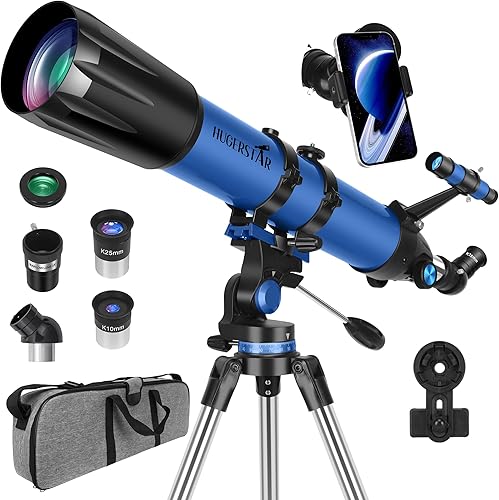
- 90mm aperture
- 800mm focal length
- Phone adapter and Moon filter included
- Tripod and carry bag included
The phone adapter supports casual image capture, and the included Moon filter is intended to reduce lunar glare during viewing. Its 800mm focal length and altazimuth mount point toward lunar and general observation rather than wide-field deep-sky work.
Pros
- Phone adapter included
- Moon filter included
- 90mm objective
Cons
- No field flattener is specified
- Tripod is included in the package
HUGERSTAR's package includes a 90mm refractor, 800mm focal length, phone adapter and Moon filter. The filter is intended to reduce glare for lunar viewing, while the phone adapter supports simple photo capture.
The included tripod adjusts from 28.7 to 46.4 inches, and the kit also comes with a carry bag and eyepieces. These accessories suit a beginner who wants to observe the Moon and try smartphone photography without assembling an imaging setup from separate parts.
Its long focal length and altazimuth mount are more naturally suited to general viewing than broad deep-sky frames. The product information does not specify a field flattener, so don't assume stars will stay corrected across a large camera sensor.
Pick HUGERSTAR if the Moon is a main target and the included filter and phone adapter are useful to you. For nebulae and star fields, consider the SV503's field flattener and plan for a suitable tracking mount.
6. SVBONY SV48P Telescope: Best for a wider 90mm field
SVBONY SV48P Telescope: Best for a wider 90mm field

- 90mm aperture
- 500mm focal length
- Dual-speed focuser with 1:10 ratio
- Rotatable focuser for composition
The 500mm focal length gives this 90mm OTA a shorter focal length than the 800mm beginner refractors. Its rotatable focuser helps with photographic composition, but a camera, mount and any required field correction are separate planning decisions.
Pros
- 90mm objective and 500mm focal length
- Dual-speed focuser
- Rotatable focuser for composition
Cons
- No field flattener is specified
- OTA only
The SV48P is a 90mm aperture, 500mm focal length OTA with a dual-speed focuser and a rotatable focuser assembly. The shorter focal length gives it a wider field than the 800mm beginner scopes, which can help when framing larger targets.
The focuser's 1:10 ratio allows fine manual adjustment. Its 360-degree rotation can help orient a camera for composition, and the tube includes a dovetail plate for mounting.
This is an optical tube assembly, so plan for a camera, mount and any needed field correction separately. No field flattener is specified for this model, so check the image quality you need across your sensor before choosing it for wide-field work.
Choose the SV48P if you want a 90mm refractor with a relatively short focal length and imaging-friendly focus controls. If edge-to-edge correction is a priority, the SV503 is the more complete imaging package here.
What should you look for in an astrophotography refractor?
Start with the target and camera, then match the focal length, optical correction and mount to them. A telescope that frames a large nebula well may not be the right choice for planets or small galaxies.
Is an ED refractor better for astrophotography?
ED glass is designed to reduce chromatic aberration, or colored fringes around bright objects. The SV503 uses S-FPL51 ED glass, while the SV48P is described as using achromatic glass.
An apochromatic refractor can be a stronger fit when color correction matters across the frame. Learn what an apochromatic refractor is and quick fixes to consider before deciding whether that optical design fits your budget and targets.
Does focal length affect what you can photograph?
Yes. Focal length affects the image scale and field of view, so a shorter scope frames a broader area with the same camera.
The SV48P is 500mm, the SV503 is 560mm before its reducer, and the bundled beginner scopes run from 600mm to 800mm. Check a field-of-view calculator with your specific camera sensor and target before you buy.
Why does a field flattener matter?
A field flattener helps keep stars from stretching toward the edges of an image. It's useful when you want a wide, even frame from a refractor.
The SV503 package includes a 0.8X field flattener. For other telescopes, verify that a compatible flattener exists and whether it is included, since correction can depend on the telescope and camera spacing.
Can an altazimuth telescope take deep-sky photos?
An altazimuth telescope can take simple images, especially of the Moon, but long deep-sky exposures need the mount to track the sky. Field rotation can also affect images during longer sessions.
For deep-sky imaging, plan around a tracking equatorial mount and the full weight of the optical tube, camera and accessories. Our guide to refractor versus reflector telescopes can help with the broader optical choice, while the Celestron Moon Mission telescope guide covers a visual-first alternative.
How do you match a refractor to a camera and mount?
Match the camera connection, optical tube weight and focal length to the mount before ordering. The mount must carry the complete imaging setup and track smoothly for the exposures you plan to take.
The SV503 weighs 5.51 lb as an optical tube and includes a 2-inch focuser. The SV48P weighs 3 kg and includes a dovetail plate, but the camera and mount are separate pieces to account for.
For the beginner packages, the tripod and altazimuth mount are part of a visual observing kit. A phone adapter can capture bright objects, but it should not be treated as a substitute for a tracking mount and dedicated camera in deep-sky work.
Leave room in the budget and payload calculation for a camera, mounting rings or dovetail fit, cables and any corrector. A mount that is near its limit can make focusing and tracking harder.
Which refractor should you choose for astrophotography?
Choose the SVBONY SV503 if you want an ED refractor with an included field flattener for deep-sky imaging. Pick the SV48P if a 500mm focal length, 90mm aperture and rotatable focuser better fit your framing plans.
For phone snapshots and visual observing, compare the MEEZAA, Gskyer, Dianfan and HUGERSTAR by their focal length and included accessories. If you are still weighing optical designs, start with our best apochromatic refractor telescope guide.
Our top 3 picks at a glance
-
1
Best for deep-sky imaging
SVBONY SV503 Upgraded ED Refractor Telescope
9.7/10 our score
See it on Amazon -
2
-
3
Best for lunar viewing and photos
Gskyer Telescope 600x90mm AZ Astronomical Refractor Telescope
9.5/10 our score
See it on Amazon
Frequently asked questions
What makes a refractor suitable for astrophotography?
A refractor for astrophotography needs a camera connection, a stable mount and optics suited to the target. For deep-sky images, a field flattener can help keep stars sharp toward the frame edges.
The SVBONY SV503 in this roundup includes a 0.8X field flattener, while the beginner packages focus on visual use and phone capture.
Can I take astrophotography pictures with a phone adapter?
Yes, a phone adapter can hold a smartphone at the eyepiece for simple images of bright targets such as the Moon. It is a convenient way to start, but it is different from attaching a dedicated astronomy camera to an imaging telescope.
MEEZAA, Dianfan and HUGERSTAR include phone adapters.
Do I need a field flattener for a refractor?
A field flattener can correct star distortion toward the edges of an image, which matters when you want a broad, sharp frame. The SVBONY SV503 package includes a 0.8X field flattener designed for its 80mm ED refractor.
The other products here do not specify one, so check compatibility before planning full-frame deep-sky images.
Is a short focal length better for astrophotography?
A shorter focal length gives a wider field of view with the same camera, which can suit large nebulae and star fields. It does not make every target easier, since smaller galaxies and planets need a different image scale.
Among these picks, the SV48P is 500mm and the SV503 is 560mm.
What mount should I use for astrophotography?
Choose a mount that can carry the optical tube, camera and accessories while tracking smoothly. Deep-sky imaging usually calls for an equatorial tracking setup, and the tube's weight and focal length affect the choice.
Read our telescope mounts and tripods guide before pairing an imaging OTA with a mount.