9 Best Telescopes for Lunar Photography (November 2026)
The best telescopes for lunar photography include the ZWO Seestar S30 Pro Smart Telescope for app-based lunar capture, the Blue Marble NASA Lunar Telescope for Kids Ages for a child's first Moon photos, and the MEEZAA Telescope for long-focal-length refractor framing.
On this page (6 sections)
The best telescope for lunar photography depends on the framing and camera setup you want. The MEEZAA 150EQ pairs a 650 mm focal length with a 150 mm aperture, Moon filter and phone adapter, while the Celestron NexStar 8SE offers a much longer 2032 mm focal length and computerized tracking.
A longer focal length makes the Moon larger in the camera frame, but it can crop the full lunar disk. Aperture gathers light and affects fine detail, while the mount and camera connection determine how practical it is to focus, track and capture.
If you want a general visual scope as well as Moon photos, compare our guide to the best telescope for planets. For digital capture, also see our guide to astronomy cameras for telescopes.
Our picks at a glance
-
1
 Best for app-based lunar capture
ZWO Seestar S30 Pro Smart Telescope
9.7/10 our score
See it on Amazon -
2
 Best for a child's first Moon photos
Blue Marble NASA Lunar Telescope for Kids Ages
9.6/10 our score
See it on Amazon -
3

- 4
 Best for portable phone captureCheck it
- 5
 Check it
Celestron NexStar 8SE Computerized Telescope
Best for tracked lunar close-ups - 6
 Check it
Celestron AstroMaster 70AZ Refractor Telescope for Moon
Best for simple visual-to-phone practice - 7
 Best for lunar imaging with a Moon filterCheck it
- 8
 Check it
DWARFLAB Dwarf Mini Smart Telescope
Best for lightweight app-controlled captures - 9
 Check it
DWARFLAB Dwarf 3 Smart Telescope
Best for portable dual-camera imaging
How we chose telescopes for lunar photography
The strongest choices here combine useful lunar focal length, a clear path to attach a camera, and controls that fit the way you want to image. We compared the stated optics, mount features and included camera accessories, with extra weight on practical Moon capture.
Our score weighs specs and features against what you're shopping for. A phone adapter or built-in app capture can simplify a first attempt, while a longer focal length and tracking can help when you want a tighter view or a repeatable sequence.
There are two broad approaches in this list. Traditional optical telescopes form a view for an eyepiece or attached camera, while smart telescopes capture and process images through an app.
Before choosing a camera, consider whether you want phone-through-eyepiece imaging or a dedicated astronomy camera. The astronomy camera buying guide covers the sensor and connection factors to check.
| Product | Best for | Focal length | Objective lens | Control | Our score |
|---|---|---|---|---|---|
| ZWO Seestar S30 Pro Smart Telescope | app-based lunar capture | 160 mm | 30 mm | App controlled; auto tracking | 9.7 |
| Blue Marble NASA Lunar Telescope for Kids Ages | a child's first Moon photos | 25 mm | 9.6 | ||
| MEEZAA Telescope | long-focal-length refractor framing | 800 mm | 9.6 | ||
| Gskyer Telescope | portable phone capture | 400 mm | 9.5 | ||
| Celestron NexStar 8SE Computerized Telescope | tracked lunar close-ups | 2032 mm | 9.4 | ||
| Celestron AstroMaster 70AZ Refractor Telescope for Moon | simple visual-to-phone practice | 900 mm | 9.3 | ||
| MEEZAA Telescope | lunar imaging with a Moon filter | 650 mm | 9.3 | ||
| DWARFLAB Dwarf Mini Smart Telescope | lightweight app-controlled captures | 150 mm | 30 mm | App controlled; Auto GOTO | 9.1 |
| DWARFLAB Dwarf 3 Smart Telescope | portable dual-camera imaging | 9.0 |
Which telescopes suit different Moon photo goals?
The right pick depends on whether you value automated capture, a traditional optical path, portability or close lunar framing. These nine options span all four approaches, with the score order reflecting fit for lunar photography.
ZWO Seestar S30 Pro Smart Telescope: Best for app-based lunar capture
- 160 mm focal length
- 30 mm objective lens
- App control and auto tracking
- One-tap Moon capture
App control, automatic tracking and one-tap Moon capture reduce the setup work for digital imaging. ZWO says the telescope is designed for deep-sky imaging and is not intended for planetary observation.
Pros
- Automatic GOTO targeting and tracking
- One-tap Moon capture
- Compact, app-controlled setup
Cons
- Not intended for planetary observation
- Short 160 mm focal length
The Seestar S30 Pro is the most direct choice if you want an app to handle targeting and capture. Its one-tap Moon imaging and automatic tracking simplify the process of getting a lunar image without assembling a separate camera and telescope combination.
Its 160 mm focal length and 30 mm objective lens make it a compact wide-field instrument. ZWO describes it as designed for deep-sky objects and says it is not intended for planetary observation, so choose it for accessible Moon captures rather than close-up crater detail.
The app-controlled workflow also suits people who want the telescope to handle more of the imaging process. It includes a tripod and supports smartphone or tablet control.
If you prefer a conventional telescope with a longer focal length, look at our best long focal length telescope options. For a solar imaging setup, read how to choose a solar telescope for photography and use proper solar equipment and methods.
Blue Marble NASA Lunar Telescope for Kids Ages: Best for a child's first Moon photos
- 25 mm objective lens
- Low- and high-power eyepieces
- Finder scope
- Tabletop tripod
This beginner scope is built around finding and viewing the Moon with a finder scope and two eyepieces. A phone or camera adapter is not among its listed accessories, so check camera fit before planning to take photos.
Pros
- Moon-focused beginner setup
- Two eyepieces for low and high power
- Tabletop tripod and finder scope
Cons
- No camera adapter specified
- 25 mm objective lens
The Blue Marble NASA Lunar Telescope is designed for children learning to find and view the Moon. It includes a finder scope, low- and high-power eyepieces and a tabletop tripod with a smooth mount.
Those parts support visual lunar observing, but the scope does not specify a phone adapter. If photos are a priority, confirm how a phone or camera can be held in line with the eyepiece before choosing it.
This is a child-focused option for learning the lunar surface alongside an adult. Its 25 mm objective lens and included learning guide keep the setup simple, though the information here does not identify a camera connection.
MEEZAA Telescope: Best for long-focal-length refractor framing
- 800 mm focal length
- 90 mm aperture
- Smartphone adapter
- 32X to 240X stated magnification range
The 800 mm refractor focal length and included phone adapter make this a practical starting point for photographing the Moon with a smartphone. Its 10 mm and 25 mm eyepieces and 3X Barlow support visual magnification choices.
Pros
- 800 mm focal length
- 90 mm aperture
- Phone adapter included
Cons
- Manual focus
- Smartphone imaging rather than a dedicated astronomy camera setup
The 90 mm MEEZAA refractor gives you an 800 mm focal length and an included smartphone adapter. That pairing makes it a sensible traditional scope for a beginner who wants to try phone photos of the Moon.
The 800 mm focal length can make the lunar disk larger in a phone frame than a short-focal-length smart scope. It includes 10 mm and 25 mm eyepieces plus a 3X Barlow, with a stated magnification range of 32X to 240X.
The alt-azimuth mount is manual, so you may need to recenter the Moon during a longer session. Start with the lower-power eyepiece to locate and frame the target, then increase magnification if focus and stability allow.
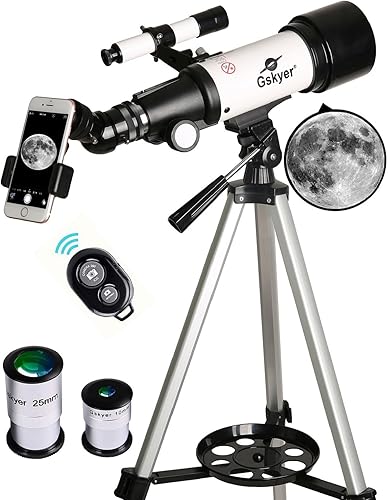
Gskyer Telescope: Best for portable phone capture
- 400 mm focal length
- 70 mm aperture
- Smartphone adapter and wireless remote
- Two eyepieces and 3X Barlow
The 400 mm refractor includes a phone adapter and wireless remote, giving beginners a straightforward way to frame and trigger Moon images. Its shorter focal length can show a wider lunar view than longer scopes.
Pros
- Phone adapter and wireless remote included
- Portable design with carry bag
- Two eyepieces and 3X Barlow
Cons
- 70 mm aperture
- 400 mm focal length
The Gskyer 70 mm refractor provides a phone adapter and wireless remote in a portable kit. Those accessories give you a way to frame and trigger a phone image without touching the screen during capture.
Its 400 mm focal length is shorter than the 800 mm and 900 mm traditional scopes here, so it can show more of the lunar disk in the frame. The two eyepieces and 3X Barlow give you options for visual magnification, while the manual alt-azimuth mount keeps operation straightforward.
This is a practical travel option for learning phone-through-eyepiece capture. The 70 mm aperture and shorter focal length make it less suited to tight close-ups than the 150 mm MEEZAA or 8-inch Celestron.
Celestron NexStar 8SE Computerized Telescope: Best for tracked lunar close-ups
- 2032 mm focal length
- 8-inch Schmidt-Cassegrain optics
- Computerized GoTo mount
- Tracks selected targets
The 2032 mm focal length and 8-inch aperture suit detailed lunar views, while the computerized mount locates and tracks a selected target. Confirm camera and adapter compatibility for your imaging setup.
Pros
- Long 2032 mm focal length
- 8-inch aperture
- Computerized target finding and tracking
Cons
- Camera adapter not specified among included items
- Long focal length makes framing a smaller section of the Moon more likely
The Celestron NexStar 8SE is the strongest traditional choice here for close lunar framing and automated tracking. Its 2032 mm focal length and 8-inch aperture are suited to detailed lunar views, while the GoTo mount can locate and track the target.
SkyAlign helps set up the mount by centering three bright stars or planets. The NexStar+ hand control provides access to a database of more than 40,000 objects, and the mount then slews to and follows the selected target.
The listed included items do not specify a camera adapter. Check that your camera and adapter fit the telescope before buying, especially if you plan to connect a dedicated astronomy camera.
For a closer look at Celestron options aimed at planetary viewing, see our best Celestron telescope for planets guide. Lunar photography shares some setup needs with planetary imaging, including focus, stable framing and camera fit.
Celestron AstroMaster 70AZ Refractor Telescope for Moon: Best for simple visual-to-phone practice
- 900 mm focal length
- 70 mm aperture
- 20 mm and 10 mm eyepieces
- Manual alt-azimuth mount
Its 900 mm focal length and straightforward manual mount support lunar observation before you add a camera setup. No phone adapter is specified, so verify how your camera will attach.
Pros
- 900 mm focal length
- Two eyepieces included
- Manual panhandle controls
Cons
- 70 mm aperture
- No phone adapter specified
The AstroMaster 70AZ is a simple manual refractor with a 900 mm focal length and two eyepieces. It can work as a visual Moon scope and a starting point for camera experiments, but its included accessories do not specify a phone adapter.
Its manual alt-azimuth mount uses a panhandle for pointing. That control is familiar for beginners, though you will need to move the telescope by hand to keep the Moon centered.
The 70 mm aperture and 900 mm focal length offer a different balance from the shorter Gskyer. Confirm camera attachment before choosing this model specifically for photography, then consider whether the longer focal length fits your camera's field of view.
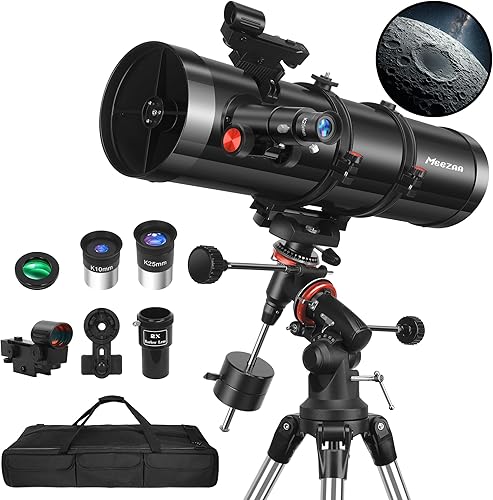
MEEZAA Telescope: Best for lunar imaging with a Moon filter
- 650 mm focal length
- 150 mm aperture
- Moon filter and phone adapter
- Equatorial mount with slow-motion controls
The 150 mm aperture, included Moon filter and phone adapter make this a strong fit for a first lunar imaging setup. The equatorial mount has slow-motion controls for manual tracking as the Moon moves across the sky.
Pros
- 150 mm aperture
- Moon filter and phone adapter included
- Equatorial mount with slow-motion controls
Cons
- Manual focus
- Maximum stated magnification is 130X
The MEEZAA 150EQ is the best all-around traditional pick for lunar photography in this group. Its 150 mm aperture, 650 mm focal length, Moon filter and phone adapter bring together the core parts many beginners want for Moon imaging.
The equatorial mount has precision dials and slow-motion controls for manual tracking. It also includes 25 mm and 10 mm eyepieces and a 2X Barlow, with a stated magnification range from 26X to 130X.
The moderate focal length can frame more of the lunar disk than a 2032 mm telescope, while the larger aperture is useful for gathering light. Its Moon filter can reduce glare for comfortable viewing, but frame and focus carefully for photos rather than relying on magnification alone.
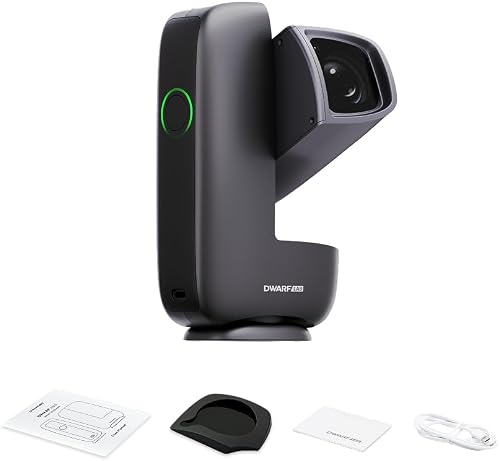
DWARFLAB Dwarf Mini Smart Telescope: Best for lightweight app-controlled captures
- 150 mm focal length
- 30 mm objective lens
- App control and Auto GOTO
- 360-degree pivot
This compact smart scope uses app control, Auto GOTO and tracking for digital sky imaging, and its feature set mentions lunar eclipse capture. Its 150 mm focal length and 30 mm objective lens favor a small, portable setup over close-up lunar framing.
Pros
- App control and Auto GOTO
- Lightweight portable design
- Lunar eclipse capture mentioned
Cons
- 150 mm focal length
- No phone adapter specified
The Dwarf Mini is a lightweight app-controlled scope with Auto GOTO, a 360-degree pivot and a 150 mm focal length. Its feature description includes capture of lunar eclipses, making it an option for portable digital sky imaging.
It has a 30 mm objective lens and app-based controls, but the provided feature list does not specify a phone adapter or a traditional eyepiece camera connection. The short focal length also favors a compact wide-field approach instead of close crater framing.
Choose it if portability and automated app operation matter more than traditional telescope-camera flexibility. For tight Moon views, compare its framing with the longer focal length models in this roundup.
DWARFLAB Dwarf 3 Smart Telescope: Best for portable dual-camera imaging
- Dual imaging system
- Auto tracking
- App-based processing
- Compact 3 lb design
The Dwarf 3 combines telephoto and wide-angle imaging with automatic tracking and app-based processing. Its compact smart design suits quick digital captures, though a traditional focal length and aperture pair is not specified here for planning close lunar framing.
Pros
- Dual imaging system
- Auto tracking
- Portable 3 lb design
Cons
- Traditional focal length not specified
- No camera adapter specified
The Dwarf 3 suits buyers who want a compact digital imaging device with two camera systems and automatic tracking. The telephoto lens handles distant subjects while the wide-angle lens is intended for broad sky scenes such as the Milky Way and star trails.
Its compact body and app-based image processing can make capture easier to start. However, the listed facts do not specify a traditional focal length or aperture pair, so it is harder to predict lunar framing against conventional telescope optics.
Choose it for portable, app-based imaging across day and night subjects. If your main goal is detailed lunar close-ups, compare the specified focal lengths and camera connection on the traditional telescopes first.
How should focal length and aperture shape a Moon setup?
Focal length controls image scale, while aperture influences how much light the telescope gathers and its potential to show fine detail. A longer focal length can make the Moon fill more of the sensor, but may crop the whole disk.
The range here runs from the 150 mm smart telescopes to the 2032 mm NexStar 8SE. Traditional options like the 650 mm MEEZAA and 800 mm MEEZAA sit between those extremes.
Aperture matters alongside focal length. The 150 mm MEEZAA and 8-inch Celestron gather more light than the 70 mm refractors, but usable detail also depends on focus, atmospheric steadiness, camera sampling and mount stability.
For a tighter field and long focal length, compare the best high power telescope choices. High magnification is not automatically better for photos, since a dimmer, cropped image can be harder to focus and keep steady.
How do you connect a camera to a telescope?
A smartphone adapter holds a phone camera in line with an eyepiece, while a dedicated astronomy camera connects through a compatible adapter and capture setup. Match the camera sensor and adapter to the telescope before deciding how much focal length you need.
The MEEZAA 90 mm refractor, Gskyer and MEEZAA 150EQ include phone adapters. The smart telescopes use app-based imaging instead, while the Celestron and AstroMaster included accessories do not specify a phone adapter.
Start with the simplest camera path you can use consistently. A phone adapter is convenient, but alignment and focus still matter; a dedicated astronomy camera can offer a more specialized workflow if the telescope supports the needed connection.
What mount features help lunar photography?
A stable mount and easy controls help you keep the Moon in the frame while focusing and capturing. Tracking can reduce the need to recenter manually, while a manual mount can be adequate for short captures.
The Seestar S30 Pro and Dwarf Mini offer app-based automated tracking. The NexStar 8SE uses a computerized GoTo mount, and the MEEZAA 150EQ offers an equatorial mount with slow-motion controls.
Manual alt-azimuth models like the Gskyer and AstroMaster use direct pointing. If you choose one, make small adjustments and use a remote or timer when available to reduce movement during the exposure.
Which telescope should you choose for lunar photography?
Choose the MEEZAA 150EQ if you want a larger aperture, Moon filter, phone adapter and manual tracking controls in one traditional setup. Choose the Celestron NexStar 8SE if long focal length, an 8-inch aperture and computerized target tracking matter most.
For app-led capture, choose the Seestar S30 Pro with the understanding that ZWO says it is not intended for planetary observation. For a simple phone setup, compare the included adapter and focal length on the Gskyer and 800 mm MEEZAA.
The best telescope for lunar photography is the one that matches the framing and camera connection you can use. Confirm adapter fit, then choose a focal length that suits full-disk images or closer lunar detail.
Our top 3 picks at a glance
-
1
Best for app-based lunar capture
ZWO Seestar S30 Pro Smart Telescope
9.7/10 our score
See it on Amazon -
2
Best for a child's first Moon photos
Blue Marble NASA Lunar Telescope for Kids Ages
9.6/10 our score
See it on Amazon -
3
Frequently asked questions
What focal length is best for lunar photography?
A longer focal length makes the Moon appear larger in the camera frame, while a shorter focal length can fit more of the lunar disk. Scopes in this roundup range from 150 mm to 2032 mm, so choose based on whether you want the whole Moon or close views of craters.
Check your camera sensor and adapter too, since framing depends on the full imaging setup.
Can I photograph the Moon with a smartphone?
Yes. A smartphone can record the Moon through a telescope when the phone camera lines up with the eyepiece.
The MEEZAA 90 mm refractor and Gskyer include phone adapters, while the MEEZAA 150EQ includes one as well.
A steady mount and careful focus help reduce blur.
Do I need tracking for Moon photos?
Tracking can keep the Moon in the frame while you adjust focus or capture a sequence, but it's not essential for every single image. A manual mount can work for brief captures if you recenter the Moon as it moves.
For longer imaging sessions, compare mount control and camera compatibility before choosing a telescope.
What camera works with a telescope for lunar photography?
A smartphone is an accessible starting point if the telescope supports a phone adapter. Dedicated astronomy cameras offer a different capture workflow, so check the camera's sensor, connection and adapter fit against the telescope before buying.
Our guide to astronomy cameras for telescopes explains the main choices.


