9 Best Telescopes with a Wide Field of View (November 2026)
The best telescopes with a wide field of view include the ZWO Seestar S30 Pro Smart Telescope for wide-field astrophotography, the Celestron AstroMaster 130EQ Telescope for Deep-Sky Beginners for manual deep-sky viewing, and the Blue Marble NASA Lunar Telescope for Kids Ages for introducing kids to the Moon.
On this page (5 sections)
The best telescope with a wide field of view for imaging is the ZWO Seestar S30 Pro, with a stated 4.6-degree field, automatic tracking and mosaic stitching. For manual telescope viewing, the Celestron StarSense Explorer LT 114AZ combines a 2.04-degree field with smartphone-guided target finding.
A wide view helps keep a large star cluster or extended nebula inside the eyepiece at once. Aperture still matters: a wide field frames more sky, while a larger objective or mirror gathers more light.
Our picks at a glance
-
1
 Best for wide-field astrophotography
ZWO Seestar S30 Pro Smart Telescope
9.7/10 our score
See it on Amazon -
2
 Best for manual deep-sky viewing
Celestron AstroMaster 130EQ Telescope for Deep-Sky Beginners
9.7/10 our score
See it on Amazon -
3
 Best for introducing kids to the Moon
Blue Marble NASA Lunar Telescope for Kids Ages
9.6/10 our score
See it on Amazon
- 4
 Best for portable beginner viewingCheck it
- 5
 Check it
Celestron StarSense Explorer LT 114AZ Newtonian Smartphone
Best for guided manual observing - 6
 Check it
CELTICBIRD Telescope for Adults High Powered
Best for a portable refractor setup - 7
 Check it
WOSPORTS Telescope for Adults High Powered
Best for a larger refractor aperture - 8
 Check it
Pankoo Monocular Telescope High Power 16X52
Best for handheld wide-area scanning - 9
 Check it
ASxmhGo Monocular-Telescope 80x100 High Powered Monoculars High
Best for compact daytime spotting
Which wide field of view telescope fits your observing style?
The Seestar is the strongest match for wide-field imaging, while the StarSense and CELTICBIRD offer manual telescope viewing with relatively broad stated fields. Choose a handheld monocular only for broad-area spotting, not deep-sky astronomy.
ZWO Seestar S30 Pro Smart Telescope: Best for wide-field astrophotography
- 4.6-degree field of view
- Automatic GoTo targeting and tracking
- Automatic mosaic stitching
- 3.64 lb
The widest stated field in this roundup pairs with automatic tracking and imaging modes for star fields, nebulae and galaxies. It is designed for deep-sky imaging, not planetary observation.
Pros
- Widest stated field here
- Automatic targeting and tracking
- Mosaic stitching for wide-field imaging
Cons
- Designed for imaging rather than planetary viewing
- Requires a stationary setup for deep-sky imaging
The Seestar S30 Pro is the clearest choice when your goal is capturing wide star fields and extended deep-sky targets. Its 4.6-degree field of view is the widest stated figure among the conventional telescopes here, and automatic GoTo targeting and tracking reduce the work of finding and following an object.
Its imaging modes cover deep-sky objects, the Moon and the Sun, with automatic mosaic stitching for wide-field images. The design is intended for deep-sky imaging rather than planetary observation, so pick another scope if close views of Saturn or Jupiter are your priority.
At 3.64 lb, this is a compact setup for travel or a balcony. The app-based approach also makes it distinct from a telescope where you look through an eyepiece to observe.
Choose it if you want a guided imaging workflow for nebulae, galaxies and sky landscapes. For city observing, see our guide to best telescope for light pollution and our overview of whether telescopes work in the city.
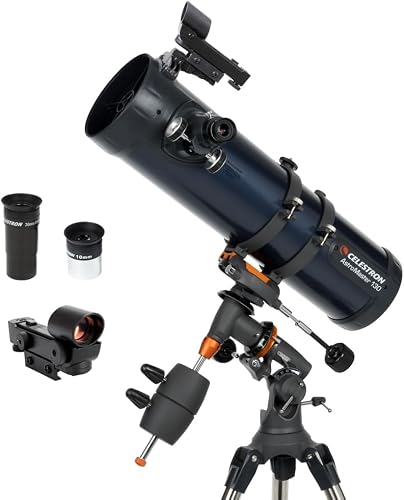
Celestron AstroMaster 130EQ Telescope for Deep-Sky Beginners: Best for manual deep-sky viewing
- 130mm Newtonian reflector
- 0.67-degree field of view
- Equatorial mount with slow-motion controls
- 20mm and 10mm eyepieces
A 130mm mirror gathers light for deep-sky observing, while the equatorial mount's slow-motion knobs help center and follow targets. Its stated field is narrower than the smart imaging pick.
Pros
- 130mm mirror for deep-sky viewing
- Slow-motion controls in right ascension and declination
- Two eyepieces included
Cons
- Narrower stated field than several picks here
- Manual aiming and tracking
The AstroMaster 130EQ is a manual reflector for buyers who want a conventional eyepiece view and enough aperture for deep-sky observing. Its 130mm mirror gathers more light than the smaller refractors here, though its stated field of view is 0.67 degrees.
The equatorial mount has slow-motion controls for right ascension and declination. Those controls help you center a target and follow it as the sky moves, but you still aim the scope yourself.
The included 20mm and 10mm eyepieces give two viewing powers. The 20mm is the better starting point for framing a larger target; the shorter eyepiece trades field width for higher magnification.
Choose this model if aperture and manual deep-sky viewing matter more than a very wide frame. Compare it with our best telescope for deep sky objects recommendations.
Blue Marble NASA Lunar Telescope for Kids Ages: Best for introducing kids to the Moon
- 0.85-degree field of view
- Low- and high-power eyepieces
- Tabletop tripod
- Designed for ages 8 and up
This beginner telescope is aimed at lunar viewing, with a tabletop tripod and two eyepieces for scanning the Moon and viewing it at higher power. Its field is modest, so it is not a wide-sky instrument.
Pros
- Simple lunar focus for young beginners
- Two eyepieces for low and high power
- Tabletop tripod
Cons
- Best suited to the Moon, not extended deep-sky targets
- Smaller field than several picks here
The Blue Marble NASA Lunar Telescope is built around a simple goal: helping a young beginner find and explore the Moon. Its stated 0.85-degree field is not especially wide for sweeping star fields, but the two eyepieces offer low- and high-power lunar views.
A tabletop tripod and smooth mount make it easier to scan across the lunar surface. The telescope is described for ages 8 and up, so it fits a child and adult observing together better than someone seeking faint deep-sky targets.
Use the low-power eyepiece first to find the Moon, then switch to the high-power one to inspect craters. That same change in magnification narrows the amount of sky visible.
Choose it as an introductory lunar telescope, not as a wide-field nebula instrument. If planetary detail is the priority, our guide to the best telescope to see Saturn's rings covers a different observing goal.
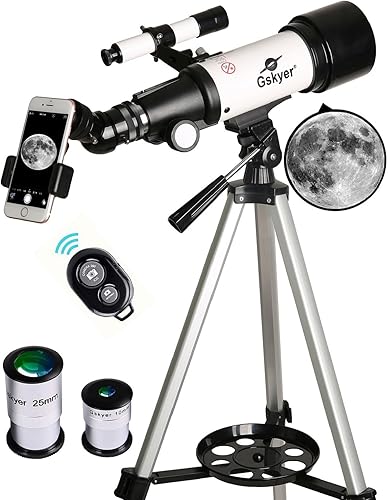
Gskyer Telescope: Best for portable beginner viewing
- 70mm aperture
- 400mm focal length
- Adjustable tripod and carry bag
- Phone adapter and wireless remote
The short 400mm focal length and portable carry bag suit a beginner who wants a compact setup for the Moon and planets. The stated field figure is unusually large, so confirm what view you can expect from the supplied eyepieces.
Pros
- Compact, travel-ready format
- Adjustable tripod and carry bag
- Phone adapter and wireless remote
Cons
- Stated field figure needs clarification before comparing
- Better suited to lunar and planetary viewing than extended deep-sky targets
The Gskyer 70mm refractor is a portable beginner option with a 400mm focal length, adjustable tripod and carry bag. Its field-of-view specification is 175 degrees, a figure that is unusually large for an astronomical telescope and should be confirmed before treating it as a usable eyepiece field.
It includes two replaceable eyepieces, a 3x Barlow lens, a phone adapter and a wireless camera remote. The maker describes it as suited to lunar and planetary viewing, which is a better-supported use than assuming it frames large nebulae.
The short 400mm focal length can support a wider view than a longer telescope when used with comparable eyepieces. Actual true field depends on the eyepiece and the telescope's optical design.
Choose it for a compact beginner setup with phone-photo accessories, and check the field expectation before buying it specifically for deep-sky framing.
Celestron StarSense Explorer LT 114AZ Newtonian Smartphone: Best for guided manual observing
- 2.04-degree field of view
- 114mm Newtonian reflector
- Smartphone sky recognition
- Manual altazimuth mount
A relatively broad stated field and 114mm mirror make this a flexible manual scope for clusters and bright deep-sky targets. Its phone-guided system helps locate objects without motorized tracking.
Pros
- Broad stated field for a manual telescope
- Phone app guides target finding
- 114mm reflector
Cons
- Manual mount requires you to move the telescope
- Field is narrower than the Seestar's stated 4.6 degrees
The StarSense Explorer LT 114AZ offers a 2.04-degree field of view with a 114mm Newtonian reflector, making it a practical manual choice for larger clusters and bright nebulae. Its smartphone app uses sky recognition and on-screen arrows to help you locate targets.
This is an altazimuth telescope with a manual mount, not motorized tracking. Once you find an object, you move the telescope to keep it in view.
The 25mm eyepiece is the better starting point for a broad frame, while the 10mm eyepiece shows a smaller section of sky at higher power. The 114mm mirror gives it a different light-gathering role from small travel refractors.
Choose it when you want to observe through an eyepiece and need help finding targets. For smaller observing spaces, see our guide to the best telescope for balcony observing.
CELTICBIRD Telescope for Adults High Powered: Best for a portable refractor setup
- 80mm aperture
- 600mm focal length
- 3.4-degree field of view
- Backpack and adjustable tripod
The stated 3.4-degree field is among the widest in this selection, and the 80mm refractor comes with a backpack and adjustable tripod. It can suit broad star fields, though its 600mm focal length gives a different view than a short-focus imaging telescope.
Pros
- Wide stated field
- 80mm aperture
- Backpack for carrying the setup
Cons
- Eyepieces supplied are aimed at 30x and 66x
- Manual mount needs frequent adjustment
The CELTICBIRD refractor has a stated 3.4-degree field, the broadest listed angle among the manual telescopes in this roundup. Its 80mm aperture and 600mm focal length place it between compact beginner scopes and larger, more specialized instruments.
The package includes 20mm and 9mm eyepieces, a phone adapter, moon filter, adjustable tripod and backpack. The 20mm eyepiece is the sensible choice for larger views, while the 9mm gives more magnification and a narrower frame.
The supplied accessories make it convenient to carry, but the manual altazimuth mount still needs small adjustments as an object drifts. Use the low-power view for clusters and broad star fields rather than expecting the same imaging workflow as the Seestar.
Choose it if you want a portable refractor with a relatively wide stated field for visual use.
WOSPORTS Telescope for Adults High Powered: Best for a larger refractor aperture
- 90mm aperture
- 600mm focal length
- 1.99-degree field of view
- 25mm and 10mm eyepieces
The 90mm refractor has a stated field close to 2 degrees and includes two eyepieces. It trades some field width for a larger aperture than the 80mm refractor in this roundup.
Pros
- Largest refractor aperture in this selection
- Two eyepieces and a 3x Barlow lens
- Adjustable tripod and carrying case
Cons
- Field is narrower than the 80mm CELTICBIRD's stated field
- Barlow magnification narrows the view
The WOSPORTS 90mm refractor gives you a larger aperture than the CELTICBIRD, paired with a 1.99-degree stated field. That is broad enough for many bright clusters, though it frames less sky than the 80mm model's stated 3.4 degrees.
Its 600mm focal length comes with 25mm and 10mm eyepieces and a 3x Barlow lens. Start with the 25mm eyepiece for a larger frame; adding the Barlow increases magnification and makes the visible field smaller.
The adjustable tripod and carrying case support transport between observing locations. The phone adapter is an accessory for capturing images, while the telescope itself remains a manually aimed refractor.
Choose it if you prefer a larger refractor aperture and accept a narrower field than the broadest options here.
Pankoo Monocular Telescope High Power 16X52: Best for handheld wide-area scanning
- 5.8-degree field of view
- 16x magnification
- 52mm objective lens
- Handheld monocular
Its stated 5.8-degree field is the broadest figure in this list, but this is a handheld monocular rather than an astronomy telescope. It can help scan a large area, though it is not a substitute for a mounted telescope when viewing faint nebulae.
Pros
- Broad stated field for quick scanning
- Compact handheld design
- 52mm objective lens
Cons
- Not a mounted astronomical telescope
- 16x handheld magnification can make steady viewing harder
The Pankoo 16x52 is a handheld monocular with a stated 5.8-degree field, wider than the listed telescope fields. That makes it useful for scanning a large area, but its handheld format and 16x magnification do not make it a practical substitute for a telescope aimed at faint nebulae.
Its 52mm objective and BAK4 prism are intended for outdoor viewing. You can carry it without a tripod, although holding any 16x optic steady for a long look can be difficult.
This pick makes sense for a quick look at a broad star field or for daytime wildlife and landscape use. For serious astronomy, choose a mounted telescope with suitable aperture and an eyepiece that gives the field you need.
ASxmhGo Monocular-Telescope 80x100 High Powered Monoculars High: Best for compact daytime spotting
- Handheld monocular format
- Smartphone adapter
- Waterproof and fogproof design
- Wide field described by the brand
This compact monocular is described as having a broad field for locating moving targets, but no field angle is stated. It is an outdoor spotting option, not a telescope pick for observing extended nebulae.
Pros
- Compact one-hand design
- Smartphone adapter included
- Sealed waterproof and fogproof structure
Cons
- No field angle is stated
- Not a mounted astronomy telescope
The ASxmhGo monocular is a compact outdoor spotter, and its description calls the view wide without giving a field angle. That missing number means you cannot compare its actual sky coverage with the stated fields of the other products.
It has a 10cm objective, a smartphone adapter and a sealed waterproof and fogproof structure. The maker also describes it as lightweight and easy to hold, which supports daytime travel use.
Treat it as a portable spotting tool rather than a telescope recommendation for extended nebulae or star clusters. Choose a mounted astronomy telescope when your priority is a stable view of faint targets.
How to choose a telescope with a wide field of view
A wide field depends on the telescope, eyepiece and magnification working together. Compare field angles only when the figures refer to a similar setup, and remember that a wider view does not automatically mean a brighter view.
For visual observing, a longer focal-length eyepiece usually shows more sky than a shorter one in the same telescope. Higher magnification makes the field narrower, so start with the lowest practical power when framing a large cluster.
A larger aperture gathers more light, which can help with faint targets, but optical design also affects the view near the edge. Curved star shapes toward the edges may relate to field curvature; learn what field curvature in telescope optics means.
A field flattener can reduce edge distortion in some telescope and camera setups, especially for imaging across a large sensor. Our guide explains what a field flattener for a telescope does.
For eyepiece observing, consider the eyepiece's apparent field as well as the telescope's focal length and magnification. See our guide to wide-angle telescope eyepieces before choosing an accessory to broaden the view.
What is a wide field of view useful for?
A wide view is most useful when the target is physically large in the sky or when you want context around it. It can frame star clusters, broad nebulae and Milky Way regions without requiring multiple separate views.
A wide frame also makes it easier to locate a target because more of the surrounding star pattern remains visible. This can help beginners, though phone-guided finding systems and a finder scope can also make target acquisition easier.
A small target such as Saturn's rings calls for more magnification and a narrower field. A scope chosen for large sky vistas may not be the best single choice for close planetary views.
How do light pollution and location affect wide-field observing?
Light pollution can wash out faint extended objects, even when a telescope shows a large patch of sky. A wide field helps with framing, but it cannot restore contrast lost to bright skies.
From a city or balcony, prioritize bright clusters and objects that suit your aperture and sky conditions. You can read more about telescopes under light pollution and observing from city skies.
For balcony use, also check that the tripod fits the available floor space and that you can aim safely without obstruction. The best telescope for balcony observing guide focuses on those practical limits.
Which wide field telescope should you choose?
Choose the ZWO Seestar S30 Pro if you want a broad field for automated deep-sky imaging, or the StarSense Explorer LT 114AZ if you want manual eyepiece views with guided target finding. Pick the CELTICBIRD for a portable refractor with a broad stated field, and avoid relying on unusually large or unstated field figures without confirming them.
For faint extended targets, compare aperture and sky brightness alongside field width. A telescope that frames more sky is useful only if the target remains visible from your location.
| Product | Best for | Field of view | Use | Weight | Our score |
|---|---|---|---|---|---|
| ZWO Seestar S30 Pro Smart Telescope | wide-field astrophotography | 4.6 degrees | Deep-sky and wide-field imaging | 3.64 lb | 9.7 |
| Celestron AstroMaster 130EQ Telescope for Deep-Sky Beginners | manual deep-sky viewing | 0.67 degrees | 9.7 | ||
| Blue Marble NASA Lunar Telescope for Kids Ages | introducing kids to the Moon | 0.85 degrees | 9.6 | ||
| Gskyer Telescope | portable beginner viewing | 9.5 | |||
| Celestron StarSense Explorer LT 114AZ Newtonian Smartphone | guided manual observing | 2.04 degrees | 9.3 | ||
| CELTICBIRD Telescope for Adults High Powered | a portable refractor setup | 3.4 degrees | 8.9 | ||
| WOSPORTS Telescope for Adults High Powered | a larger refractor aperture | 1.99 degrees | 8.6 | ||
| Pankoo Monocular Telescope High Power 16X52 | handheld wide-area scanning | 5.8 degrees | 9.2 | ||
| ASxmhGo Monocular-Telescope 80x100 High Powered Monoculars High | compact daytime spotting | 9.1 |
faq:
- q: "What is a wide field of view in a telescope?" a: "A wide field of view shows a larger area of sky at once. It helps frame big star clusters, extended nebulae and star fields, but the visible angle depends on the telescope and eyepiece together.\n\nFor visual use, lower magnification usually gives a wider true field."
- q: "Which telescope in this roundup has the widest stated field?" a: "The Pankoo monocular has the widest stated figure at 5.8 degrees, but it is handheld outdoor gear rather than an astronomy telescope. Among the telescopes, the ZWO Seestar S30 Pro states 4.6 degrees and is designed for wide-field imaging.\n\nCheck unusual figures before comparing products."
- q: "Does a wider field make a telescope better for nebulae?" a: "A wider field helps fit a large nebula into one view, but it does not guarantee the nebula will look bright. Aperture, sky darkness, optical quality and the target's apparent size also affect what you can see.\n\nFor faint objects, balance field width with light gathering and observing conditions."
- q: "Can I make my telescope's field of view wider?" a: "A longer focal-length eyepiece can widen the true field in a given telescope, as long as the eyepiece is compatible. A wide-angle eyepiece can also show a larger apparent field, but changing eyepieces does not change the telescope's aperture.\n\nUse the lowest practical magnification for large targets."
Our top 3 picks at a glance
-
1
Best for wide-field astrophotography
ZWO Seestar S30 Pro Smart Telescope
9.7/10 our score
See it on Amazon -
2
Best for manual deep-sky viewing
Celestron AstroMaster 130EQ Telescope for Deep-Sky Beginners
9.7/10 our score
See it on Amazon -
3
Best for introducing kids to the Moon
Blue Marble NASA Lunar Telescope for Kids Ages
9.6/10 our score
See it on Amazon