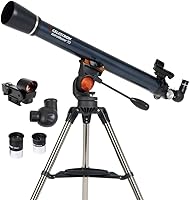
What Is Field Curvature in Telescope Optics?
On this page (3 sections)
Field curvature in telescope optics is a common optical defect where the focal plane of a lens or mirror system is not flat, causing stars near the edge of your view to appear blurry. For more on this topic, see our guide to telescope field flatteners. Instead of a sharp, clear image across your entire field of view, you might see a curve where the focus naturally falls. This happens because different parts of the lens or mirror bend light slightly differently, leading to a curved focal surface rather than a flat one, affecting the sharpness of stars at the edges.
Understanding field curvature helps you appreciate why some telescopes perform better than others. It’s a challenge that lens designers work hard to minimize, especially in wide-field instruments like those used for astrophotography. While it’s a natural consequence of how lenses bend light, advanced designs and accessories can help correct for this, leading to flatter, sharper images across your entire view. You’ll often hear it discussed when people talk about telescope performance and image quality.
- Field curvature means your telescope’s focus isn’t flat.
- Stars at the edge of your view can look blurry.
- This happens because different parts of the lens bend light differently.
- Good telescope designs try to reduce this effect.
- Correctors and flatteners can help fix it for sharper images.
Let’s dive into what causes this optical quirk and what you can do about it if you notice it with your telescope.
Understanding Why Your Telescope Images Might Curve
Have you ever looked at stars at the edge of your telescope’s view and noticed they weren’t quite as sharp as those in the center? This common optical quirk is called field curvature. It’s not a sign of a broken telescope, but rather a natural characteristic of how lenses and mirrors bend light to form an image. Understanding it helps you appreciate the design of your telescope and what to expect.
Essentially, field curvature means the focal plane – the surface where light rays converge to form a sharp image – isn’t perfectly flat. Instead, it’s shaped like a shallow bowl or curve. This curve causes stars near the edge of your view to come into focus either before or after the stars in the center. It’s a challenge optical designers work to minimize, especially for telescopes intended for wide-field viewing or astrophotography.
How Light Bending Creates a Curved Focus
Lenses and mirrors in telescopes are designed to bend light rays so they meet at a single point, forming a clear image. However, achieving this perfectly across an entire, flat plane is incredibly difficult. Different parts of a lens or mirror might refract or reflect light slightly differently. Light rays passing through the edges of a lens, for instance, might bend at a slightly different angle than those passing through the center.
Imagine a simple lens. Light rays hitting the center are bent along the optical axis. Rays hitting further out are bent at different angles. When these rays are gathered and brought to focus, they naturally form a curved surface. Think of it like water flowing down a hill; it naturally collects in the lowest points, forming a pool rather than a perfectly flat surface.
Refracting telescopes, which use lenses, are often more susceptible to field curvature than reflecting telescopes, which use mirrors. This is because light has to pass through the glass, and the way glass bends light can introduce this effect. Reflecting telescopes use mirrors, which can be shaped to reduce curvature more effectively.
When Field Curvature Becomes Noticeable
You’re most likely to notice field curvature when you’re observing objects with a wide field of view. This means using low-power eyepieces or observing areas of the sky that contain many stars, like nebulae or star clusters. If you focus on stars in the very center of your view and they appear sharp, but then you look at stars towards the edge and they seem fuzzy or elongated, you’re likely seeing field curvature.
Astrophotographers are particularly sensitive to this. When taking long-exposure images, they need the entire sensor to be in focus to capture fine detail across the whole frame. If the focal plane curves away from the sensor, stars at the edges will appear out of focus, leading to blurry images. This is why field curvature is a major consideration when choosing a telescope for serious astrophotography.
Comparing Different Telescope Types and Field Curvature
The design of your telescope plays a big role in how much field curvature you’ll experience. Different types of optical designs tackle this issue in various ways.
Refracting Telescopes (Apochromats vs. Achromats)
In refractors, the amount of field curvature often depends on the type of objective lens. Achromatic doublets use two lens elements. While they correct for chromatic aberration (color fringing), they can still exhibit noticeable field curvature. For more on this topic, see our guide to telescope aberrations. Apochromatic (APO) triplets use three lens elements, often with special glass types, to provide better correction for both chromatic aberration and field curvature. APO refractors generally offer flatter fields than achromats.
Reflecting Telescopes (Newtonians vs. Cassegrains)
Reflecting telescopes, like Newtonians and Cassegrains, use mirrors. Mirrors don’t suffer from the same chromatic aberration issues as lenses, but they can still have field curvature. Newtonian reflectors, especially those with faster focal ratios (e.g., f/4 or f/5), can show field curvature. However, many modern Newtonian designs and coma correctors help flatten the field. Cassegrain designs, like Schmidt-Cassegrains and Maksutov-Cassegrains, often have longer focal ratios and can exhibit less field curvature than fast Newtonians.
Catadioptric Telescopes (Schmidt-Cassegrains, Maksutov-Cassegrains)
These hybrid designs use both mirrors and lenses. The corrector plate in a Schmidt telescope, for example, is shaped to correct aberrations and often helps flatten the field. Maksutov-Cassegrains use a thick meniscus lens, which can also contribute to a relatively flat field of view, especially compared to some faster Newtonian designs. However, even these aren’t perfectly flat across the board.
What Affects the Degree of Field Curvature?
Several factors influence how pronounced field curvature is in a telescope’s image.
Focal Ratio (f-number)
The focal ratio, indicated by an f-number (like f/5 or f/10), is the telescope’s focal length divided by its aperture diameter. Telescopes with faster focal ratios (lower f-numbers, e.g., f/4, f/5) tend to exhibit more field curvature and other aberrations like coma. Telescopes with slower focal ratios (higher f-numbers, e.g., f/8, f/10, f/12) generally have flatter fields of view and less pronounced aberrations.
Optical Design and Quality
The specific arrangement of lenses and mirrors, the quality of the glass or mirror surfaces, and the coatings used all impact field curvature. High-end optical designs often incorporate special lens elements or precisely shaped mirrors to minimize this effect. The precision of manufacturing is a key factor; even small imperfections can increase field curvature.
Aperture and Field of View
While not a direct cause, the aperture (the diameter of the main lens or mirror) influences the potential field of view. Larger apertures, especially when paired with shorter focal lengths (fast f-ratios), can produce a wider field of view where curvature becomes more apparent. The larger the objective, the more light-gathering power, and often, the wider the potential view you can achieve.
Can Field Curvature Be Corrected?
The good news is that while field curvature is a natural phenomenon, there are ways to manage and correct for it. Optical designers aim to reduce it in the telescope itself, but accessories can also help significantly.
Field Flattener Lenses
For astrophotography, a field flattener is a very common accessory. It’s a lens placed in the light path, usually near the focuser. This lens is designed to counteract the inherent curvature of the telescope’s focal plane, effectively making the field flatter. They are crucial for achieving sharp stars across your entire camera sensor.
Coma Correctors (Often Address Field Curvature Too)
In fast Newtonian telescopes, coma is often a more dominant aberration than field curvature. A coma corrector is an optical device that corrects for coma. Many coma correctors also have the beneficial side effect of flattening the field of view. So, if you have a fast Newtonian, a coma corrector can address two issues at once.
Choosing the Right Eyepieces
While eyepieces themselves don’t “correct” field curvature, the type you use can influence how you perceive it. Some eyepieces are designed to provide a wide apparent field of view, which can sometimes make curvature seem more pronounced. Others have internal elements that help to minimize aberrations, though they don’t eliminate the fundamental field curvature of the telescope optics themselves. It’s often a balancing act between field of view and edge sharpness.
Is Field Curvature a Dealbreaker?
For visual observers, especially those not looking for pinpoint sharpness at the extreme edges of their view, field curvature is often a minor issue. Many astronomers are perfectly happy with the sharp view in the center and don’t mind a slight softening at the edges. The overall brightness and detail in the center of the field are often more important for casual observation.
Conclusion
You’ve learned that field curvature is a natural optical characteristic where the focal plane isn’t flat. This means stars at the edge of your view might appear blurry while those in the center are sharp. While refractors and fast Newtonians may show it more, even other designs experience it to some degree. For visual observing, it’s often not a major concern. But for astrophotography, accessories like field flatteners or coma correctors are essential for crisp, edge-to-edge images. When choosing your next telescope, consider how much this factor matters for your observing goals and budget.
Frequently Asked Questions
Does every telescope have field curvature?
Most telescopes experience some degree of field curvature. It’s a consequence of how lenses and mirrors bend light. The amount varies greatly depending on the telescope’s optical design, focal ratio, and manufacturing precision. Some designs are specifically made to minimize it.
Can I fix field curvature with my eyepiece?
Eyepieces can affect how you perceive field curvature, but they don’t correct it. Some eyepieces offer wide fields that might make curvature more apparent. Others have internal corrections for aberrations, but the fundamental curvature comes from the telescope’s main optics, not the eyepiece itself.
Is field curvature worse on cheaper telescopes?
While more expensive telescopes generally have better optical correction, field curvature isn’t solely tied to price. A fast focal ratio on any telescope, regardless of cost, can exacerbate field curvature. Well-designed, even budget-friendly, telescopes can offer relatively flat fields compared to poorly designed, expensive ones.
How does focal ratio relate to field curvature?
Telescopes with lower f-numbers (faster focal ratios, like f/4 or f/5) tend to show more field curvature. This is because the light rays converge more steeply. Telescopes with higher f-numbers (slower focal ratios, like f/8 or f/10) typically have flatter focal planes and less noticeable curvature.
Is field curvature more noticeable during the day or night?
Field curvature is generally more noticeable when observing distant, point-like sources of light, such as stars at night. While the principle applies to daytime objects, the context of sharp star points at the edge of a wide celestial field makes it a more prominent issue in astronomy.