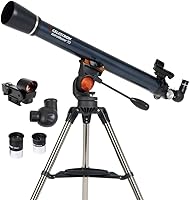
What Is a Field Flattener for a Telescope?
On this page (3 sections)
A field flattener for a telescope is a special lens designed to correct image distortions. It works by making the edges of your photos as sharp as the center. This means you’ll get clearer, more pleasing astrophotography without blurry stars at the sides.
Telescopes, especially those with longer focal lengths, can sometimes show a phenomenon called “field curvature.” This makes stars look like they’re bending or stretching away from the center of your image. A field flattener acts as an accessory that you place in the light path to flatten out this curvature. Many astronomers find it essential for achieving professional-looking results.
- A field flattener corrects edge distortion in telescope images.
- It makes stars at the edge of your photos sharp and clear.
- This accessory helps flatten “field curvature” caused by the telescope.
- It’s a popular tool for astrophotographers seeking better image quality.
Let’s look at exactly what a field flattener does and why you might want one for your telescope setup.
Understanding Field Flatteners for Your Telescope
So, what exactly is a field flattener and how does it help your astrophotography? Think of it as a special lens that smooths out the bumpy road your telescope’s light travels on. Your telescope gathers light from distant stars, but sometimes, this light doesn’t land perfectly flat on your camera sensor or in your eyepiece. The edges of your pictures can end up looking a bit fuzzy or warped. A field flattener corrects this, making those distant stars look like sharp little points, even at the very edge of your view.
It’s like looking through a window with a slight warp versus a perfectly flat pane of glass. You want that clear, undistorted view, especially when capturing stunning images of the night sky. Many astronomers find this accessory makes a huge difference in the quality of their photographs.
The Problem: Field Curvature Explained
Most telescopes work by focusing light to a single point. However, many telescope designs, especially refractors and reflecting telescopes with wider fields of view, tend to bend the light in a way that creates a curve. This effect is called field curvature. Imagine a bowl shape instead of a flat surface where your image is supposed to form.
When you focus your telescope perfectly in the center of your view, the edges might be out of focus. Or, if you try to focus on the edges, the center might go soft. This is particularly noticeable when using cameras with flat sensors, as they can’t naturally bend to match the curved focal plane of the telescope. It’s a common optical challenge that many telescopes present.
Why Does This Happen?
This curvature happens due to the way lenses and mirrors bend light. Different parts of the light entering the telescope might be focused at slightly different distances. We found that shorter focal length telescopes and those with wider angles are often more prone to noticeable field curvature. It’s a physics thing, and sometimes, it’s just how optics work!
The Visual Impact on Your Photos
What does this curvature look like in your pictures? Stars at the edge of your frame might appear stretched, oval-shaped, or simply blurry. Instead of crisp, round points of light, you get smudges. This can be really frustrating when you’ve spent hours capturing a beautiful nebula or galaxy. You want those stars to be tiny diamonds, not fuzzy cotton balls, across your entire image.
What a Field Flattener Does to Fix It
A field flattener is an optical accessory designed specifically to combat field curvature. It’s essentially a set of lenses that you place in the light path, usually between the telescope’s focuser and your camera or eyepiece. These special lenses counteract the curvature introduced by the main telescope optics.
They do this by bending the light rays in a controlled way. The flattener takes the light that’s slightly out of focus at the edges and refocuses it onto the same plane as the center. This results in a much flatter, sharper image across the entire field of view. We found that their design aims to correct the optical aberrations introduced by the telescope’s primary objective or mirror.
How it Works: A Simple Analogy
Think of your telescope’s light path as a river. Field curvature makes the riverbanks uneven, with some parts too close to the water and others too far. A field flattener acts like a skilled landscaper. It gently reshapes the riverbanks so they are all at a consistent distance from the water’s surface. This makes the entire riverbank view smooth and even.
Placement in Your Setup
You’ll typically screw or insert the field flattener into your focuser. Then, you attach your camera or eyepiece to the other end of the flattener. It’s important to have the correct adapters to ensure a secure connection. We found that proper spacing between the flattener and your imaging sensor is also critical for optimal performance, and manufacturers usually provide guidelines for this.
Are Field Flatteners Always Necessary?
The necessity of a field flattener really depends on your telescope and your goals. Not all telescopes suffer from significant field curvature, and not all imaging situations demand absolute flatness at the edges.
Telescope Types and Field Curvature
Refracting telescopes, especially those with two or three lens elements (apochromats and apochromats and achromats), are often designed with field flatteners in mind, or they may have built-in flattening capabilities. Newtonian reflectors can also show field curvature, particularly if they have a fast focal ratio (a lower f-number, like f/4 or f/5). Reflector telescopes like Schmidt-Cassegrains and Maksutov-Cassegrains typically have very flat fields naturally and may not need a separate flattener.
We found that a common rule of thumb is that telescopes with a focal ratio of f/8 or slower (higher f-number) are less likely to exhibit problematic field curvature. Faster telescopes are the ones where you’ll often see the most benefit from a flattener.
The Impact on Astrophotography vs. Visual Observing
For visual observing, where you’re just looking through the eyepiece, field curvature is usually less of an issue. Your eye can adapt more easily, and you’re not capturing a static image. For astrophotography, however, it’s a different story. Cameras have flat sensors, and any distortion is recorded permanently. If you’re aiming for crisp, wide-field images of star fields, nebulae, or galaxies, a field flattener is often considered essential. Many experienced astrophotographers say it’s one of the first accessories they add.
Types of Field Flatteners and Reducers
It’s worth noting that you might see terms like “field flattener” and “focal reducer” used together, or even as a combined unit. This is because some accessories do both jobs.
Dedicated Field Flatteners
These are purely designed to correct field curvature. They don’t change the focal length of your telescope. You get a sharper image across the entire field of view, but the magnification and exposure times remain the same as without the flattener.
Field Flattener/Focal Reducers
These clever devices perform two functions. First, they flatten the image field. Second, they reduce the focal length of your telescope. This means you get a wider field of view and the light is concentrated more, allowing for shorter exposure times. They are very popular for deep-sky astrophotography, as they let you capture more of the sky and get images faster.
We found that combined units are especially useful for cameras with larger sensors, as they help ensure the entire sensor receives a sharp, flat image. However, they can sometimes introduce their own set of optical effects that need to be considered.
Choosing the Right Field Flattener
Selecting the best field flattener for your setup involves a few key considerations. It’s not a one-size-fits-all solution.
Compatibility with Your Telescope
The most important factor is ensuring the field flattener is designed to work with your specific telescope. Manufacturers often specify which models their flatteners are compatible with. This is usually based on the telescope’s focal length, focal ratio, and optical design. Using a flattener not designed for your scope can actually worsen your images.
Camera Sensor Size and Back Focus
Your camera’s sensor size plays a role. Larger sensors need a flattener that can cover the entire sensor area without vignetting (darkening at the edges). You also need to consider “back focus.” This is the amount of space available between the flattener and your camera sensor. Most flatteners require a specific amount of back focus to work correctly, and you need to ensure your focuser can achieve this. Many experts say checking the required back focus distance is crucial.
Image Quality Expectations
Consider what you want to achieve. If your main goal is sharp stars at the edges, a dedicated flattener is excellent. If you also want shorter exposures and wider views, a combined focal reducer and flattener might be the better choice. Researching reviews and looking at sample images taken with specific flatteners can be very helpful.
Here’s a quick checklist to help you decide:
- Does my telescope have noticeable field curvature?
- Is my telescope’s focal ratio f/8 or faster?
- Am I doing astrophotography or visual observing?
- What is the sensor size of my camera?
- Does the field flattener match my telescope model?
- Do I have sufficient back focus available?
Conclusion
You’ve learned that a field flattener is a smart accessory for your telescope. It’s designed to fix image distortions, especially blurry or stretched stars at the edge of your photos. By flattening the image field, you get sharper, more pleasing astrophotography results. While not every telescope or observer needs one, it’s a game-changer for capturing detailed images of the night sky, particularly with faster telescopes and larger camera sensors. If you’re serious about astrophotography, research field flatteners to see how they can improve your images.
Frequently Asked Questions
Do I need a field flattener for visual observing?
Usually, you don’t need a field flattener for just looking through your telescope. Your eye is quite forgiving of slight distortions. Field flatteners are primarily for astrophotography, where cameras capture every detail on their flat sensors. You’ll find it’s much more beneficial for taking pictures than for casual viewing.
Will a field flattener change my telescope’s magnification?
A dedicated field flattener will not change your telescope’s magnification or focal length. Its sole purpose is to correct image flatness. If you also want to reduce magnification and exposure times, you’d look for a combined field flattener and focal reducer.
How do I know if my telescope has field curvature?
You’ll likely notice field curvature if stars at the edge of your images appear stretched, smeared, or out of focus, even when the center is sharp. This is more common in refractors and fast Newtonian reflectors. Many astronomers find testing their specific telescope setup reveals the extent of this issue.
Can I use a field flattener with any camera?
You can use a field flattener with most cameras, but compatibility is key. You need to ensure the flattener can cover your camera’s sensor size without causing vignetting. Also, check the required back focus distance to make sure your focuser can achieve proper spacing for sharp images across the entire sensor.
Are focal reducers and field flatteners the same thing?
No, they are not exactly the same, though they are often combined. A focal reducer’s main job is to decrease your telescope’s focal length, resulting in wider fields of view and shorter exposure times. A field flattener’s job is solely to correct image distortion by flattening the field. Many modern accessories offer both functions in one unit.