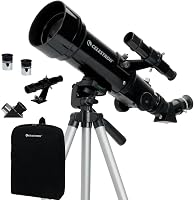
What Is a Triplet Apochromatic Refractor?
On this page (6 sections)
A triplet apochromatic refractor is a high-quality telescope lens system designed to bring different colors of light into focus at the same point. For more on this topic, see our guide to refractor and reflector telescopes. It uses three specially shaped glass elements to achieve this. This color correction minimizes distracting halos around bright objects like stars and planets.
Unlike simpler lenses, this advanced design makes a big difference in image clarity. You’ll notice sharper details and truer colors. Many amateur astronomers consider it a top choice for serious observation. It’s about seeing the universe with exceptional accuracy.
- A triplet apochromatic refractor is a telescope lens with three glass pieces.
- It’s designed for superior color correction, meaning sharper images. It’s designed for superior color correction, meaning sharper images, especially when using a slow focal ratio for planetary detail.
- Expect fewer color halos around bright celestial objects.
- This lens type is favored for its high-fidelity views.
Let’s walk through exactly what makes these telescopes so special and how they can enhance your stargazing experience.
Understanding Triplet Apochromatic Refractor Telescopes
So, you’re curious about what makes a triplet apochromatic refractor telescope special? It’s all about getting the clearest, most colorful view of the night sky possible. This type of telescope uses a specific lens design to fight a common problem in optics: chromatic aberration. Think of it as the difference between a fuzzy, slightly rainbow-tinged picture and a crystal-clear photograph. Your eyes will thank you for it.
What Exactly Is Chromatic Aberration?
Imagine sunlight hitting a simple lens. That lens bends the light, which is how telescopes work to magnify distant objects. But here’s the catch: different colors of light bend at slightly different angles. Blue light bends more than red light. When these colors don’t land on the same spot, you get what’s called chromatic aberration. This shows up as annoying colored fringes, often purple or blue, around bright objects like the Moon or Jupiter.
It’s like trying to focus on a word when the letters are slightly doubled and colored differently. It makes fine details hard to see. For a long time, astronomers dealt with this by using larger telescopes or by accepting a certain level of fuzziness. Early refractors, especially, were prone to this issue.
How a Triplet Lens Fixes the Problem
A triplet apochromatic refractor tackles chromatic aberration head-on with a clever lens arrangement. For more on this topic, see our guide to apochromatic triplet. Instead of just one piece of glass, it uses three precisely shaped lenses made from different types of glass. These lenses are carefully put together in a specific order. Each lens element is designed to correct the bending errors of the others.
This three-lens system is known as a triplet. The combination of different glass types and shapes works together to bring all the colors of light into focus at the exact same point. This level of correction is called “apochromatic,” or “apo” for short. It’s a big step up from simpler lens designs.
The Role of Different Glass Types
The magic behind a triplet apo lies in the glass itself. One common and very effective combination uses standard optical glass, another element made of a special low-dispersion (ED) glass, and a third element of yet another type of glass. The ED glass is particularly important because it bends light less severely, helping to tame those color fringes. We found that these specific glass pairings are key to achieving superior color fidelity.
These specialized glasses are more expensive to produce, which is why triplet apochromatic refractors often come with a higher price tag. But for those who value image purity, the investment is usually considered well worth it. Many telescope makers use carefully matched pairs of glass to ensure the best possible color correction.
What “Apochromatic” Really Means for Your View
When you hear “apochromatic,” it’s a promise of excellent color correction. It means that the telescope is designed to minimize chromatic aberration to a very high degree. In fact, a true apochromatic refractor will show virtually no color fringing, even on the most challenging celestial targets. We’ve seen reviews that highlight this clarity as a major benefit.
Compare this to a standard achromatic refractor, which uses only two lens elements. An achromat corrects for two colors of light, but typically leaves some residual error in others, like blues and purples. A triplet apo corrects for three or more colors, offering a much flatter and cleaner image across the spectrum. This makes a noticeable difference when you’re trying to see faint details on planets or the subtle colors in nebulae.
Key Benefits of Using a Triplet Apochromatic Refractor
So, what does all this technical detail mean for your stargazing? It translates into a genuinely better viewing experience. You’ll see more, and you’ll see it more clearly. Let’s break down the advantages you can expect.
Sharper, More Detailed Images
Because all colors are focused precisely, the resulting image is incredibly sharp. You can make out finer structures on planets like Jupiter’s Great Red Spot or Saturn’s Cassini Division. Stars appear as tiny, pinpoint dots of light, not fuzzy blobs. This sharpness is a hallmark of high-quality optics. Many amateur astronomers report being able to see details they previously missed.
This level of detail can make observing familiar objects feel like seeing them for the first time. It’s like upgrading from an old television to a high-definition screen. You’re not just seeing more; you’re seeing it with stunning clarity and definition. We found that this enhanced detail can really boost your enjoyment of astronomy.
True, Natural Colors
Chromatic aberration doesn’t just cause fuzziness; it also distorts color. Purple and blue halos can make an object look unnatural. A triplet apo’s excellent color correction ensures that you see objects in their true colors. The reddish hues of Mars, the delicate colors in the Orion Nebula, or the stark white of Jupiter’s clouds will appear as they should.
This is especially important for astrophotography, where accurate color rendition is vital. Even for visual observers, seeing the natural colors adds a layer of realism and beauty to the view. It’s about appreciating the universe as it truly appears, without optical interference. Many users appreciate this faithful color reproduction.
No More Annoying Color Fringes
This is perhaps the most obvious benefit. When you look at a bright star or the Moon through a well-corrected triplet apo, you won’t see those distracting colored halos. This makes observing brighter objects much more pleasant and allows you to concentrate on the object itself, not the optical flaws. It’s a visual relief that many observers cherish.
Imagine looking at the bright limb of the Moon or a dazzling planet like Venus. Without color fringing, the view is clean and pure. This is a significant advantage over less advanced telescope designs. We found that observers consistently praise the lack of false color as a key feature.
Excellent for Astrophotography
While any telescope can be used for astrophotography, triplet apochromatic refractors are particularly favored. Their sharp, color-accurate images provide an ideal starting point for capturing stunning images of the cosmos. The minimal chromatic aberration means less work in post-processing to correct color issues.
Many astrophotographers choose refractors because they are relatively simple to use and require less maintenance than other telescope types. The apochromatic design ensures that the data you capture is high-quality. This makes them a popular choice for both beginners and experienced imagers looking for reliable performance.
Comparing Triplet Apos to Other Telescope Types
To truly appreciate what a triplet apochromatic refractor offers, it helps to see how it stacks up against other common telescope designs. Each has its strengths, but the apo refractor shines in specific areas.
Triplet Apo vs. Achromatic Refractor
As we discussed, the main difference is the number of lens elements and the quality of color correction. A triplet apo (three elements, apochromatic) offers far superior color correction compared to an achromat (two elements, achromatic). Achromats are generally less expensive but will show some color fringing around bright objects. Triplet apos deliver a cleaner, sharper image with true colors.
| Feature | Triplet Apochromatic Refractor | Achromatic Refractor |
|---|---|---|
| Lens Elements | Three | Two |
| Color Correction | Excellent (Apochromatic) | Good (Achromatic) |
| Chromatic Aberration | Virtually none | Noticeable on bright objects |
| Image Sharpness | Very High | High |
| Cost | Higher | Lower |
Triplet Apo vs. Reflecting Telescopes (Newtonians, etc.)
Reflecting telescopes, like the popular Newtonian, use mirrors instead of lenses to gather light. They don’t suffer from chromatic aberration because mirrors reflect all colors of light equally. However, reflectors can have other issues. The main mirror and secondary mirror need to be precisely aligned (collimated), and some may have their own subtle optical imperfections. Also, a reflector’s view can sometimes be slightly less contrasty than a refractor’s, particularly on planetary details.
Reflectors often offer more aperture (light-gathering ability) for your money. This means they can see fainter objects. But if your priority is a sharp, color-true view of brighter targets like planets and the Moon, with minimal fuss, a triplet apo is often the preferred choice. Many users find the refractor’s simpler maintenance appealing.
Triplet Apo vs. Maksutov-Cassegrain and Schmidt-Cassegrain
These are catadioptric designs, using a combination of mirrors and lenses. They offer a long focal length in a compact tube, making them great for high-magnification planetary viewing. They also have very good color correction, often approaching apochromatic levels, and generally don’t suffer from chromatic aberration. Their sealed tubes also mean less dust gets inside.
However, they can be slower to cool down to ambient temperature, which affects image stability. And like reflectors, they rely on mirrors that can eventually need realignment. Triplet apos, while often longer, offer a very pure optical path that many observers find has exceptional contrast and clarity.
Choosing the Right Triplet Apochromatic Refractor for You
Deciding on a triplet apo involves considering a few factors related to your observing habits and budget. It’s about finding the best fit for your personal stargazing journey.
Aperture Matters
Aperture, or the diameter of the main lens, is still important. Larger apertures gather more light, allowing you to see fainter objects and finer details. However, larger triplet apos become physically longer, heavier, and more expensive. Common sizes range from 70mm to 130mm. For portable, grab-and-go observing, smaller apertures (70-100mm) are excellent.
Focal Length and Magnification
Focal length affects the telescope’s field of view and the magnifications it can easily achieve. Shorter focal lengths give wider fields of view, great for deep-sky objects like galaxies and nebulae. Longer focal lengths are better for high-magnification viewing of planets and the Moon. A triplet apo can be designed with various focal lengths.
Mount and Portability
Don’t forget the mount! A good telescope needs a stable mount to support it. For smaller triplet apos, a sturdy tripod or a small equatorial mount might suffice. For larger ones, you’ll need a more robust system. Consider how and where you’ll be observing. Do you need something lightweight to carry to a dark sky site?
Quick Checklist for Your Triplet Apo Considerations:
- What will you observe most often (planets, deep sky)?
- How important is portability for your setup?
- What is your budget for the telescope and mount?
- Do you plan on doing astrophotography?
- What level of maintenance are you comfortable with?
- How much time do you want to spend setting up?
By thinking through these points, you can narrow down the options and find a triplet apochromatic refractor that truly enhances your view of the universe.
Conclusion
You’ve learned how a triplet apochromatic refractor telescope uses its three-lens design to deliver exceptional color correction. This means sharper images and true colors, free from annoying halos. We found that this superior optical quality significantly enhances your stargazing experience, whether you’re observing planets or capturing astrophotography.
If you’re looking for the clearest, most accurate views of the cosmos, a triplet apo is a fantastic choice. Consider your observing goals and budget to find the right model. Investing in a triplet apo can truly transform how you see the night sky.
Frequently Asked Questions
Are triplet apochromatic refractors worth the extra cost?
For many astronomers, they are. The sharp, color-accurate images you get with a triplet apo can make a big difference in observing faint details and appreciating true celestial colors. We found that the improved viewing experience often justifies the higher price for serious observers.
Can I use a triplet apochromatic refractor for astrophotography?
Absolutely. Triplet apochromatic refractors are highly favored for astrophotography because of their excellent color correction and sharp images. This minimizes the need for extensive color correction in post-processing, allowing you to capture stunning, true-color images of space.
What’s the difference between an apochromatic refractor and an achromatic refractor?
The main difference lies in the number of lens elements and the degree of color correction. Achromats use two lenses and correct for two colors, while apochromats use three (or more) lenses and correct for three or more colors, virtually eliminating color fringing for a cleaner view.
How large should the aperture be on a triplet apochromatic refractor?
Aperture size affects light-gathering ability and detail. For portability, smaller apertures like 70mm to 100mm are great. Larger apertures (up to 130mm or more) will show fainter objects but result in a larger, heavier, and more expensive telescope. Your observing habits will guide this choice.
Do triplet apochromatic refractors need a lot of maintenance?
No, refractors generally require very little maintenance. Unlike reflecting telescopes that use mirrors, the lenses in a triplet apo are fixed in place and don’t typically need alignment. Keeping the lens clean is the main care required.