What Is the Most Powerful Portable Telescope?
The most powerful portable telescope depends on aperture, useful magnification, and the weight you can carry. A larger aperture gathers more light, but the best choice also needs a mount and setup you can manage.
On this page (6 sections)
The most powerful portable telescope depends on aperture, useful magnification, and carrying weight. A larger aperture gathers more light, but a telescope is only portable if you can transport, assemble, and steady it for the observing you plan to do.
For a compact travel setup, a 70mm refractor can be easier to carry. A 130mm reflector gathers more light, but its assembled weight and equatorial mount ask more of you.
Compare the trade-offs in our best portable telescope for astronomy guide.
What makes a portable telescope powerful?
Aperture is the clearest starting point: it describes the diameter of the telescope’s main lens or mirror. A larger aperture gathers more light, which helps you observe fainter targets and can reveal finer detail when the optics, sky, and mount support it.
Aperture alone does not decide what you will see. A wobbly mount, poor focus, or hazy sky can make a high-magnification view hard to use.
| Factor | Why it matters |
|---|---|
| Aperture | Larger lenses or mirrors gather more light |
| Magnification | Enlarges the view, but does not create detail |
| Mount stability | Helps keep the target steady as you observe |
| Weight | Affects how easily you can carry and set up the telescope |
| Packing method | A case or backpack can make transport easier |
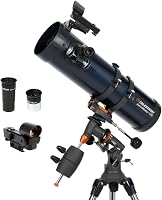
The Celestron AstroMaster 130EQ has a 130mm Newtonian reflector and weighs 17 lb. It gathers more light than the 70mm examples below, but its German equatorial mount and tripod add to the setup you need to move.
If easy transport matters more than aperture, compare our best portable telescopes for travel.
Does more magnification mean more power?
More magnification does not automatically mean a better or more powerful telescope. Magnification enlarges what the telescope collects; aperture and viewing conditions limit the detail you can see.
The magnification you get depends on the telescope’s focal length and the eyepiece you use. For example, the AstroMaster 130EQ includes 20mm and 10mm eyepieces.
Its maker describes those as 33x and 65x views.
The Travel Scope 70mm also includes 20mm and 10mm eyepieces, but it has a shorter focal length. The same eyepiece size does not give the same magnification on every telescope.
Very high power can make an image dim, soft, or hard to keep in view. Start with a lower power to find and center your target, then increase magnification if the image remains clear and steady.
Which portable telescope gives you the most aperture?
Among these three examples, the AstroMaster 130EQ has the largest aperture at 130mm. Its 17 lb weight makes it a more substantial carry than either 70mm telescope.
The Celestron Travel Scope 70mm pairs a smaller aperture with a travel-focused setup. It weighs 4.2 lb and includes a backpack, tripod, two eyepieces, and a finderscope.
That lighter design suits travel and quick setup, but 70mm aperture gathers less light than 130mm. For another compact option, see our guide to the best portable 70mm telescope with backpack.
The Celestron AstroMaster 70AZ is another 70mm refractor, weighing 10.8 lb. It has a manual alt-azimuth mount with a panhandle for pointing up, down, and side to side.
The 70AZ is heavier than the Travel Scope 70mm, so compare the complete carry weight and setup style rather than aperture alone. If you're buying a first telescope, our best portable telescope for beginners guide covers beginner-friendly options.
How should you balance aperture and carrying weight?
Choose the largest aperture you can comfortably transport and use. A telescope that stays at home because it is hard to carry may be less useful than a smaller one you take to darker skies.
For compact options, see the best small telescopes for stargazing.
Consider the route from storage to your observing spot. Stairs, public transport, a long walk, and limited car space all change what “portable” means for you.
| If you value… | Consider… | Trade-off |
|---|---|---|
| More light gathering | 130mm reflector | Heavier setup at 17 lb |
| Lower carrying weight | 70mm travel refractor | Smaller aperture |
| Simple manual pointing | 70AZ refractor | 10.8 lb weight despite 70mm aperture |
| Packed travel storage | Travel Scope 70mm | More limited aperture for faint targets |
Check whether the stated weight includes the tube, mount, and tripod. Also think about where the telescope will sit during observation, because a compact tube still needs a stable support.
What can you expect to see with a portable telescope?
A portable telescope can show different targets depending on its aperture, optics, sky darkness, and setup. The Moon is a practical starting target because its bright surface and craters are easy to find.
A 70mm scope can also show bright planets and star clusters. Fainter deep-sky objects are more demanding, especially under light-polluted skies.
A larger aperture can help with dimmer targets, but it does not guarantee a sharp view every night. Atmospheric turbulence, focus, and how steadily the telescope is supported all affect the result.
For lunar viewing, compare our best telescope to view the moon guide. For a specific beginner model, see the NASA lunar telescope review.
Which telescope fits your observing plans?
The most powerful portable telescope for you is the one whose aperture fits your targets and whose weight fits your travel routine. Choose a 130mm reflector if light gathering is your priority and a 17 lb setup is manageable.
Choose a 70mm travel refractor if you want a lighter telescope with a backpack. For a manual alt-azimuth option, consider the 70AZ and its 10.8 lb weight.
If you are comparing a computerized beginner telescope, read our 114LCM computerized telescope review. For a child’s first setup, see our best telescope for young kids guide.
Frequently asked questions
What is the most powerful portable telescope?
There is no single answer because power depends on aperture, optics, mount, and how much weight you can carry. A 130mm reflector gathers more light than a 70mm telescope, while a lighter 70mm travel scope may be easier to pack and set up.
Match the telescope to your observing plans and transport limits.
Does higher magnification mean a more powerful telescope?
No. Magnification enlarges the view, but it cannot add detail that the telescope's aperture and optics cannot resolve.
Atmospheric conditions, focus, and mount stability also affect what you can see.
Compare aperture and the eyepieces or magnification options, then choose a power that still gives a sharp, steady image.
Is a 70mm telescope powerful enough for astronomy?
A 70mm telescope can show the Moon, planets, and bright targets, and it is easier to carry than a larger scope. It gathers less light than a 130mm reflector, so it is less suited to faint deep-sky objects.
Consider portability alongside the kinds of targets you want to observe.
How heavy is a portable telescope?
Portable telescope weight varies by model and whether the stated weight includes the mount and tripod. The examples here range from 4.2 lb for a 70mm travel scope to 17 lb for a 130mm reflector.
Check the full assembled weight and how you will carry the scope before choosing.