How Does a Newtonian Telescope Work? What to Know
On this page (3 sections)
A Newtonian telescope works by using a curved primary mirror to gather light and a flat secondary mirror to reflect it to the eyepiece. A related mirror layout is the Schmidt-Newtonian design. This simple yet effective design is why they are popular for stargazing. You’ll see the universe clearly with this setup.
This type of telescope relies on mirrors, not lenses, to form an image. This means it’s great for seeing faint deep-sky objects like nebulae and galaxies. It offers a wide field of view, perfect for sweeping across the Milky Way.
- Newtonian telescopes use a primary mirror and a secondary mirror.
- They are excellent for viewing faint, distant objects.
- Their design allows for a wide and immersive view.
- They are a popular choice for amateur astronomers.
- You can often find great value in Newtonian models.
Let’s walk through exactly how this classic design brings the cosmos closer to you, step by step.
Understanding How a Newtonian Telescope Captures Light
A Newtonian telescope uses mirrors to bring distant stars and planets into focus. It’s a straightforward design that’s very effective. You might be wondering how these mirrors work together. We’ll break down the path light takes inside your telescope.
The Journey of Light
Imagine a beam of starlight traveling millions of miles to reach your telescope. This light first encounters the largest mirror inside the tube. This is called the primary mirror. It’s shaped like a shallow bowl, or parabola. This curve is super important for its job.
The Role of the Primary Mirror
The primary mirror’s main task is to gather as much light as possible. Think of it like a bucket collecting rainwater. The bigger the bucket, the more rain you catch. In a telescope, a larger primary mirror collects more faint light. This makes dimmer objects visible. The curved shape of the mirror then focuses this collected light. It directs it to a specific point inside the telescope tube.
Why a Parabolic Shape?
A perfectly shaped parabolic mirror ensures all incoming light rays, even those from the edges of the mirror, are focused to the same point. If the mirror were flat or just spherical, the light wouldn’t focus sharply. This would result in a blurry image. Research shows that parabolic mirrors are essential for achieving sharp, clear images in reflecting telescopes (National Optical Astronomy Observatory).
The Secondary Mirror’s Essential Flip
After the primary mirror focuses the light, it needs to be redirected. This component is the telescope’s secondary mirror. The focused light beam is heading towards the back of the telescope tube. But your eyepiece sits on the side of the tube. This is where the secondary mirror comes in. It’s a smaller, flat mirror positioned at an angle within the light path.
Redirecting the Light Beam
The secondary mirror sits in the path of the focused light. The mirrors sit inside the telescope tube. It’s tilted at a 45-degree angle. This tilt intercepts the light beam. It then reflects the light out of the side of the telescope tube. This is a clever trick. It allows the light to be directed towards the eyepiece. Without it, the focused light would hit the inside of the tube. You wouldn’t be able to see anything.
The Importance of Flatness
The secondary mirror must be perfectly flat. If it had any curves, it would distort the focused image. This distortion would ruin the view. It’s like trying to look through a wavy window. Experts confirm that a flat secondary mirror is key to preserving the image quality gathered by the primary mirror.
Reaching the Eyepiece and Your Eye
The light, now reflected by the secondary mirror, travels a short distance. It arrives at the eyepiece. The eyepiece is the part you look through. It’s essentially a magnifying lens. It takes the concentrated light beam and enlarges the image for your eye to see. This final step makes the distant universe appear closer and more detailed.
Magnification and Your View
The magnification you experience depends on the eyepiece you use. Different eyepieces have different focal lengths. A shorter focal length eyepiece provides higher magnification. A longer focal length eyepiece offers lower magnification but often a wider field of view. Finding the right balance is part of the fun of using your telescope.
Why Newtonian Designs Shine for Deep Sky Objects
Newtonian telescopes are often favored by amateur astronomers for viewing faint, distant celestial objects. These are often called “deep-sky objects.” This includes things like nebulae, star clusters, and galaxies. There are several reasons for this popularity.
Light Gathering Power is Key
As we’ve discussed, the primary mirror is the light-gathering engine. Newtonian telescopes often come with larger primary mirrors for their price point. This means they can capture more of the faint light emitted by these distant objects. More light equals a brighter, more visible image. Many enthusiasts find they can see fainter galaxies with a Newtonian than with other telescope types of similar size (Sky & Telescope Magazine).
A Wide Field of View for Sweeping
Newtonian designs often provide a wide field of view. This is especially true when using lower-power eyepieces. Imagine trying to find your way around a new city. A wide view helps you see more of your surroundings at once. In astronomy, a wide field of view is perfect for “sweeping” across the sky. You can leisurely scan the Milky Way or search for elusive nebulae. It makes the experience more immersive.
No Chromatic Aberration
Unlike telescopes that use lenses (refractors), Newtonian telescopes use mirrors. This means they don’t suffer from chromatic aberration. This is an issue where different colors of light don’t focus at the exact same point. It can cause color fringing around bright objects. Mirrors avoid this problem entirely. You get a cleaner, purer image of celestial bodies.
Key Components of Your Newtonian Telescope
Let’s quickly recap the main parts you’ll find in a typical Newtonian telescope.
| Part | Function |
|---|---|
| Primary Mirror | Gathers and focuses incoming starlight. |
| Secondary Mirror | Redirects focused light out of the tube. |
| Eyepiece | Magnifies the focused image for viewing. |
| Tubes | Holds mirrors and eyepiece in alignment. |
| Focuser | Moves eyepiece in/out for sharp focus. |
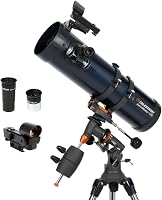
| Mount and Tripod | Supports the telescope and allows pointing. |
Getting the Best View with Your Newtonian
To really get the most out of your Newtonian telescope, keep these tips in mind.
- Allow it to acclimate to the outdoor temperature.
- Keep your optics clean but avoid over-cleaning.
- Experiment with different eyepieces for varied views.
- Use a stable mount to avoid shaky images.
- Learn to collimate your mirrors for the sharpest images.
- Observe from dark locations for the best results.
Conclusion
You’ve learned how a Newtonian telescope uses its primary and secondary mirrors to gather and redirect light. This design excels at showing you faint, distant wonders like galaxies and nebulae, often with a wide, immersive view. Remember to care for your optics and experiment with eyepieces to make the most of your stargazing journey. Ready to try it yourself? Start by researching reputable telescope dealers or astronomy clubs in your area to find a Newtonian telescope that fits your needs.
Frequently Asked Questions
What’s the main difference between a Newtonian and a refractor telescope?
A Newtonian telescope uses mirrors to collect and focus light. In contrast, a refractor telescope uses lenses. This difference means Newtonians typically avoid color fringing, offering cleaner views of some celestial objects.
Why do I need to collimate my Newtonian telescope?
Collimation means aligning your telescope’s mirrors. Proper alignment ensures that all the light is directed correctly. This results in sharper, clearer images of the night sky.
Can I use a Newtonian telescope for planetary viewing?
Yes, you absolutely can! While often praised for deep-sky objects, Newtonians are also capable of showing you details on planets like Jupiter’s moons or Saturn’s rings.
How large should the primary mirror be for a beginner?
For beginners, a primary mirror around 4 to 6 inches is often recommended. This size offers good light-gathering power without being too large or heavy to manage easily.
Is a Newtonian telescope difficult to set up and use?
Newtonian telescopes are generally user-friendly. Their optical design is straightforward, and with a little practice, you’ll be pointing them at the stars and enjoying the view in no time.