9 Best Telescopes for Beginners to See Planets (November 2026)
The best beginner telescopes for viewing planets include the Blue Marble NASA Lunar Telescope for Kids for young Moon watchers, the Celestron Travel Scope 70mm Beginner Portable Telescope for travel and daytime use, and the MEEZAA Telescope for a larger refractor aperture.
On this page (4 sections)
The best telescope for beginners to see planets is the Celestron AstroMaster 70AZ for its 70 mm optics, included 20 mm and 10 mm eyepieces, and simple manual mount. Pick the MEEZAA if you want a 90 mm aperture, the Travel Scope 70 if carrying ease matters, or a kids' telescope for a younger first-time observer.
Planet views are small and depend on more than a high magnification number. Aperture, steady air, careful focus and a mount that holds position all matter, so a stable beginner setup can be more useful than a scope promising extreme power.
The picks below cover family use, travel, kids' learning and larger refractor apertures. If you want a broader comparison beyond beginner equipment, see our guide to the best telescope for planets.
Our picks at a glance
-
1
 Best for young Moon watchers
Blue Marble NASA Lunar Telescope for Kids
9.6/10 our score
See it on Amazon -
2
 Best for travel and daytime use
Celestron Travel Scope 70mm Beginner Portable Telescope
9.6/10 our score
See it on Amazon -
3

- 4
 Best for phone photosCheck it
- 5
 Check it
Celestron AstroMaster 70AZ Refractor Telescope for Moon
Best for straightforward planet viewing - 6
 Check it
CELTICBIRD Telescope for Adults High Powered
Best for an 80 mm travel kit - 7
 Check it
Educational Insights GeoSafari Vega 600 Telescope
Best for kids learning telescope basics - 8
 Check it
ToyerBee Telescope for Adults & Kids
Best for a light family kit - 9
 Check it
Educational Insights GeoSafari Starview Telescope
Best for simple tabletop practice
Which beginner telescopes show planets clearly?
A 70 mm or larger refractor with a steady mount and usable eyepieces is a sensible starting point for bright planets. The nine picks below are ordered by their assigned scores, with each suited to a different kind of beginner.
We compared the stated aperture, focal length, eyepieces, mount and included accessories against the goal of getting started with lunar and planetary viewing. Our score weighs specs, features and buyer feedback against what you're shopping for.
| Product | Best for | Objective lens | Mount | Included | Our score |
|---|---|---|---|---|---|
| Blue Marble NASA Lunar Telescope for Kids | young Moon watchers | 25 mm | Equatorial mount | Tabletop tripod, 2 eyepieces, learning guide | 9.6 |
| Celestron Travel Scope 70mm Beginner Portable Telescope | travel and daytime use | 70 mm | Altazimuth mount | Backpack, finder scope, star diagonal, 2 eyepieces | 9.6 |
| MEEZAA Telescope | a larger refractor aperture | 90 mm | Altazimuth mount | Tripod, phone adapter, carry bag, 2 eyepieces, Barlow lens | 9.6 |
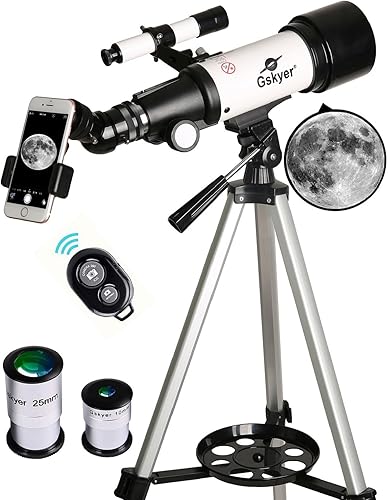
| Gskyer Telescope | phone photos | 70 mm | Altazimuth mount | Carry bag, phone adapter, remote, finder scope | 9.5 |
| Celestron AstroMaster 70AZ Refractor Telescope for Moon | straightforward planet viewing | 70 mm | Altazimuth mount | Adjustable tripod, 2 eyepieces, erect image diagonal | 9.3 |
| CELTICBIRD Telescope for Adults High Powered | an 80 mm travel kit | 80 mm | Altazimuth mount | Backpack, tripod, phone adapter, Moon filter | 8.9 |
| Educational Insights GeoSafari Vega 600 Telescope | kids learning telescope basics | 50 mm | Altazimuth mount | Two eyepieces, finder scope, tripod | 8.0 |
| ToyerBee Telescope for Adults & Kids | a light family kit | 70 mm | Tripod, finder scope, phone adapter, star chart | 7.9 | |
| Educational Insights GeoSafari Starview Telescope | simple tabletop practice | Altazimuth mount | Tabletop tripod, two lenses, activity journal | 7.8 |
Blue Marble NASA Lunar Telescope for Kids: Best for young Moon watchers
- For ages 8 and up
- Finder scope
- Low- and high-power eyepieces
- Tabletop tripod
A kid-focused option for learning to locate and view the Moon. Its small objective and tabletop tripod make it less suited to detailed planetary observing.
Pros
- Learning guide included
- Finder scope and 2 eyepieces
- Easy-to-use tabletop setup
Cons
- Designed around lunar viewing
- 25 mm objective
Blue Marble's NASA Lunar Telescope is a child-focused first scope built around finding and viewing the Moon. It includes a finder scope, a low-power eyepiece, a high-power eyepiece and a tabletop tripod with a smooth mount.
The product is described for ages 8 and up, and a learning guide introduces lunar features. Its 25 mm objective is much smaller than the 70 mm and 90 mm options in this roundup, so consider it for an early astronomy activity rather than a first choice for planetary detail.
A smooth tabletop mount can make it easier to scan across the lunar surface. For a child who is mainly curious about planets, explain that the view will be modest and that steady hands and patience still matter.
Choose it for a young beginner whose first target is the Moon. If you want a full-height tripod and a larger objective, compare the adult-oriented refractors below.
Celestron Travel Scope 70mm Beginner Portable Telescope: Best for travel and daytime use
- 70 mm refractor
- 20 mm and 10 mm eyepieces
- Backpack included
- No-tool setup
A portable 70 mm refractor for beginners who want to carry one telescope between daytime and night-sky viewing. The included backpack keeps the telescope and accessories together.
Pros
- 70 mm aperture
- Backpack included
- Two eyepieces
Cons
- Travel-focused setup
- No magnification figures in the included product details
The Celestron Travel Scope 70 is a portable 70 mm refractor for beginners who want to use one scope for daytime scenery and night-sky viewing. It comes with 20 mm and 10 mm eyepieces, a finder scope, a star diagonal, a full-height tripod and a padded backpack.
Celestron describes its setup as tool-free, and the parts pack into the included bag. That makes it a useful fit if you plan to take the telescope to a campsite or move it between storage and a viewing spot.
Its 70 mm aperture gives it a solid starting point for bright targets, but its travel focus means portability is a major part of the value. If planets are your only goal and the scope will stay in one place, also compare the longer-focal-length AstroMaster 70AZ.
Choose it when carrying and daytime use matter alongside astronomy. For a compact scope dedicated to travel, read our guide to the best portable telescope for beginners.
MEEZAA Telescope: Best for a larger refractor aperture
- 90 mm aperture
- 800 mm focal length
- 10 mm and 25 mm eyepieces
- 3x Barlow lens
The largest stated aperture among these picks pairs with two eyepieces and a 3x Barlow lens. It suits beginners willing to manage a larger telescope and its accessories.
Pros
- 90 mm aperture
- 800 mm focal length
- Carry bag and phone adapter included
Cons
- More accessories to set up
- No weight figure provided
The MEEZAA telescope has a 90 mm aperture and an 800 mm focal length, making it the largest stated objective in this roundup. It includes 25 mm and 10 mm eyepieces, a 3x Barlow lens, a finder scope, a phone adapter, a carry bag and an adjustable tripod.
The two eyepieces and Barlow lens offer several magnification combinations. Begin with the lower-power view to find a target, then increase magnification only if the image remains clear and stable.
A larger aperture can collect more light, but it doesn't remove the effects of atmospheric turbulence or make a planet look like a close-up image. The tripod and alt-azimuth mount still need a firm, level surface, especially when you use more magnification.
Choose it if you want a larger refractor and are comfortable setting up several accessories. To understand the tradeoff between aperture and image detail, see our guide to telescope aperture and resolution is not part of the provided link plan, so compare the specific planet-focused options in our planet viewing guide instead.
Gskyer Telescope: Best for phone photos
- 70 mm aperture
- 400 mm focal length
- Two eyepieces and 3x Barlow lens
- Phone adapter and wireless remote
A compact 70 mm refractor with a phone adapter and wireless remote. The included eyepieces and Barlow lens give beginners multiple magnification combinations.
Pros
- Phone adapter and remote
- Finder scope
- Carry bag included
Cons
- 400 mm focal length
- Tripod stability matters at higher magnification
Gskyer's 70 mm refractor comes with two eyepieces, a 3x Barlow lens and a 5x24 finder scope. It also includes a phone adapter, wireless camera remote, adjustable tripod and carry bag.
Its stated 400 mm focal length makes it a compact option, and the accessories support casual phone pictures through the eyepiece. Phone adapters can take time to line up, so treat photography as an extra activity rather than the main reason to choose a first telescope.
The included finder scope helps with aiming, while the alt-azimuth mount keeps movements familiar for new observers. At higher magnification, even small bumps can shift the target, so take time to steady the tripod and refocus.
Choose it if you want a portable 70 mm scope with phone accessories. If you are comparing two other beginner Celestron options, our Celestron StarSense Explorer vs AstroMaster comparison explains their different approaches.
Celestron AstroMaster 70AZ Refractor Telescope for Moon: Best for straightforward planet viewing
- 70 mm achromatic refractor
- 20 mm and 10 mm eyepieces
- Manual alt-azimuth mount
- StarPointer red dot finder
A beginner-friendly 70 mm refractor with a manual panhandle mount and two eyepieces. The stated 45x and 90x views give a clear starting point for viewing bright planets.
Pros
- 70 mm optics
- Simple panhandle mount
- Two eyepieces and a red dot finder
Cons
- Manual tracking
- Larger to carry than travel-focused scopes
The Celestron AstroMaster 70AZ is a straightforward first telescope for bright planets and the Moon. Its 70 mm achromatic refractor pairs with 20 mm and 10 mm eyepieces, an erect image diagonal and a StarPointer red dot finder.
The included eyepieces are described as giving 45x and 90x views. That gives you a practical lower-power option to find a target and a higher-power option to try once the telescope is focused and steady.
Its manual alt-azimuth mount uses a panhandle to move the telescope up, down and side to side. Beginners can learn those simple motions quickly, though you'll need to adjust the scope by hand as a target moves across the sky.
Choose it if simple controls and planetary viewing are your main priorities. For Moon-focused observing, compare it with our best telescope to view the Moon.
CELTICBIRD Telescope for Adults High Powered: Best for an 80 mm travel kit
- 80 mm aperture
- 600 mm focal length
- 20 mm and 9 mm eyepieces
- Moon filter and phone adapter
An 80 mm refractor with a 600 mm focal length and a travel bag. Its two eyepieces are stated as 30x and 66x, giving beginners modest starting magnifications.
Pros
- 80 mm aperture
- Tripod adjusts from 17.7 to 52 in
- Backpack and Moon filter included
Cons
- Highest stated eyepiece magnification is 66x
- Phone adapter adds setup steps
The CELTICBIRD refractor has an 80 mm aperture, a 600 mm focal length and an adjustable tripod. Its 20 mm and 9 mm eyepieces are stated as 30x and 66x, and the kit includes a Moon filter, phone adapter, finder scope and backpack.
The extra aperture over a 70 mm scope may appeal to beginners who also want a carry bag for transport. The tripod adjusts from 17.7 to 52 inches, giving adults and children options for viewing height.
The highest stated eyepiece magnification is 66x, so this is not the pick for someone focused on pushing magnification. Instead, compare its aperture and portable kit with the longer focal length and larger aperture of the MEEZAA.
Choose it if you want an 80 mm travel setup with a Moon filter. A telescope's portability and aperture often involve tradeoffs; our guide to the most powerful portable telescope explores that choice.
Educational Insights GeoSafari Vega 600 Telescope: Best for kids learning telescope basics
- 50 mm objective lens
- Two eyepieces
- 5x24 finder scope
- Adjustable tripod
A lightweight refractor kit for young beginners who want to explore the Moon, planets and daytime targets. The 50 mm objective is smaller than those on the adult-oriented scopes here.
Pros
- Finder scope included
- Adjustable tripod up to 50 in
- Made for manual learning
Cons
- Smaller 50 mm objective
- Magnification claims vary in the product details
The GeoSafari Vega 600 is a lightweight refractor kit for children and families who want to explore the Moon, planets and daytime targets. It has a 50 mm objective, two eyepieces, a 5x24 finder scope and an adjustable tripod that reaches 50 inches.
Its stated magnification figures vary across the product details, so don't choose it based on the largest number alone. The more useful fit is a young observer learning how to focus, find a target and use a tripod.
The smaller objective makes it less suitable than the larger refractors here for a beginner mainly seeking planetary detail. Its portability and educational focus may still suit a child who wants to try both sky watching and nature viewing.
Choose it for a child learning basic telescope use. If you're comparing beginner equipment on a tighter budget, see our best cheap telescope to see planets guide.
ToyerBee Telescope for Adults & Kids: Best for a light family kit
- 70 mm aperture
- 300 mm focal length
- 20 mm and 6 mm eyepieces
- Phone adapter and wireless remote
A lightweight 70 mm refractor with accessories for family stargazing. Its short 300 mm focal length and wide range of advertised magnifications call for realistic expectations about planetary detail.
Pros
- 3.5 lb stated weight
- Phone adapter and remote
- Star chart included
Cons
- Short 300 mm focal length
- Product details use inconsistent magnification figures
ToyerBee's 70 mm refractor is a lightweight family kit with a 300 mm focal length. The package includes 20 mm and 6 mm eyepieces, a 3x Barlow lens, a phone adapter, wireless remote, tripod, finder scope and star chart.
The product describes magnification from 15x to 150x, though its accessory combinations make that range unclear. For planetary viewing, judge it by the 70 mm aperture, short focal length and whether the image stays sharp, instead of treating the maximum magnification as a promise of detail.
The stated 3.5 lb weight makes it one of the lighter full kits here. That can help when packing for a trip, while the phone accessories and several optical parts mean there is still some setup to learn.
Choose it if you want a light family kit with phone accessories. For planet observing, start with the 20 mm eyepiece and use the higher-power options only when the view stays steady.
Educational Insights GeoSafari Starview Telescope: Best for simple tabletop practice
- 10x and 50x eyepieces
- Tabletop tripod
- Activity journal
- For indoor and outdoor viewing
A compact kids' telescope for practicing basic aiming and eyepiece changes. Its 50x high-power eyepiece is a modest choice for planet viewing.
Pros
- Activity journal included
- Tabletop tripod
- Simple two-eyepiece setup
Cons
- 50x maximum stated magnification
- Designed as a kids' introduction
The GeoSafari Starview is a compact tabletop telescope designed for kids to practice basic observing. It includes 10x and 50x lenses, a tabletop tripod and an activity journal.
Its 50x upper eyepiece magnification is modest for planets, so this pick is best understood as an introduction to looking at the Moon, stars and nearby daytime targets. The small tabletop setup is easy to store and can help a child practice aiming without managing a full-height tripod.
An activity journal gives young observers projects to try as they learn. For adults who want more room to grow into planetary viewing, the 70 mm or 90 mm refractors above provide larger stated apertures and longer focal lengths.
Choose it for simple tabletop practice and guided activities. If a planet-focused view is the priority, move up to one of the larger refractors.
What should beginners compare before choosing a telescope for planets?
Beginners should compare aperture, focal length, mount, eyepieces and setup before considering advertised maximum magnification. These factors help set realistic expectations for what you can see and how easy it will be to find it.
How much aperture does a beginner telescope need to see planets?
A 70 mm refractor is a practical starting point for bright planets, while an 80 mm or 90 mm aperture gathers more light. A larger objective can help, but it doesn't guarantee a sharp view if the air is unsteady, the focus is off or the tripod shakes.
The 50 mm GeoSafari Vega and 25 mm NASA Lunar Telescope are better treated as introductory or child-focused options. For a beginner whose main goal is planets, the larger refractors offer more room to explore.
Do eyepieces matter more than maximum magnification?
Eyepieces set the magnification when used with a telescope's focal length, but a large number alone doesn't make an image clearer. A lower-power eyepiece often makes it easier to locate and focus on a target before trying a stronger view.
The AstroMaster's stated 45x and 90x eyepieces make the starting options clear. For kits with a Barlow lens, such as the MEEZAA and Gskyer, remember that more magnification can also make a shaky image harder to manage.
Is a manual alt-azimuth mount good for a beginner?
A manual alt-azimuth mount is a simple way to point up, down and across the sky. The AstroMaster 70AZ uses a panhandle, while the Travel Scope 70 and several other picks include alt-azimuth mounts.
Manual mounts need small adjustments to keep a planet in view as it moves across the sky. A stable tripod and gentle movements can make practice easier, especially when you use higher magnification.
Can you see Neptune with a beginner telescope?
Neptune is much harder to observe than bright planets such as Jupiter and Saturn, and it appears as a tiny point in many beginner telescopes. Aperture, dark skies, accurate locating and knowing where to look all matter.
Our guide to a telescope that can see Neptune explains what to expect before you choose equipment for that faint target. For a first observing session, start with a bright planet or the Moon.
How much should you spend on a beginner telescope for planets?
The right budget depends on how often you'll use the scope and which features matter, such as a larger aperture, a backpack or phone accessories. Compare the full kit and the mount along with the telescope's objective, since accessories alone don't promise better planet views.
If price is the main constraint, use our guide to the cost of a telescope to see planets to plan a realistic budget. A cheaper scope can be a sensible way to learn, as long as you keep its aperture and intended use in mind.
Which beginner telescope should you choose for planets?
Choose the Celestron AstroMaster 70AZ if you want a straightforward 70 mm refractor with stated 45x and 90x eyepieces for bright planets. Pick the MEEZAA for a 90 mm aperture and multiple eyepiece combinations, or the Travel Scope 70 if a backpack and daytime use matter.
For a child just starting out, choose the Blue Marble NASA Lunar Telescope for Moon-focused learning or the GeoSafari Vega 600 for a lightweight discovery kit. If your target is a faint planet such as Neptune, check the expectations in our Neptune telescope guide before deciding.
Our top 3 picks at a glance
-
1
Best for young Moon watchers
Blue Marble NASA Lunar Telescope for Kids
9.6/10 our score
See it on Amazon -
2
Best for travel and daytime use
Celestron Travel Scope 70mm Beginner Portable Telescope
9.6/10 our score
See it on Amazon -
3
Frequently asked questions
What is the best beginner telescope to see planets?
The Celestron AstroMaster 70AZ is a practical beginner choice here, with a 70 mm objective, 20 mm and 10 mm eyepieces, and a simple alt-azimuth mount. The MEEZAA has a larger 90 mm aperture, while the Celestron Travel Scope 70 prioritizes portability with an included backpack.
Choose based on aperture, ease of pointing and how often you'll carry it.
Can a beginner telescope see Saturn's rings?
A beginner telescope can show Saturn as a small object, and its rings may be visible when Saturn is well placed and the air is steady. A larger aperture can gather more light, but focus, atmospheric conditions and a stable mount also affect the view.
Expect a small image rather than a close-up photograph.
What planets can you see with a beginner telescope?
A beginner telescope can show bright planets such as Jupiter and Saturn, as well as Mars and Venus when they are visible in the night sky. What detail you can make out depends on the telescope, the planet's position and the steadiness of the air.
Start with the Moon to practice focusing and aiming.
How much magnification do you need to see planets?
There isn't one magnification that works for every planet or night. A telescope's useful magnification depends on its aperture, optics, focus and the air above you.
Start with a lower-power eyepiece to find the target, then move to a higher-power eyepiece only while the image stays sharp and steady.
Is a refractor or reflector better for a beginner?
Both designs can work for beginners. The refractors in this roundup use lens-based optical tubes, and their included mounts are generally simple alt-azimuth designs.
Compare aperture, focal length, setup and portability first.
The design name alone doesn't tell you how easy a particular telescope will be to use.