6 Best Achromatic Refractor Telescopes (November 2026)
The best achromatic refractor telescopes include the SVBONY SV503 Upgraded ED Refractor Telescope for lower-color imaging, the Hawkko 90mm Aperture 900mm Telescope for Adults for a complete 90mm kit, and the Celestron StarSense Explorer LT 80AZ Smartphone Guided for app-guided stargazing.
On this page (6 sections)
- Which achromatic refractor telescope fits your priorities?
- What should you expect from a 70mm achromat?
- Is the SV48P a good short-focal-length achromat?
- Is the ToyerBee a confirmed achromatic telescope?
- How should you choose between aperture and color correction?
- Which achromatic refractor should you pick?
The best achromatic refractor telescope depends on whether you want more aperture, a longer focal length or less color fringing. The SVBONY SV503 is an ED refractor that reduces chromatic aberration, while the SV48P and AstroMaster 70AZ are explicitly described as achromatic.
Achromatic refractors trade some color correction for a simpler lens design. That can make them a practical option for visual observing, especially if you accept a colored edge around very bright objects.
This roundup includes several refractors that help illustrate the choices, but not every model here is confirmed as an achromat.
Read What Is an Achromatic Lens in a Telescope? for the lens basics, and see What Is a Refracting Telescope? The Key Facts for the broader design.
Our picks at a glance
-
1
 Best for lower-color imaging
SVBONY SV503 Upgraded ED Refractor Telescope
9.7/10 our score
See it on Amazon -
2
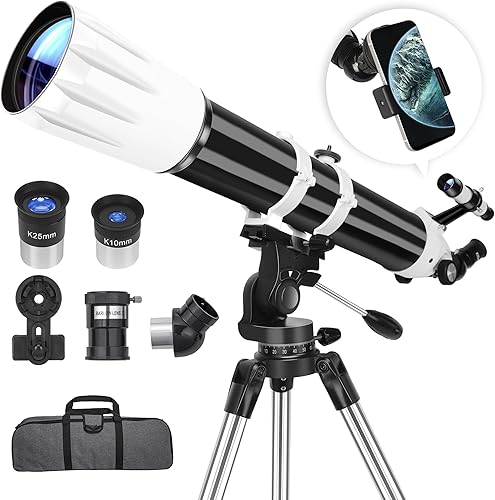 Best for a complete 90mm kit
Hawkko 90mm Aperture 900mm Telescope for Adults
9.7/10 our score
See it on Amazon -
3
 Best for app-guided stargazing
Celestron StarSense Explorer LT 80AZ Smartphone Guided
9.5/10 our score
See it on Amazon
- 4
 Check it
Celestron AstroMaster 70AZ Refractor Telescope for Moon
Best for simple Moon viewing - 5
 Best for a wide-field 90mm OTACheck it
- 6
 Check it
ToyerBee Telescope for Adults & Kids
Best for a lightweight starter kit
Which achromatic refractor telescope fits your priorities?
The SVBONY SV503 leads for lower-color imaging, while the Hawkko 90mm pairs a larger objective with a full kit. For confirmed achromatic designs, compare the SV48P’s short focal length with the AstroMaster’s longer one.
We compared aperture, focal length, optical design and included equipment against common buyer priorities. Our score weighs specs and features against what you're shopping for.
Aperture describes the objective lens diameter, which affects how much light the telescope can collect. Focal length helps frame the tradeoff between a wider field and a more focused view, but eyepieces and observing conditions matter too.
| Product | Best for | Aperture | Focal length | Optics | Our score |
|---|---|---|---|---|---|
| SVBONY SV503 Upgraded ED Refractor Telescope | lower-color imaging | 80mm | 560mm | ED refractor | 9.7 |
| Hawkko 90mm Aperture 900mm Telescope for Adults | a complete 90mm kit | 90mm | 900mm | 9.7 | |
| Celestron StarSense Explorer LT 80AZ Smartphone Guided | app-guided stargazing | 80mm | 400mm | 9.5 | |
| Celestron AstroMaster 70AZ Refractor Telescope for Moon | simple Moon viewing | 70mm | 900mm | Achromatic refractor | 9.3 |
| SVBONY SV48P Telescope | a wide-field 90mm OTA | 90mm | 500mm | Achromatic refractor OTA | 9.0 |
| ToyerBee Telescope for Adults & Kids | a lightweight starter kit | 70mm | 300mm | 7.9 |
Can an achromatic refractor show more color than an ED model?
Yes. An achromat can show color fringing around bright objects, while ED glass is designed to reduce chromatic aberration.
The SV503 is the only ED option in this group, so it offers a useful reference point for buyers who want a refractor with less color.
SVBONY SV503 Upgraded ED Refractor Telescope: Best for lower-color imaging
- 80mm aperture
- 560mm focal length
- S-FPL51 ED glass
- 0.8X field flattener
An 80mm ED refractor with a field flattener, built for portable deep-sky imaging. Its ED glass reduces chromatic aberration, though this is not a conventional achromat.
Pros
- ED glass reduces chromatic aberration
- Field flattener supports edge-to-edge imaging
- Dual-speed focuser
Cons
- Optical tube only
- No finderscope
The SVBONY SV503 combines an 80mm objective with S-FPL51 ED glass. For a different corrected lens design, compare triplet apochromatic refractors.
Its ED optics are designed to reduce chromatic aberration, which makes it a better match than a conventional achromat if color fringing is your main concern.
This is an optical tube with a 560mm focal length, a 2-inch dual-speed focuser and a 0.8X field flattener. The included field flattener is aimed at deep-sky imaging, with the design intended to keep stars sharp from the center toward the edge.
The tube weighs 2.5kg and has no finderscope. Plan for a compatible mount and a way to locate targets, and check that your camera setup can reach focus.
Choose it for a portable imaging setup and lower color, not as a conventional achromat. If you want a wider range of beginner telescope options, compare our best 80mm refractor telescopes.
Does a 90mm refractor make sense for visual astronomy?
A 90mm objective is the largest aperture in this group and can suit buyers who want a larger refractor. The Hawkko includes its mount and accessories, while the SV48P is an optical tube that needs a compatible mount.
Hawkko 90mm Aperture 900mm Telescope for Adults: Best for a complete 90mm kit
- 90mm aperture
- 900mm focal length
- Altazimuth mount
- Phone adapter and carry bag
A 90mm refractor supplied with a mount, tripod, eyepieces and phone adapter. Its longer focal length is a useful fit for buyers prioritizing Moon and landscape views.
Pros
- 90mm objective
- Includes mount, tripod and carry bag
- Two eyepieces and 3X Barlow included
Cons
- Heavier than the listed 70mm and 80mm options
- No ED glass specified
The Hawkko gives you a 90mm aperture and 900mm focal length in a complete kit. It includes a manual altazimuth mount, stainless steel tripod, finder, 25mm and 10mm eyepieces, a 3X Barlow, phone adapter and carry bag.
That longer focal length makes it a different kind of choice from the short SV48P. The Hawkko's supplied accessories also mean you don't need to shop separately for a mount before planning a first observing session.
The 90mm objective is described as multi-coated, but ED glass isn't specified. Expect the usual achromat tradeoff if you see color fringing around bright targets.
Choose it if you want a 90mm refractor with a mount and starter accessories in the box. Compare other adult-friendly models in our guide to the best refractor telescope for adults.
Is smartphone guidance useful on an 80mm refractor?
Smartphone guidance can help beginners find targets without relying only on a red-dot finder. The Celestron StarSense Explorer LT 80AZ pairs that guidance with an 80mm objective and a manual mount.
Celestron StarSense Explorer LT 80AZ Smartphone Guided: Best for app-guided stargazing
- 80mm refractor
- Smartphone sky guidance
- Manual altazimuth mount
- 25mm and 10mm eyepieces
An 80mm refractor that pairs a manual mount with smartphone sky guidance. Choose it when finding targets matters more than getting the longest focal length.
Pros
- App guides you toward targets
- 80mm aperture
- Mount and tripod included
Cons
- Shorter 400mm focal length
- No ED glass specified
The Celestron StarSense Explorer LT 80AZ is an 80mm refractor with a 400mm focal length. Its smartphone dock and StarSense app guide you toward targets using on-screen arrows, while the mount remains manual.
The package includes a tripod and mount, 25mm and 10mm eyepieces, a 2X Barlow, an erect-image diagonal and a red-dot finder. The app's target list varies with your time and location, which can help you decide what to observe.
This model is not identified as achromatic or ED in the product details here. Choose it for the guided setup and supplied accessories, then compare the lens type if color correction is a deciding factor.
Choose it if finding objects is your main hurdle. For a mount that can locate targets electronically, see our best GoTo telescopes.
What should you expect from a 70mm achromat?
A 70mm achromat offers a smaller objective than the 90mm models, with a longer focal length in the AstroMaster 70AZ. That combination suits buyers focused on the Moon, planets and daytime viewing.
Celestron AstroMaster 70AZ Refractor Telescope for Moon: Best for simple Moon viewing
- 70mm achromatic objective
- 900mm focal length
- Manual altazimuth mount
- 20mm and 10mm eyepieces
A 70mm achromatic refractor with a 900mm focal length and straightforward manual controls. It suits a beginner focused on the Moon, planets and daytime views.
Pros
- Achromatic optics are identified
- Includes mount, tripod and finder
- Day and night use
Cons
- Smallest aperture among the 70mm to 90mm options
- No ED glass specified
The Celestron AstroMaster 70AZ has a 70mm achromatic objective and 900mm focal length. See beginner refractor telescope options for other starter kits.
It includes a manual altazimuth mount with panhandle control, a tripod, red-dot finder, 20mm and 10mm eyepieces and an erect-image diagonal.
That equipment supports a simple start for backyard or daytime viewing. The listed uses include the Moon, planets, bright star clusters and terrestrial landmarks.
Its aperture is smaller than the 90mm options, and the lens is achromatic rather than ED. That makes it a more modest choice for light gathering, but a straightforward fit if you want a confirmed achromat with mount and accessories.
Choose it for basic Moon and planet observing with a complete kit. If you want more visual-use options, compare our best refractor telescopes for visual astronomy.
Is the SV48P a good short-focal-length achromat?
The SV48P is a 90mm achromatic optical tube with a 500mm focal length. It suits buyers who want a shorter tube and wider-field potential, provided they already have or plan to buy a compatible mount.
SVBONY SV48P Telescope: Best for a wide-field 90mm OTA
- 90mm aperture
- 500mm focal length
- Achromatic glass
- Dual-speed focuser
A 90mm achromatic optical tube with a 500mm focal length and dual-speed focuser. It offers a shorter focal length than the 900mm models, but you'll need a compatible mount.
Pros
- 90mm aperture
- Short 500mm focal length
- Rotatable dual-speed focuser
Cons
- Mount not included
- No finderscope
The SVBONY SV48P combines a 90mm aperture with a 500mm focal length. Its achromatic glass, fully multi-coated lens and dual-speed focuser make it the clearest conventional achromat choice here for a shorter focal length.
The focuser rotates 360 degrees for framing, and its dual-speed adjustment supports fine focus changes. The tube weighs 3kg and includes a dovetail slot, but it has no finderscope or mount in the package details.
Budget for a mount and finder if you don't already own them. The SV48P's shorter focal length may suit larger targets, but it doesn't replace the longer focal length of the 900mm models for every observing goal.
Choose it when you want a 90mm achromat OTA and can supply the rest of the setup. To compare the main refractor designs before choosing, read about the types of refractor telescopes.
Is the ToyerBee a confirmed achromatic telescope?
The ToyerBee is a 70mm refractor, but its lens type isn't specified in the available details. Treat it as a starter refractor alternative, not as a confirmed achromat.
ToyerBee Telescope for Adults & Kids: Best for a lightweight starter kit
- 70mm aperture
- 300mm focal length
- Phone adapter
- Tripod included
A compact 70mm refractor kit with a 300mm focal length, phone adapter and tripod. The available details don't identify its objective as achromatic, so treat it as a budget alternative rather than a confirmed achromat.
Pros
- 70mm aperture
- Phone adapter and wireless camera remote
- Tripod included
Cons
- Achromatic lens type not specified
- Short focal length
The ToyerBee has a 70mm aperture and 300mm focal length, with a tripod, phone adapter, wireless camera remote, two eyepieces and a 3X Barlow. It is the lightest stated complete kit in this group at 3.5 lb.
The shorter focal length and included phone accessories suit casual daytime viewing or trying basic phone photography. The product details don't identify the objective as achromatic, so buyers who specifically want that lens design should favor the SV48P or AstroMaster 70AZ instead.
Choose it for a lightweight starter kit and phone adapter, after confirming that its short focal length fits your observing plans. For a broader design comparison, read Is a Refractor or Reflector Telescope Better?.
How should you choose between aperture and color correction?
Choose aperture if collecting more light is your priority, and choose ED glass if reducing color fringing matters more. For visual use, also consider focal length, mount stability and whether the box includes the accessories you need.
A 90mm achromat such as the SV48P gives you more aperture than the 70mm AstroMaster, but it arrives as an optical tube. The Hawkko also has a 90mm objective and includes a mount, while the 80mm SV503 uses ED glass to reduce chromatic aberration.
A longer focal length can make it easier to frame the Moon and planets with common eyepieces, while shorter focal lengths can show a wider patch of sky. The telescope's mount and eyepiece choices also affect the view, so don't decide from focal length alone.
Which achromatic refractor should you pick?
Pick the SV503 if lower color fringing and imaging features matter most, the Hawkko if you want a 90mm complete kit, or the SV48P if you want a 90mm achromatic OTA with a shorter focal length. Choose the AstroMaster for a simpler 70mm achromat with its mount included.
If you're still weighing lens designs, start with our refractor and reflector comparison. For primarily visual observing, the visual astronomy refractor guide can help narrow the choice.
Our top 3 picks at a glance
-
1
Best for lower-color imaging
SVBONY SV503 Upgraded ED Refractor Telescope
9.7/10 our score
See it on Amazon -
2
Best for a complete 90mm kit
Hawkko 90mm Aperture 900mm Telescope for Adults
9.7/10 our score
See it on Amazon -
3
Best for app-guided stargazing
Celestron StarSense Explorer LT 80AZ Smartphone Guided
9.5/10 our score
See it on Amazon
Frequently asked questions
What is an achromatic refractor telescope?
An achromatic refractor uses a lens design that brings two colors of light to a common focus, reducing color fringing compared with a simple single lens. Some color may remain, especially around bright objects.
Aperture, focal length and lens design all affect the view.
Do achromatic refractors show color around the Moon?
They can show a colored fringe around bright targets such as the Moon or planets. The amount depends on the lens design, aperture and focal length.
If reducing color matters more than keeping the cost and setup simple, compare ED refractors, which use extra-low-dispersion glass.
Is a 90mm achromat better than an 80mm ED refractor?
A 90mm achromat gathers more light by aperture, while an 80mm ED refractor is designed to reduce chromatic aberration. The better fit depends on whether you value aperture or lower color fringing more.
Also compare focal length, mount and whether the telescope is an optical tube only.
Can you use an achromatic refractor for astrophotography?
Yes, but color fringing can affect bright stars and other high-contrast targets. A field flattener may help keep stars sharp across the image, while an ED refractor can reduce chromatic aberration.
Check camera compatibility, focus and mount needs before choosing a setup.



