Best 80mm Refractor Telescopes: Top 7 Picks (November 2026)
The best 80mm refractor telescopes include the SVBONY SV503 Upgraded ED Refractor Telescope for entry-level deep-sky imaging, the EACONN Telescopes for Adults Astronomy for portable visual observing, and the Celestron StarSense Explorer LT 80AZ Smartphone Guided for guided first observations.
On this page (4 sections)
The best 80mm refractor telescope for entry-level imaging is the SVBONY SV503, with ED glass, a 0.8X focal reducer and a dual-speed focuser. For guided visual observing, the Celestron StarSense Explorer LT 80AZ offers phone-based sky guidance, while the EACONN makes a practical portable kit with a backpack and tripod.
An 80mm refractor is a useful middle ground: it can be light enough for travel while offering more aperture than many smaller beginner scopes. But the best choice depends on whether you want a complete visual kit, easier target finding or an optical tube for a camera setup.
If you're new to refractor optics, start with What Is a Refracting Telescope? The Key Facts.
For adult-focused options beyond this aperture, see best refractor telescope for adults.
Our picks at a glance
-
1
 Best for entry-level deep-sky imaging
SVBONY SV503 Upgraded ED Refractor Telescope
9.7/10 our score
See it on Amazon -
2
 Best for portable visual observing
EACONN Telescopes for Adults Astronomy
9.6/10 our score
See it on Amazon -
3
 Best for guided first observations
Celestron StarSense Explorer LT 80AZ Smartphone Guided
9.5/10 our score
See it on Amazon
- 4
 Check it
Celestron PowerSeeker 80EQ Refractor Telescope for Moon
Best for learning equatorial tracking - 5
 Check it
CELTICBIRD Telescope for Adults High Powered
Best for a travel-ready family kit - 6
 Check it
MEEZAA Telescope for Adults & Kids
Best for mixed daytime and night viewing - 7
 Best for advanced color-corrected imagingCheck it
Which 80mm refractor telescope fits your observing plans?
The SVBONY SV503 is the strongest match for entry-level deep-sky imaging, while the StarSense Explorer LT 80AZ and EACONN are better suited to straightforward visual use. Choose an optical tube if you already have a mount plan, or a complete kit if you want the tripod and accessories included.
SVBONY SV503 Upgraded ED Refractor Telescope: Best for entry-level deep-sky imaging
- 80mm aperture
- S-FPL51 ED glass
- 0.8X focal reducer and field flattener
- 2-inch dual-speed focuser
ED glass and the included 0.8X focal reducer suit a portable imaging setup. The dual-speed focuser offers fine focus adjustment, while the reducer is designed to flatten the field for sharper stars across the frame.
Pros
- ED glass to reduce chromatic aberration
- Includes a 0.8X focal reducer
- Dual-speed focuser with 1:10 adjustment
Cons
- Optical tube only, so you need a compatible mount
- Imaging features may add cost without helping a visual-only setup
The SVBONY SV503 Upgraded ED Refractor Telescope is the top choice here for a compact imaging setup. Its 80mm aperture, S-FPL51 ED glass and included SV193 0.8X focal reducer are aimed at deep-sky photography, where a flatter field and shorter exposures can matter.
The 2-inch dual-speed focuser gives a 1:10 fine adjustment, a useful feature when making small focus changes with a camera attached. The tube weighs 5.51 lb, which can reduce the load on a suitable mount, though the mount itself is not part of this pick.
For visual observing, it can still work with compatible accessories, but the included imaging pieces add less value if you mainly want to look at the Moon and planets. Confirm the camera connection and mount capacity for your setup before choosing it.
Pick it for imaging flexibility in a portable tube, especially if you want a reducer and field flattener in the kit. Choose a complete visual set instead if you need a tripod, mount and eyepieces in one package.
EACONN Telescopes for Adults Astronomy: Best for portable visual observing
- 80mm aperture
- 600mm focal length
- Backpack and adjustable tripod
- 20mm and 9mm eyepieces
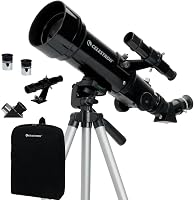
This complete set pairs an 80mm refractor with a tripod, backpack, two eyepieces and a phone adapter. Its carrying case and simple altazimuth mount suit casual visual sessions and travel.
Pros
- Includes tripod and backpack
- Two eyepieces and a phone adapter
- Altazimuth mount is simple to point
Cons
- No imaging-specific field flattener
- Rough-adjustment mount offers less precise tracking
The EACONN is the most ready-to-carry visual kit in this group. Compare refractors for visual astronomy if eyepiece observing is your priority.
It includes an 80mm refractor, an altazimuth mount, an adjustable tripod, two eyepieces, a finder scope, a phone adapter and a backpack.
Its 600mm focal length gives it a longer reach than the 400mm StarSense model, while the included 20mm and 9mm eyepieces are listed for 30X and 66X magnification. That is a simple starting range for the Moon, planets and daytime targets, though atmospheric conditions and focus affect how much detail you can see.
The mount uses rough adjustment and a positioning scale. That keeps basic pointing simple, but it does not offer the slow-motion controls found on some alternatives.
Choose it for a portable visual kit that packs into a backpack. If you want phone assistance finding night-sky targets, the StarSense Explorer has a more focused guidance system.
Celestron StarSense Explorer LT 80AZ Smartphone Guided: Best for guided first observations
- 80mm refractor
- StarSense smartphone sky guidance
- Manual altazimuth mount
- 25mm and 10mm eyepieces
StarSense uses sky recognition to guide you toward targets through a phone app. The set includes a phone dock, two eyepieces, a red dot finder and a full-height tripod.
Pros
- Phone guidance helps find targets
- Includes two eyepieces and a tripod
- Designed for Moon, planet and bright deep-sky viewing
Cons
- Manual mount requires you to move the telescope
- Phone compatibility requirements should be checked
The Celestron StarSense Explorer LT 80AZ is the best fit here if locating targets is your main hurdle. Its phone dock and StarSense app use sky recognition to guide you toward objects, then the manual altazimuth mount lets you point the telescope.
The 80mm refractor comes with 25mm and 10mm eyepieces, a red dot finder, a full-height tripod and an erect image diagonal. Celestron describes it for the Moon, Jupiter, Saturn, bright nebulae and galaxies, with the available targets depending on your sky and location.
This is a visual telescope with phone guidance, not a motorized GoTo mount. If you want a broader set of powered target-finding options, compare best go to telescopes.
Pick it for guided beginner observing and a complete manual setup. Check phone compatibility before buying, since the app has stated operating-system requirements.
Celestron PowerSeeker 80EQ Refractor Telescope for Moon: Best for learning equatorial tracking
- 80mm refractor
- 900mm focal length
- Manual German equatorial mount
- 20mm and 4mm eyepieces plus 3X Barlow
The longer focal length and equatorial mount make this a fit for Moon and planet viewing. The mount takes more setup than an altazimuth design, but its slow-motion control can help follow objects across the sky.
Pros
- Equatorial mount with slow-motion control
- Includes two eyepieces and a Barlow lens
- 80mm aperture for Moon and planet viewing
Cons
- Heavier than the portable altazimuth kits here
- Equatorial setup takes practice
The Celestron PowerSeeker 80EQ suits buyers who want to learn an equatorial mount while observing the Moon and planets. Its 900mm focal length is the longest among the visual kits here, and the manual German equatorial mount has slow-motion control for following objects.
The package includes 20mm and 4mm eyepieces plus a 3X Barlow lens. High magnification can make an image dimmer and harder to keep steady, so begin with the lower-power eyepiece and add magnification only when the view remains clear.
At 16.4 lb, it is heavier than the compact altazimuth packages in this roundup. Make sure you're comfortable carrying and setting up the mount, especially if you plan to observe away from home.
Choose it to practice equatorial tracking with a complete telescope set. For a camera-first telescope, compare the dedicated best imaging Newtonian telescope options as another optical design.
CELTICBIRD Telescope for Adults High Powered: Best for a travel-ready family kit
- 80mm aperture
- 600mm focal length
- Backpack and adjustable tripod
- Phone adapter and Moon filter
The kit includes a backpack, phone adapter, Moon filter, two eyepieces and an adjustable tripod. Those bundled items suit family observing when you want a portable set for the Moon and planets.
Pros
- Includes a backpack and adjustable tripod
- Moon filter and phone adapter included
- Two eyepieces
Cons
- No stated imaging field flattener
- Phone photos are not a substitute for a dedicated imaging setup
The CELTICBIRD kit is a family-oriented portable option with a backpack, adjustable aluminum tripod, phone adapter and Moon filter. Its 80mm aperture and 600mm focal length are paired with 20mm and 9mm eyepieces, plus a 5x24 finder scope.
The included mount is altazimuth, which keeps pointing intuitive for casual viewing. CELTICBIRD describes the set for the Moon and planets, and the filter is designed to reduce incoming light for lunar contrast.
The phone adapter can hold a phone for basic through-the-eyepiece captures, but this is not a dedicated deep-sky imaging kit. It does not include a field flattener or camera-focused dual-speed focuser.
Pick it for family observing with travel accessories included. If you want an adult-focused comparison across refractor sizes and formats, see Best Refractor Telescopes for Adults.
MEEZAA Telescope for Adults & Kids: Best for mixed daytime and night viewing
- 80mm aperture
- 500mm focal length
- 45-degree zenith mirror
- Backpack and phone adapter
A 45-degree mirror gives an upright image for daytime use, and the kit includes a backpack, phone adapter and two eyepieces. It can serve as a family scope for landscapes and basic night-sky viewing.
Pros
- Includes an upright-image 45-degree mirror
- Backpack and phone adapter included
- Adjustable tripod
Cons
- No imaging-specific field flattener
- Bundled high magnification does not guarantee a sharp view
The MEEZAA set stands out for daytime use as well as night observing. Its 45-degree zenith mirror gives an upright image, and the included kit adds an adjustable tripod, phone adapter, backpack, two eyepieces and a 3X Barlow lens.
The 80mm aperture and 500mm focal length make it a compact family option. The maker lists a 20X to 150X magnification range, but the highest figure is not necessarily useful in every observing condition; a steady mount and clear air matter too.
The phone adapter is intended for recording views through the eyepiece. For serious astrophotography, look for a scope with imaging-specific focus and field correction features.
Choose it for a mixed daytime and beginner night-sky kit. Its upright mirror helps with landscapes, while a dedicated imaging tube makes more sense if deep-sky photography is the goal.
SVBONY SV550 AP0 Telescope: Best for advanced color-corrected imaging
- 80mm triplet apochromatic optics
- 480mm focal length
- S-FPL51 ED glass
- 2.5-inch dual-speed focuser
The triplet apochromatic design and dual-speed focuser target imaging where color correction and fine focus matter. It is an optical tube, so plan for a compatible mount and camera or eyepiece separately.
Pros
- Triplet APO optics with ED glass
- Dual-speed focuser with 1:10 ratio
- Internal baffles help control stray light
Cons
- Optical tube only
- More specialized than a simple visual starter kit
The SVBONY SV550 is the specialized imaging choice in this roundup. Its triplet apochromatic optics combine one S-FPL51 ED element with two correction lenses, while a 2.5-inch dual-speed focuser supports fine adjustment.
The 480mm focal length makes it a shorter optical tube than the SV503. SVBONY describes the scope for Moon, planet and deep-sky imaging, and the design includes internal baffles to limit stray light.
This is an optical tube, not a complete telescope kit. You will need a compatible mount, camera or eyepiece, and any other accessories required for your observing plan.
Choose it for triplet color correction and imaging focus control. Its specialized tube design is less suitable if you simply want an inexpensive all-in-one visual set.
What should you compare before choosing an 80mm refractor?
For an 80mm refractor, compare the mount, focal length, included accessories and whether the optics are designed for visual use or imaging. See achromatic refractor options for one lens design to consider.
Aperture alone doesn't tell you how easy the whole telescope will be to use.
Is the 80mm aperture enough for your targets?
An 80mm objective offers more light gathering than a 70mm objective, but it cannot make every faint object visible from a bright city. The Moon and bright planets are common visual targets, while galaxies and nebulae often need dark skies and modest expectations.
If you're weighing different optical designs, Is a Refractor or Reflector Telescope Better? explains the trade-offs. Refractors use lenses and generally need less optical maintenance, while reflectors can offer more aperture for a similar budget.
Does focal length change what you can see?
Focal length affects the view with a given eyepiece: longer focal lengths generally produce higher magnification and a narrower field. The 900mm PowerSeeker is better suited to higher-power lunar and planetary viewing than the shorter 400mm StarSense model, though seeing conditions set a practical limit.
A telescope's focal length doesn't determine quality by itself. The mount's steadiness, eyepiece choice and sky conditions all shape the view.
Should you buy an ED or apochromatic refractor?
ED and apochromatic optics are designed to reduce color fringing, a visible edge of color around bright objects. The SV503 uses ED glass, while the SV550 uses a triplet APO design with an ED element and correction lenses.
The triplet design is more specialized and often makes more sense for imaging than a basic visual kit. Learn how the design works in What Is a Triplet Apochromatic Refractor?.
Is an 80mm refractor suitable for imaging?
An 80mm refractor can work for entry-level imaging when the tube, mount, camera and focus system are compatible. The SV503 includes a focal reducer and field flattener, while the SV550 has a triplet objective and dual-speed focuser, but neither includes a complete imaging mount in this roundup.
For deep-sky work, the mount's tracking and payload capacity matter as much as the telescope. A phone adapter can capture simple Moon images, but it does not replace a camera-ready imaging system.
What mount is easiest for a beginner?
An altazimuth mount moves up-down and side-to-side, which is usually simpler for casual visual use. Equatorial mounts require alignment but can follow the sky's motion with one axis, which is useful for sustained tracking.
The Celestron PowerSeeker 80EQ is the equatorial option here. For an altazimuth kit, consider the EACONN or StarSense Explorer, depending on whether you prefer simple pointing or phone guidance.
How do you choose between an 80mm and a 70mm refractor?
Choose an 80mm refractor if you want more light gathering and can manage the full setup, including the mount and tripod. A 70mm model may be easier to carry and can be a sensible first scope when portability and simplicity matter most.
The included mount can change the practical difference more than the aperture number suggests. Compare the best 70mm refractor telescope choices with the 80mm kits here before deciding.
Which 80mm refractor is the right pick?
Choose the SVBONY SV503 if entry-level deep-sky imaging is your priority, and the Celestron StarSense Explorer LT 80AZ if guided visual target finding sounds useful. Pick EACONN for a portable all-in-one set, or the PowerSeeker 80EQ if you want to learn an equatorial mount.
For visual viewing, prioritize a steady mount and accessories that fit your plans. For imaging, start with mount compatibility, then compare focus control and field correction before choosing an 80mm refractor.
Our top 3 picks at a glance
-
1
Best for entry-level deep-sky imaging
SVBONY SV503 Upgraded ED Refractor Telescope
9.7/10 our score
See it on Amazon -
2
Best for portable visual observing
EACONN Telescopes for Adults Astronomy
9.6/10 our score
See it on Amazon -
3
Best for guided first observations
Celestron StarSense Explorer LT 80AZ Smartphone Guided
9.5/10 our score
See it on Amazon
Frequently asked questions
What can you see with an 80mm refractor telescope?
An 80mm refractor can show the Moon, bright planets, and some bright deep-sky objects, depending on sky conditions, magnification and optical quality. The Celestron StarSense Explorer LT 80AZ is described for lunar, planetary and bright deep-sky viewing.
A dark site helps with faint targets, while steady air helps keep planetary views from shimmering.
Is an 80mm refractor good for astrophotography?
Yes, an 80mm refractor can suit entry-level imaging if the optical design, focuser and mount match your camera and targets. The SVBONY SV503 includes a 0.8X focal reducer and field flattener, while the SV550 has triplet APO optics and a dual-speed focuser.
Check camera compatibility and mount capacity before choosing an optical tube.
Is an 80mm refractor portable?
Many 80mm refractors are manageable for travel, but portability depends on the tube, mount, tripod and accessories together. EACONN and CELTICBIRD include backpacks, while the SV503 tube is listed at 5.51 lb without a full observing setup.
Check packed dimensions and the total carried weight before planning a trip.
Should I choose an altazimuth or equatorial mount?
An altazimuth mount moves up and down and left and right, making it straightforward for visual observing. An equatorial mount takes more setup but can follow the sky's apparent motion with one slow-motion axis when aligned.
Compare the mount options for a Celestron 80mm refractor if mount style is your main choice.
Is an 80mm refractor better than a 70mm model?
An 80mm objective gathers more light than a 70mm objective, while the full telescope's weight, mount and price tier also affect the choice. A 70mm scope may be easier to carry as a complete set.
See our guide to the best 70mm refractor telescope for smaller-aperture options.