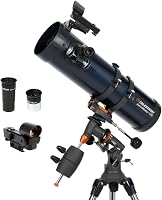
9 Best Telescopes for Galaxy Astrophotography (November 2026)
The best telescopes for galaxy astrophotography include the ZWO Seestar S30 Pro Smart Telescope for automatic galaxy imaging, the Celestron NexStar 8SE Computerized Telescope for larger aperture and GoTo, and the DWARFLAB Dwarf 3 Smart Telescope for portable telephoto imaging.
On this page (4 sections)
The best telescope for galaxy astrophotography depends on your target size and tracking needs. The ZWO Seestar S30 Pro makes automated imaging approachable, while the Celestron NexStar 8SE offers a larger aperture and longer focal length for smaller targets.
Galaxies are faint and often small in the frame, so aperture alone does not decide the result. Tracking, focal length, camera compatibility, sky darkness and your willingness to align equipment all shape the setup.
For a broader setup overview, start with our telescopes for astrophotography guide. If you plan to use a DSLR, compare dedicated best telescope for DSLR astrophotography options as well.
Our picks at a glance
-
1
 Best for automatic galaxy imaging
ZWO Seestar S30 Pro Smart Telescope
9.7/10 our score
See it on Amazon -
2
 Best for larger aperture and GoTo
Celestron NexStar 8SE Computerized Telescope
9.4/10 our score
See it on Amazon -
3
 Best for portable telephoto imaging
DWARFLAB Dwarf 3 Smart Telescope
9.0/10 our score
See it on Amazon
- 4
 Check it
DWARFLAB Dwarf Mini Smart Telescope
Best for lightweight EQ imaging - 5
 Check it
Sky-Watcher Sky-Watcher Heritage 130mm Tabletop Dobsonian 5-inch
Best for visual galaxy observing - 6
 Check it
Celestron AstroMaster 130EQ Telescope for Deep-Sky Beginners
Best for learning manual EQ tracking - 7
 Check it
Gskyer 130EQ Professional Astronomical Reflector Telescope
Best for budget visual deep-sky use - 8
 Best for general beginner observingCheck it
- 9
 Best for phone-assisted sky viewingCheck it
How we chose telescopes for galaxy astrophotography
We compared aperture, focal length, mount type, tracking features and the imaging approach each model supports. Automated smart telescopes simplify target finding and capture, while traditional optical tubes give you more control over the camera and mount pairing.
Galaxy targets vary widely in apparent size and brightness. A large nearby galaxy can fit a short focal length, while compact galaxies often benefit from more image scale and precise tracking.
The scores weigh those features against the needs of galaxy imaging. Our score weighs specs, features and buyer feedback against what you're shopping for.
| Product | Best for | Aperture | Focal length | Control | Our score |
|---|---|---|---|---|---|
| ZWO Seestar S30 Pro Smart Telescope | automatic galaxy imaging | 30mm | 160mm | App controlled with automatic GoTo and tracking | 9.7 |
| Celestron NexStar 8SE Computerized Telescope | larger aperture and GoTo | 8 in | 2032mm | 9.4 | |
| DWARFLAB Dwarf 3 Smart Telescope | portable telephoto imaging | 9.0 | |||
| DWARFLAB Dwarf Mini Smart Telescope | lightweight EQ imaging | 150mm | 9.1 | ||
| Sky-Watcher Sky-Watcher Heritage 130mm Tabletop Dobsonian 5-inch | visual galaxy observing | 130mm | 650mm | 9.7 | |
| Celestron AstroMaster 130EQ Telescope for Deep-Sky Beginners | learning manual EQ tracking | 130mm | 650mm | 9.7 | |
| Gskyer 130EQ Professional Astronomical Reflector Telescope | budget visual deep-sky use | 5.1 in | 650mm | 8.9 | |
| MEEZAA Telescope | general beginner observing | 90mm | 800mm | 9.6 | |
| HUGERSTAR Telescope | phone-assisted sky viewing | 90mm | 800mm | 9.3 |
The best telescope for galaxy astrophotography by use
The strongest picks balance target framing with tracking and workflow. Use the individual fit notes to match a scope to your experience and the type of galaxy you want to photograph.
ZWO Seestar S30 Pro Smart Telescope: Best for automatic galaxy imaging
- Automatic GoTo targeting and tracking
- 30mm apochromatic optics
- App-based imaging
- Deep-sky imaging modes
Automatic target finding and tracking reduce setup work for app-based deep-sky imaging. Its 30mm optics suit compact, portable use, though small galaxy targets call for careful expectations.
Pros
- Automatic GoTo and tracking
- App-controlled capture
- Portable 3.6 lb design
Cons
- 30mm aperture limits image scale for small galaxies
- Stationary placement is advised during deep-sky imaging
The Seestar S30 Pro is the most direct choice here if you want an integrated imaging workflow. Its app provides automatic GoTo targeting and tracking, and the 30mm apochromatic optics are designed for deep-sky imaging.
Built-in light pollution filters and image processing can help simplify capture in brighter locations. The device weighs 3.6 lb, so it is easier to bring to a dark-sky site than a full-size telescope and mount.
Its 160mm focal length gives a broad view, which helps with larger targets and sky scenes. Small galaxies will occupy less of the frame, so check target framing expectations before choosing it specifically for compact objects.
Choose this if you value automated capture and portability over a large aperture. For more all-in-one camera options, see our best computer-controlled telescope with camera guide.
Celestron NexStar 8SE Computerized Telescope: Best for larger aperture and GoTo
- 8-inch Schmidt-Cassegrain optics
- Computerized GoTo mount
- 40,000+ object database
- Automatic target tracking
The 8-inch aperture and long focal length offer a larger image scale for compact galaxies than the small smart scopes here. Its altitude-azimuth mount is computerized for finding and tracking targets.
Pros
- Largest aperture in this roundup
- Automated GoTo and tracking
- 40,000+ object database
Cons
- Astrophotography setup needs more planning than an all-in-one smart scope
- Long focal length makes tracking accuracy important
The NexStar 8SE is the aperture pick for buyers who want a traditional telescope with computerized target finding. Its 8-inch Schmidt-Cassegrain optics and 2032mm focal length give compact galaxies a larger image scale than the small smart scopes.
The GoTo mount uses a database of more than 40,000 objects and tracks after finding a target. SkyAlign uses three bright stars or planets for alignment, and the hand control operates the mount.
The mount is an altitude-azimuth single fork arm design. Long exposures require attention to tracking and camera integration, so plan the imaging setup rather than assuming the GoTo function alone handles every astrophotography need.
Choose the 8SE if aperture and longer focal length matter more than a simple all-in-one process. For a lighter setup, the most powerful portable telescope options may help narrow the trade-offs.
DWARFLAB Dwarf 3 Smart Telescope: Best for portable telephoto imaging
- Dual imaging system
- Telephoto lens for deep-sky objects
- Automatic tracking
- Equatorial mode
The telephoto lens is intended for distant galaxies and nebulae, while the second camera handles wide-field scenes. Its automatic tracking and EQ mode make it a flexible portable imaging option.
Pros
- Telephoto and wide-angle imaging
- Automatic tracking
- EQ mode
Cons
- 35mm objective lens is small for faint, compact targets
- Smartphone or computer workflow differs from a traditional imaging rig
The DWARF 3 combines telephoto and wide-angle imaging in a compact smart system. Its telephoto lens is intended for distant galaxies and nebulae, while automatic tracking and EQ mode support deep-sky capture.
The dual imaging system also makes it useful when you want both a tighter target view and wide sky scenes. Its app-based workflow handles capture and cloud processing without requiring a separate computer for basic use.
This is a portable option for people who want automatic imaging and more than one field of view. For easy-to-carry first scopes, see portable telescopes for beginners.
Its 35mm objective is still small compared with an 8-inch telescope, so the most compact galaxies remain challenging targets.
Choose it if travel and a simplified camera workflow rank highly. If you're new to the equipment, our best beginner telescope for astrophotography picks cover easier entry points.
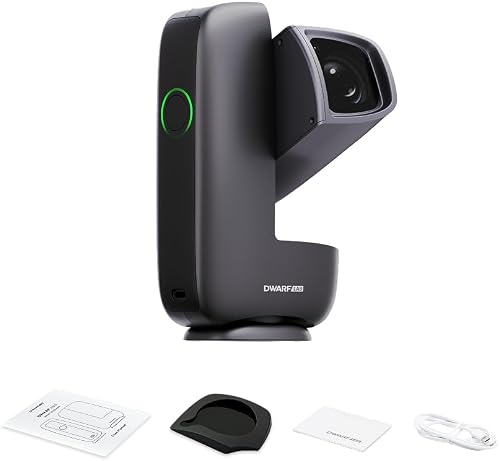
DWARFLAB Dwarf Mini Smart Telescope: Best for lightweight EQ imaging
- Automatic GoTo
- Equatorial mode
- Up to 90-second single-frame exposures
- Built-in light pollution filters
Equatorial mode and single-frame exposures up to 90 seconds provide useful tools for deep-sky imaging in a compact device. Its small objective is better suited to brighter or larger targets than tiny, faint galaxies.
Pros
- EQ mode
- Single-frame exposures up to 90 seconds
- Very light at 1.85 lb
Cons
- 30mm objective gathers less light than larger telescopes
- Small image scale is a limitation for compact galaxies
The DWARF Mini adds EQ mode and exposures up to 90 seconds in a 1.85 lb device. Automatic GoTo and built-in light pollution filters give it a useful set of deep-sky tools for a small package.
Its 30mm objective and 150mm focal length favor bright, larger targets over tiny galaxy details. The light weight makes it easy to take to darker skies, where the background is less affected by local light pollution.
Choose the Mini if portability and automated operation matter most. It can be an accessible way to learn target selection and capture, but a longer focal length telescope is more suitable when you want galaxies to fill more of the image.
See our DWARFLAB Mini telescope review for a closer look at its portable imaging approach.
Sky-Watcher Sky-Watcher Heritage 130mm Tabletop Dobsonian 5-inch: Best for visual galaxy observing
- Over 5 inches of aperture
- 650mm focal length
- Tabletop Dobsonian mount
- Collapsible design
The 130mm aperture gathers more light than the compact smart scopes, making this a useful visual telescope for brighter deep-sky objects. Its manual tabletop Dobsonian mount is not designed for long-exposure galaxy imaging.
Pros
- 130mm aperture
- Compact tabletop package
- Fully assembled design
Cons
- Manual altazimuth mount does not track targets
- Visual telescope rather than a dedicated imaging system
The Heritage 130 is a visual-first Dobsonian with over 5 inches of aperture. Its collapsible tabletop design makes it compact to transport, and it arrives assembled with two eyepieces and a red dot finder.
That aperture can help reveal brighter deep-sky objects through the eyepiece. The altazimuth Dobsonian mount is manual, however, so it does not provide the tracking needed to keep a galaxy centered during a long exposure.
Choose it if visual observing is the priority and you want to explore galaxies before investing in an imaging rig. It is not the right match for long-exposure astrophotography without a suitable tracking solution.
For daytime and planetary viewing choices, compare our best telescope for beginners to see planets guide.
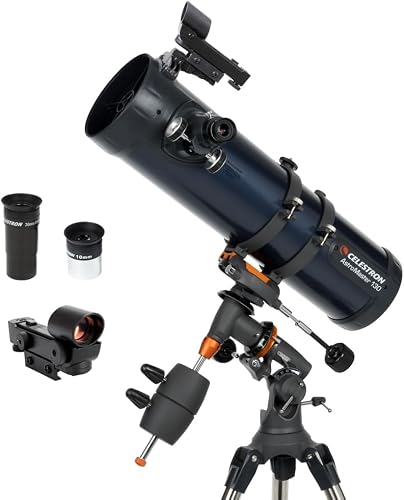
Celestron AstroMaster 130EQ Telescope for Deep-Sky Beginners: Best for learning manual EQ tracking
- 130mm Newtonian reflector
- German equatorial mount
- Right ascension and declination slow-motion controls
- 650mm focal length
Its equatorial mount and slow-motion controls introduce manual tracking, while the 130mm aperture supports visual views of brighter galaxies. Imaging still requires careful alignment and a camera setup.
Pros
- 130mm aperture
- Equatorial mount with slow-motion controls
- Includes StarPointer finder
Cons
- Manual mount requires user tracking
- Not an automated imaging system
The AstroMaster 130EQ pairs 130mm Newtonian optics with a manual German equatorial mount. Slow-motion controls on the right ascension and declination axes let you make small pointing adjustments as an object moves.
This setup can teach the basics of polar alignment and manual tracking while providing visual views of brighter galaxies. Its 650mm focal length gives a wider field than the 8SE, so compact galaxies appear smaller in the frame.
A DSLR or astronomy camera may be part of a later upgrade, but the mount remains manually controlled. Consider this model for learning and visual use, not as an automated long-exposure system.
Gskyer 130EQ Professional Astronomical Reflector Telescope: Best for budget visual deep-sky use
- 5.1-inch aperture
- 650mm focal length
- German equatorial mount
- Bluetooth camera remote
The 5.1-inch reflector and equatorial mount can introduce beginners to galaxy observation and basic tracking. The included Bluetooth remote supports phone photos, but it does not replace a dedicated deep-sky camera workflow.
Pros
- 5.1-inch aperture
- German equatorial mount
- Bluetooth camera remote
Cons
- Phone remote is not a dedicated astrophotography camera
- Manual tracking requires practice
The Gskyer 130EQ has a 5.1-inch aperture, 650mm focal length and German equatorial mount. Its Bluetooth camera remote can trigger a compatible phone, but that feature does not turn it into a dedicated deep-sky imaging setup.
The equatorial mount provides a starting point for learning how to follow targets, and the aperture supports visual viewing of brighter galaxies. The included accessories are oriented toward observing, so camera and tracking expectations should stay modest.
Choose it for entry-level sky viewing and basic phone photography. Buyers who want more control over image capture should budget for a separate camera and consider whether this mount can meet the tracking demands of their targets.
MEEZAA Telescope: Best for general beginner observing
- 90mm refractor aperture
- 800mm focal length
- Phone adapter included
- Manual altazimuth mount
This refractor includes a phone adapter and carry bag for casual viewing and simple phone captures. Its manual altazimuth mount is not a strong fit for tracking the long exposures needed for faint galaxies.
Pros
- 90mm aperture
- Phone adapter included
- Carry bag included
Cons
- Manual altazimuth mount
- Not built around long-exposure tracking
The MEEZAA Telescope is a 90mm refractor with an 800mm focal length and a manual altazimuth mount. It includes a phone adapter and carry bag, which suit casual observing and simple phone captures.
The longer focal length gives a narrower view than the compact smart scopes, but there is no automatic tracking for deep-sky exposures. Manual adjustments make it less suited to capturing faint galaxies over extended sessions.
Choose it if general beginner observing is your main goal and galaxy photography is only occasional. A tracking smart scope or equatorial imaging setup is a better direction for dedicated galaxy work.
HUGERSTAR Telescope: Best for phone-assisted sky viewing
- 90mm refractor aperture
- 800mm focal length
- Phone adapter included
- Manual altazimuth mount
A 90mm refractor and phone adapter suit basic sky viewing and casual lunar photos. For faint galaxies, the manual mount and lack of automatic tracking make it a less direct imaging choice.
Pros
- 90mm aperture
- Phone adapter and moon filter included
- Adjustable tripod
Cons
- Manual altazimuth mount
- No automatic tracking
The HUGERSTAR Telescope also combines 90mm refractor optics with an 800mm focal length. Its phone adapter and moon filter support casual capture and visual lunar viewing, while the manual altazimuth mount keeps the setup simple.
For galaxies, the key limit is tracking. Without automated or motorized tracking, the telescope cannot hold faint targets steady for the longer exposures commonly needed in deep-sky imaging.
Choose it for general night-sky observation and phone-assisted snapshots rather than a dedicated galaxy camera rig. The portable bag and adjustable tripod make transport easier, but they do not change the mount's tracking limits.
What matters most when photographing galaxies?
Galaxy photos benefit from a balance of image scale, light gathering and accurate tracking. The right combination depends on whether you want wide views of bright, large galaxies or close framing of compact targets.
How does focal length affect galaxy framing?
Longer focal lengths make small galaxies occupy more of the image, but they also magnify tracking errors. A 2032mm focal length like the NexStar 8SE's calls for steady tracking and careful alignment.
Short focal lengths frame larger portions of the sky and are often easier to manage. They can be a good fit for broad galaxies, but tiny targets may appear only as small marks.
Is aperture or tracking more important?
Both matter, but a larger aperture cannot compensate for poor tracking in long exposures. Aperture gathers more light, while tracking keeps the target positioned consistently during capture.
A smart scope with a small objective can produce a simpler workflow, especially for brighter targets. A larger traditional telescope can gather more light, but it usually requires more planning around mount, camera and alignment.
Are smart telescopes a good fit for galaxies?
Smart telescopes suit beginners who want target finding, tracking and capture combined in one device. The Seestar S30 Pro and DWARF models offer automated functions that reduce manual setup.
Their compact optics make them better suited to larger or brighter galaxies than very small, faint targets. Check examples and target framing from the model before setting expectations for a particular galaxy.
Which telescope fits your galaxy imaging plan?
Choose the ZWO Seestar S30 Pro if you want automatic target finding and app-based imaging in a portable package. Choose the NexStar 8SE if you want an 8-inch aperture and longer focal length, and are ready to plan a more involved imaging setup.
The DWARF 3 and Mini suit travel and automated operation, while the 130mm Newtonians are better beginner visual scopes with manual tracking. For larger sky scenes, compare the best telescope for wide-field astrophotography before choosing a longer focal length for small targets.
Our top 3 picks at a glance
-
1
Best for automatic galaxy imaging
ZWO Seestar S30 Pro Smart Telescope
9.7/10 our score
See it on Amazon -
2
Best for larger aperture and GoTo
Celestron NexStar 8SE Computerized Telescope
9.4/10 our score
See it on Amazon -
3
Best for portable telephoto imaging
DWARFLAB Dwarf 3 Smart Telescope
9.0/10 our score
See it on Amazon
Frequently asked questions
What telescope is best for galaxy astrophotography?
A telescope with suitable image scale and steady tracking is key for galaxy photos. The Celestron NexStar 8SE has an 8-inch aperture and 2032mm focal length for compact targets, while smart scopes such as the ZWO Seestar S30 Pro automate finding and tracking.
Choose based on your camera workflow and mount, not aperture alone.
Is a bigger telescope always better for galaxy photos?
No. A larger aperture can gather more light, but galaxy imaging also depends on tracking, camera, focus, sky conditions and target size.
A long focal length can frame small galaxies more closely, yet it makes tracking errors more visible.
A smaller tracked scope can be easier to use and may suit larger targets.
Can a Dobsonian telescope take galaxy photos?
A Dobsonian can show galaxies visually, but a basic manual altazimuth model does not track the sky for long exposures. That movement limits its use for deep-sky photography.
For imaging, consider a tracking mount or an automated smart telescope.
The Sky-Watcher Heritage 130 is better treated as a visual scope.
Do smart telescopes photograph small galaxies?
Some smart telescopes can capture galaxies, but small apertures and short focal lengths give compact targets a small image scale. Brighter and larger galaxies are more suitable starting points.
Check the target framing and the device's tracking approach before choosing one for a specific galaxy.
Do I need an equatorial mount for galaxy astrophotography?
An equatorial mount helps keep a target centered as Earth rotates, which matters during long exposures. Some smart telescopes offer an EQ mode, while manual equatorial mounts need careful alignment and operation.
The mount's tracking accuracy and payload capacity matter alongside the telescope.