How to Calculate Telescope Focal Length
Use the telescope focal length formula: focal length = aperture × focal ratio. For example, a 100 mm aperture at f/5 has a 500 mm focal length.
On this page (10 sections)
- What is the focal length of a telescope?
- What is the focal length of telescope formula?
- Can you calculate telescope focal length from magnification?
- How can you estimate focal length with a lens?
- How can you find a telescope’s focal length from its eyepiece?
- How do you check a telescope’s published focal length?
- What can cause a focal length calculation to be wrong?
- How does focal length affect viewing?
- How is focal length different from resolving power?
- Which focal length formula should you use?
The focal length of a telescope is calculated by multiplying its aperture by its focal ratio: focal length = aperture × focal ratio. A 100 mm telescope at f/5, for example, has a 500 mm focal length.
If you know the telescope’s magnification and eyepiece focal length, you can also calculate it by multiplying those two values. Use the method that matches the measurements you have.
What is the focal length of a telescope?
A telescope’s focal length is the distance over which its optics bring incoming parallel light to focus. Solar telescopes adapt telescope optics for observing the Sun; see how solar telescopes work.
It is usually expressed in millimeters and helps determine magnification and field of view.
The focal length is an optical measurement, not necessarily the length of the telescope tube. Mirrors can fold the light path inside a compact tube, and some optical designs change effective focal length as you focus.
What is the focal length of telescope formula?
The standard formula is focal length = aperture × focal ratio. The focal ratio, often written as an f-number such as f/5, is the focal length divided by the aperture.
Use the same units for aperture and focal length. If aperture is in millimeters, the result is in millimeters; if aperture is in inches, the result is in inches.
For example, a 100 mm aperture and f/5 focal ratio give:
100 mm × 5 = 500 mm
A 150 mm aperture at f/8 gives:
150 mm × 8 = 1,200 mm
For more on the ratio itself, see What Does F-number Mean in Astronomy? Explained.
A slower focal ratio means a larger f-number, as described in What Is a Slow Focal Ratio Telescope? Explained.
How do you calculate focal length from aperture and f-number?
Multiply the aperture by the number after the “f/” marking. For a 70 mm aperture at f/10, the calculation is 70 × 10, giving a focal length of 700 mm.
If you know the focal length and aperture instead, divide focal length by aperture to get the focal ratio. For instance, 800 mm divided by 100 mm equals f/8.
Can you calculate telescope focal length from magnification?
Yes. Multiply the magnification by the eyepiece focal length: telescope focal length = magnification × eyepiece focal length.
Suppose a 10 mm eyepiece gives 80x magnification. Then 80 × 10 mm = 800 mm, so the telescope’s focal length is 800 mm.
This method works when the magnification and eyepiece focal length are known. To find magnification from those values, use How Do You Calculate Telescope Magnification?.
How can you estimate focal length with a lens?
A converging lens can form a real image of a distant object on a screen. For a broader comparison of their purposes, see telescopes versus microscopes.
Point the lens toward a faraway scene, then move a sheet of paper behind it until the image is sharp; the lens-to-paper distance gives a rough estimate of its focal length.
This is an approximation, not a precise measurement. The object should be very far away, the lens and screen should be aligned, and the distance should be measured from the lens’s optical center.
The EISCO 6pc Optical Lens Set includes three double convex lenses and three double concave lenses with focal lengths of 200 mm, 300 mm, and 500 mm. Its different converging and diverging lenses can help demonstrate how focal length relates to image formation.
A double concave lens spreads parallel rays apart, so it does not form a real image on a screen by itself.
How can you find a telescope’s focal length from its eyepiece?
Divide the telescope’s focal length by the eyepiece focal length to find magnification. Rearranging that relationship gives focal length = magnification × eyepiece focal length.
The SVBONY SV135 Zoom Eyepiece adjusts from 7 mm to 21 mm. That range lets you compare how changing eyepiece focal length affects magnification, provided you know the telescope’s focal length.
For example, with a 900 mm telescope, a 10 mm eyepiece gives 90x magnification: 900 ÷ 10 = 90. At 20 mm, it gives 45x: 900 ÷ 20 = 45.
How do you check a telescope’s published focal length?
Look for focal length in the telescope’s specifications or manual, then check whether the listed aperture and focal ratio agree with the formula. Small differences can come from rounding.
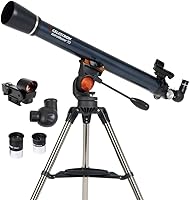
The Celestron AstroMaster 70AZ has a 70 mm aperture and a 900 mm focal length. Dividing 900 mm by 70 mm gives a focal ratio of about f/12.9.
That check also shows why the physical tube’s length is not a reliable substitute for focal length. The published optical measurement is the value to use in calculations.
What can cause a focal length calculation to be wrong?
Unit mismatches, a misread focal ratio, and estimates based on a nearby object can all lead to errors. Write down the units and formula before calculating, and use a distant target for a rough lens measurement.
Check that “f/5” means a focal ratio of 5, not a focal length of 5 mm. For magnification-based calculations, make sure you use the eyepiece’s focal length rather than the telescope’s.
A rough lens experiment can also be affected by the lens-to-screen measurement point and alignment. Treat the result as an estimate unless you have suitable measuring equipment and a controlled setup.
How does focal length affect viewing?
A longer telescope focal length gives higher magnification with the same eyepiece, because magnification equals telescope focal length divided by eyepiece focal length. A shorter focal length gives lower magnification with that eyepiece and can make wide fields easier to achieve.
Focal length alone does not determine image detail or brightness. Aperture, optical quality, observing conditions, and the eyepiece all matter.
For deep-sky imaging, consider how focal length relates to the target’s apparent size and your camera’s field of view. Our guide to what focal length is best for astrophotography explains that choice.
How is focal length different from resolving power?
Focal length affects image scale and magnification, while aperture is the main factor in a telescope’s theoretical resolving power. A longer focal length does not automatically mean the telescope can resolve finer detail.
To understand the aperture-based calculation, read What Is the Resolving Power Formula? A Simple Guide.
For a fuller overview of the term itself, see what is telescope focal length.
Which focal length formula should you use?
Use aperture × focal ratio when you know the telescope’s aperture and f-number. Use magnification × eyepiece focal length when magnification and eyepiece size are known, and treat a screen-based lens measurement as an estimate.
After calculating, check that units match and compare the result with the telescope’s stated specifications. For magnification planning, divide the focal length by the eyepiece focal length.
Frequently asked questions
What is the formula for telescope focal length?
Multiply the telescope’s aperture by its focal ratio: focal length = aperture × focal ratio. Keep the units consistent.
A 100 mm aperture at f/5 has a 500 mm focal length, while a 6 in aperture at f/8 has a 48 in focal length.
How do you find focal length from magnification?
Multiply the magnification by the eyepiece focal length. If an eyepiece produces 100x magnification and has a 10 mm focal length, the telescope focal length is 1,000 mm.
This method assumes you know the actual magnification and the eyepiece’s focal length.
Does telescope focal length equal tube length?
No. A telescope’s effective focal length describes how strongly its optics converge light, and it can be longer than the physical tube.
Folded optical designs use mirrors to direct light along a longer path inside a compact tube.
What is the focal length of a telescope eyepiece?
An eyepiece has its own focal length, usually printed on its barrel in millimeters. That number combines with the telescope’s focal length to determine magnification: divide the telescope focal length by the eyepiece focal length.