What Is Telescope Focal Length?
Telescope focal length is the distance light travels inside the telescope from its main lens or mirror to the point where it forms an image. It helps determine magnification with an eyepiece and affects how much sky you see.
On this page (8 sections)
- What does telescope focal length mean?
- How does focal length affect magnification?
- Does focal length change how much sky you see?
- How do you find your telescope's focal length?
- What products help explain focal length?
- What focal length is best for your observing?
- How should you use focal length when choosing a telescope?
- How do you interpret telescope focal length?
Telescope focal length is the distance light travels inside the telescope from its main lens or mirror to the point where it forms an image. It helps determine magnification with an eyepiece and affects how much sky you see.
The focal length is usually measured in millimeters. It is one part of how a telescope frames the Moon, planets, star clusters, and other targets.
What does telescope focal length mean?
Focal length describes how far the telescope's optics bring light to focus. In a refractor, the main objective lens bends incoming light toward a focal point; in a reflector, the primary mirror reflects it toward focus.
A telescope's focal length is not the same as the length of its tube. Some optical designs fold the light path, so the focal length can be longer than the telescope looks from the outside.
You may also see focal length used for an eyepiece or camera lens. In each case, it describes an optical distance, but the telescope's focal length and the eyepiece's focal length play different roles in the view.
How does focal length affect magnification?
Divide the telescope focal length by the eyepiece focal length to get magnification. For example, a 900 mm telescope used with a 10 mm eyepiece gives 90x magnification: 900 ÷ 10 = 90.
The same telescope with a 20 mm eyepiece gives 45x. A smaller eyepiece focal length raises magnification, while a larger one lowers it.
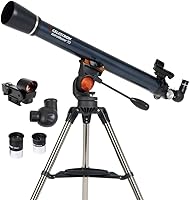
The Celestron AstroMaster 70AZ has a 900 mm focal length and includes 20 mm and 10 mm eyepieces, which correspond to 45x and 90x using that formula.
Magnification does not tell you by itself how clear or detailed an image will be. Aperture, atmospheric steadiness, alignment, and the target all affect what you can see.
For the calculation and additional examples, see how to calculate telescope focal length. For a specific instrument, the Celestron C8 focal length page applies the idea to that telescope.
Does focal length change how much sky you see?
With the same eyepiece, a longer telescope focal length gives higher magnification and a narrower view. A shorter focal length gives lower magnification and a wider view, which can make it easier to frame a large target.
For model ideas, see the best long focal length telescopes.
The eyepiece's apparent field of view also affects the view's width. A telescope field of view calculator can help estimate the full view.
So focal length is a useful guide, but it does not describe the whole field you will see.
For example, a wide star cluster may be easier to fit in a low-magnification view. A planet can benefit from more magnification when the air is steady enough to support it.
The telescope's focal ratio also combines focal length with aperture. Read what f-number means in astronomy to see how that ratio relates to imaging and light gathering.
How do you find your telescope's focal length?
Look for the focal length in the telescope's manual, on its label, or in the maker's specifications. It is commonly written in millimeters, such as 900 mm.
If you know the magnification and eyepiece focal length, you can estimate the telescope's focal length by multiplying them. For example, 90x with a 10 mm eyepiece suggests a 900 mm telescope focal length.
This is an estimate, so use the published specification when you need an exact figure. You can also review the focal length of a telescope formula for the calculation.
Can you measure focal length at home?
You can estimate a simple lens's focal length by focusing a distant scene onto a sheet of paper and measuring from the lens to the sharp image. This method applies to a single lens, not directly to a complete telescope with multiple optics.
Don't point a telescope at the Sun to try to form an image. Sunlight focused through optics can cause serious eye injury and damage equipment.
What products help explain focal length?
A few simple optics tools can make the relationship between lenses and focus easier to understand. These options suit learning or viewing, but they do not replace the telescope specification when you need its focal length.
Who should use the EISCO lens set?
The EISCO set is useful for classroom-style demonstrations of converging and diverging lenses. It includes 3 double convex and 3 double concave glass lenses, with focal lengths of 200 mm, 300 mm, and 500 mm.
Use it to explore basic refraction and image formation on an optical bench. It is a lens set for demonstrations, not a complete telescope.
When is a zoom eyepiece useful?
A zoom eyepiece lets you change eyepiece focal length without swapping between several separate eyepieces. The SVBONY SV135 adjusts from 7 mm to 21 mm, so it can show how changing the eyepiece changes magnification in a compatible telescope.
A shorter setting gives higher magnification than a longer setting on the same telescope. Check that your telescope accepts a 1.25 in eyepiece before choosing it.
What focal length is best for your observing?
Choose focal length based on the targets and framing you want, then pair it with a suitable eyepiece. Lower magnification and a wider view can help with large targets, while higher magnification can help examine smaller targets when viewing conditions allow.
No single focal length is best for every target. A telescope and eyepiece combination that frames the Moon well may show a large cluster too tightly.
For imaging, camera sensor size and the target's apparent size matter too. Compare those choices in what focal length is best for astrophotography.
How should you use focal length when choosing a telescope?
When comparing telescopes, use focal length to understand magnification and framing, and check aperture and mount alongside it. Then choose eyepieces that give the views you want without assuming that maximum magnification is always useful.
Use the telescope's stated focal length for calculations. Pick a shorter eyepiece for more magnification, or a longer one for a wider, lower-power view.
To see the concept in a product example, read about the Celestron C8 focal length. To compare telescope and eyepiece values in more detail, use the telescope focal length formula.
For a basic demonstration of how lenses focus light, the EISCO set shows the difference between convex and concave optics. For changing magnification at the telescope, the SVBONY zoom eyepiece offers a range of eyepiece focal lengths.
How do you interpret telescope focal length?
A telescope's focal length tells you how its optics bring light to focus and, with an eyepiece, helps determine magnification. Use the focal length and eyepiece focal length together, then consider the field of view you need for your target.
Pick a longer focal length eyepiece for lower magnification and broader framing. Pick a shorter one for higher magnification, and see what focal length is best for astrophotography if you're choosing equipment for a camera.
Frequently asked questions
What is telescope focal length?
Telescope focal length is the distance from the main lens or mirror to the point where it brings incoming light to focus. It is usually stated in millimeters.
Along with the eyepiece focal length, it determines the magnification you get.
How do I find the focal length of my telescope?
Check the telescope manual, label, or maker's specifications for a focal length in millimeters. If you know the telescope's magnification with a particular eyepiece, multiply that magnification by the eyepiece's focal length to estimate the telescope focal length.
Does a longer telescope focal length mean more magnification?
A longer telescope focal length gives more magnification with the same eyepiece. The eyepiece matters too: a shorter eyepiece focal length raises magnification, while a longer one lowers it.
Magnification alone doesn't guarantee a sharper or more detailed view.
How does telescope focal length affect the view?
With the same eyepiece, a longer telescope focal length gives higher magnification and a narrower view of the sky. A shorter focal length gives lower magnification and a wider view, which can make large targets easier to frame.