How to Use a Telescope Field of View Calculator
A telescope field of view calculator estimates how much sky an eyepiece or camera can show. Enter the telescope’s focal length and the eyepiece or sensor details, then use the result to check target framing.
On this page (9 sections)
- How to Use a Telescope Field of View Calculator
- What does a telescope field of view calculator tell you?
- What information should you enter?
- How do you calculate field of view with an eyepiece?
- How do you calculate camera field of view?
- How can you use the result to choose an eyepiece?
- What can make a calculator’s estimate differ from your view?
- How should you use the estimate for target framing?
- Which tools help you use a field of view calculator?
How to Use a Telescope Field of View Calculator
A telescope field of view calculator estimates how much sky an eyepiece or camera can show. Enter the telescope’s focal length and the eyepiece or sensor details, then use the result to check target framing.
For visual observing, the estimate can help you decide whether a wide target will fit in one view or whether a different eyepiece may show more sky. For imaging, it can help you compare a camera’s coverage with the size of your intended target.
What does a telescope field of view calculator tell you?
A calculator estimates the true field of view, the angular width of sky visible through your setup. The result is often shown in degrees, arcminutes, or both.
A wider field shows more sky around a target. A narrower field shows a smaller area, which can make a compact target easier to frame at higher magnification.
A calculator doesn’t tell you how bright or sharp a target will look. Aperture, magnification, sky conditions, focus, and optical quality all affect the view.
What information should you enter?
For an eyepiece calculation, enter the telescope focal length, eyepiece focal length, and apparent field of view when the calculator asks for them. For a camera calculation, enter the telescope focal length and sensor dimensions.
Your telescope’s focal length is the distance light travels through the optical system to reach focus. If you need help finding that value, read what telescope focal length means.
Check the units before calculating. If a calculator expects millimeters, enter millimeters for all focal lengths and sensor measurements; mixing units can produce a misleading result.
Which telescope field of view calculator inputs matter most?
The telescope focal length and eyepiece details are the core inputs for a visual estimate. A longer telescope focal length usually gives higher magnification with the same eyepiece, and higher magnification usually means a smaller true field.
The SVBONY SV135 is a zoom eyepiece with an adjustable 7 mm to 21 mm focal length and a stated apparent field range of 40° to 57°. You can enter the focal length and corresponding field value for the zoom setting you want to estimate.
The eyepiece’s field can change across its zoom range. Use the value that matches the setting you plan to observe with, if available.
How do you calculate field of view with an eyepiece?
A common quick estimate is true field of view = apparent field of view ÷ magnification. First estimate magnification by dividing the telescope focal length by the eyepiece focal length.
For example, with a telescope focal length of 900 mm and a 10 mm eyepiece, magnification is 90x. If the eyepiece’s apparent field is 50°, the rough true field estimate is about 0.56°.
That method is convenient, but it is an approximation. Some calculators use the eyepiece’s field stop for a more direct estimate, so results can vary between tools.
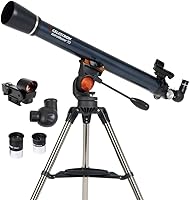
The focal length of a telescope formula explains how telescope and eyepiece focal lengths relate to magnification. For a practical starting point, the Celestron AstroMaster 70AZ is a refractor with a listed 900 mm focal length and included 20 mm and 10 mm eyepieces.
Use the calculator to compare those eyepieces, then check the result against the size of the target you want to observe. The estimate can help with framing, but actual viewing also depends on the eyepiece’s field characteristics.
How do you calculate camera field of view?
A camera calculator uses the telescope focal length and the camera sensor’s width and height to estimate the sky covered by the image. Enter the sensor dimensions in the units the tool requests, then compare the resulting width and height with the target.
A smaller sensor generally covers less sky at the same telescope focal length. A longer focal length also narrows the camera’s coverage, so changing either can change how much of a large object fits in the frame.
For imaging, field coverage is only one fit check. Confirm that your camera and adapters can reach focus; the guide to back focus for a Celestron 8 SE explains why spacing behind the telescope matters.
How can you use the result to choose an eyepiece?
Choose an eyepiece based on whether you need more sky around a target or a tighter view. A lower magnification often gives a wider view, while a higher magnification can frame a smaller target more closely.
The EISCO 6pc Optical Lens Set contains three double convex lenses and three double concave lenses, with focal lengths of 200 mm, 300 mm, and 500 mm. It is intended for optics demonstrations and experiments, so it can help explain how converging and diverging lenses affect light paths.
Use this set as an educational aid, not as a telescope eyepiece recommendation. Its listed purpose is physics classroom demonstrations and optical experiments.
What can make a calculator’s estimate differ from your view?
The estimate can differ because calculators rely on the values and formula you enter. Incorrect focal lengths, an approximate apparent field, or a unit mismatch can change the answer.
Optical effects can also affect how the view appears across the field. Field curvature in telescope optics describes why stars near the edge may not focus in the same way as stars near the center.
A field flattener addresses field curvature in some imaging setups. Learn what a telescope field flattener does before deciding whether one applies to your telescope and camera combination.
How should you use the estimate for target framing?
Compare the calculated field with the target’s angular size, then allow room around the target if you want surrounding sky in the frame. If the target is larger than the estimated field, try a shorter telescope focal length, a wider-field eyepiece, or a camera with a larger sensor, where compatible.
For a visual setup, calculate a few eyepiece options before observing. For a camera, check both the sensor’s width and height so you know whether the target fits in the orientation you plan to use.
A calculator is most useful as a planning tool. Confirm the equipment inputs, treat the result as an estimate, and use it to narrow down a framing choice before you set up.
Which tools help you use a field of view calculator?
Use an eyepiece calculator when you want to compare visual framing, and a sensor calculator when you’re planning a camera image. The SVBONY SV135 gives you several focal length settings to compare; the AstroMaster 70AZ offers an example with a stated telescope focal length and two included eyepieces.
Choose the EISCO lens set if your goal is learning basic lens behavior through demonstrations. For a specific target, enter your actual equipment details and use the calculated field as a guide to whether the target should fit.
Frequently asked questions
What information does a telescope field of view calculator need?
Most calculators need your telescope’s focal length and the eyepiece’s focal length and apparent field of view. A camera calculator instead needs the telescope focal length and sensor dimensions.
Check the calculator’s labels, since some ask for telescope aperture or a camera pixel size for additional estimates.
Is true field of view the same as apparent field of view?
No. Apparent field of view describes the angle you perceive through an eyepiece, while true field of view describes how much sky the telescope shows.
A rough estimate divides apparent field by magnification, but an optical system’s actual view can differ.
Can a field of view calculator tell me if a target fits?
Yes, if you know the target’s angular size and have entered the correct telescope and eyepiece or camera details. Compare the target size with the calculated field, and leave some margin for framing.
A calculator estimates coverage; it doesn’t show how clearly the target will appear.
Does higher magnification make the field of view smaller?
Usually, yes. With the same telescope, a shorter focal length eyepiece gives higher magnification, which generally shows a smaller section of sky.
The eyepiece’s apparent field also affects the view, so compare that value as well as focal length.
Why does my observed field differ from the calculator?
A calculator gives an estimate based on its inputs and formula. The eyepiece’s actual field stop, optical design, camera sensor dimensions, adapters, and how precisely you measure can affect the result.
Check the equipment details and use the estimate as a framing guide.