What Focal Length Is Best for Astrophotography?
The best focal length for astrophotography depends on your target, camera sensor and mount tracking. Start short for wide nebulae and large star fields, then choose longer focal lengths for small galaxies and planetary details if your mount can track precisely.
On this page (7 sections)
- What focal length is best for astrophotography targets?
- How does the camera sensor change your field of view?
- How does mount tracking limit focal length?
- Is focal ratio more important than focal length?
- Which focal length should you start with?
- How do you choose a focal length for your camera?
- What focal length is best for astrophotography?
The best focal length for astrophotography depends on the target, camera sensor and mount tracking. Short focal lengths frame large nebulae and star fields, while longer focal lengths can frame small galaxies or planetary details more tightly.
A longer telescope is not automatically better. It narrows the field of view and makes tracking errors more visible, so match the focal length to both the object and your mount's ability to follow it.
What focal length is best for astrophotography targets?
Choose focal length by the apparent size of the target and the field your camera can capture. Large objects need a wider field; small objects can benefit from a tighter view.
| Target type | Starting direction | Main trade-off |
|---|---|---|
| Large nebulae and star fields | Short focal length | A wide frame may include more surrounding sky |
| Medium-sized nebulae and galaxies | Moderate focal length | Framing depends on sensor size and target dimensions |
| Small galaxies and planetary nebulae | Longer focal length | Narrower view and more demanding tracking |
| Moon and planets | Longer effective image scale | Seeing conditions, focus and camera sampling matter |
These are starting points, not fixed rules. Two cameras on the same telescope can show different portions of the sky because their sensors may have different dimensions.
For a refresher on the key measurement, read what telescope focal length means. The tube's focal length describes how the optics bring light to focus; it is not the same as magnification for visual observing.
How can you calculate focal length for astrophotography?
Use the target's angular size and the camera sensor dimensions to estimate whether the target fits. A field-of-view calculator can turn those inputs into a practical framing estimate.
You can also calculate focal length from a telescope's focal ratio and aperture. Our guide to the focal length of a telescope formula walks through that relationship.
Before buying a telescope, look up the target's apparent width and height, then compare them with the camera's field of view. Leave some margin around the target for framing and cropping.
How does the camera sensor change your field of view?
A larger sensor captures a wider portion of the sky at the same telescope focal length. A smaller sensor crops more tightly, so it can make a target appear larger in the frame without changing the telescope's optics.
This does not mean a smaller sensor records more detail by itself. Detail depends on the full imaging chain, including pixel size, focus, optical quality, seeing and tracking.
Check the sensor's active dimensions, not just the camera body's outer size. Use a field-of-view calculator that accepts both sensor dimensions and telescope focal length, then preview the composition for your target.
If you already own a camera, start with its sensor size and choose the telescope around the objects you most want to photograph. If you have a telescope first, use its focal length to identify which targets will fit.
How does mount tracking limit focal length?
A longer focal length makes small tracking errors cover more pixels, so stars can appear elongated during exposures. The effect depends on mount alignment, guiding, exposure length, image scale and the camera.
This is why a shorter focal length can be a forgiving starting point. It generally gives a wider frame and makes the same angular drift less noticeable in the final image.
Consider the mount before moving to a longer telescope. If the mount struggles to track smoothly, a longer focal length may make the problem more visible even when the telescope's optics are capable.
Is focal ratio more important than focal length?
Focal ratio and focal length answer different questions. Focal length and sensor size set the field of view, while focal ratio helps describe how quickly an optical system records extended objects at a given image scale.
A lower focal ratio can shorten exposure needs for an extended target, but it does not guarantee that the target fits the sensor. For a plain explanation of the relationship, see what f-number means in astronomy.
For astrophotography, compare focal ratio alongside focal length, aperture, camera sensor and mount. Choosing on focal ratio alone can leave you with a frame that is too wide or too tight for the target.
Which focal length should you start with?
Start with a focal length that fits the largest targets you want to photograph and that your mount can track reliably. This keeps your first setup focused on framing and steady stars rather than pushing image scale too far.
If galaxies are your priority, a longer focal length may be a better match. Our guide to the best telescopes for galaxy astrophotography covers that use case.
A Celestron C8 has a focal length of 2,032 mm, which can frame smaller targets tightly. Read what the Celestron C8 focal length means before pairing one with a camera and mount.
This optical lens set is intended for physics demonstrations and optical bench experiments. It can help explain converging and diverging lenses, but it is not a telescope or a camera lens for capturing the night sky.
An eyepiece changes magnification for visual use. It does not replace a camera sensor, and many astrophotography setups attach a camera to the telescope without an eyepiece.
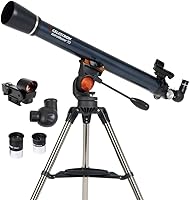
The AstroMaster 70AZ is described for visual observing and includes 20 mm and 10 mm eyepieces. Its alt-azimuth mount is a visual-use starting point, so check mount tracking and camera attachment needs before considering any telescope for long-exposure imaging.
How do you choose a focal length for your camera?
Choose using a target, a sensor and a mount together, not by the telescope number alone. A practical comparison takes only a few inputs:
- Pick a target you want to photograph and note its apparent width and height.
- Find the camera sensor's active width and height.
- Enter the sensor dimensions and telescope focal length in a field-of-view calculator.
- Check that the target fits with some space around it.
- Confirm the mount can track at that image scale for your planned exposures.
- Review focal ratio to help plan exposure time for extended targets.
If the target fills too much of the frame, consider a shorter focal length or a camera with a larger sensor. If it looks too small, a longer focal length or smaller sensor can tighten the framing, provided tracking remains accurate enough.
What focal length is best for astrophotography?
The best focal length for astrophotography is the shortest one that frames your target well while working with your sensor and mount. Choose a longer option when you need to frame a small object and your mount can support the tighter image scale.
For large nebulae, begin with a wide field. For small galaxies, compare longer focal lengths and check your mount's tracking before you commit.
Frequently asked questions
What focal length is best for astrophotography beginners?
A shorter focal length is often easier for beginners because it frames larger areas of sky and makes small tracking errors less obvious. Choose a focal length that fits your main targets and camera sensor, then confirm your mount can guide accurately enough for the exposure time you plan to use.
Is a longer focal length better for astrophotography?
A longer focal length gives a narrower field of view and can frame small galaxies or planetary details more closely. It also magnifies tracking errors and can make focusing and guiding more demanding, so it works best with a mount and camera setup suited to that image scale.
What focal length is best for photographing nebulae?
Large nebulae often fit better with a short focal length and a wide camera sensor, while smaller planetary nebulae may need a longer focal length. Check the target's apparent size and use a field-of-view calculator with your camera's sensor dimensions before choosing a telescope.
Does telescope focal ratio matter for astrophotography?
Focal ratio affects how quickly a telescope records an extended object at a given image scale, while focal length and sensor size determine the field of view. Compare both values: focal ratio helps with exposure planning, but it doesn't tell you whether the target fits the frame.
Can I use an eyepiece for astrophotography?
Many deep-sky images use a camera attached directly to the telescope, without an eyepiece. Eyepiece projection can be used for some planetary imaging setups, but it adds alignment and focusing steps; check the camera and telescope connection requirements before buying extra optics.