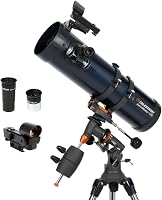
ZWO Seestar S50 Pro Review: Worth It? (November 2026)
The ZWO Seestar S50 Pro suits automated deep-sky imaging if you want a smart telescope workflow built around app control, targeting and tracking. Check its imaging details and setup needs against your goals before choosing it over a smaller model.
On this page (9 sections)
- What does the Seestar S50 Pro review find?
- What imaging should you expect from the S50 Pro?
- Is the S50 Pro setup fully automatic?
- How does the S50 Pro compare with the S30 Pro?
- Which accessories fit the S50 Pro?
- Is the Seestar S50 Pro suitable for automated observing?
- Who should consider the S50 Pro?
- Frequently asked questions about the Seestar S50 Pro
- Is the Seestar S50 Pro review a fit for you?
The ZWO Seestar S50 Pro is a smart telescope for app-based, automated observing and imaging. This review looks at the S50 Pro's imaging fit, setup considerations and accessories, while comparing it with the smaller S30 Pro.
We checked the available product details and compared the Seestar options for different observing goals.
What does the Seestar S50 Pro review find?
The S50 Pro makes sense if you want a guided imaging workflow and a telescope centered on automated observing. Its fit depends on the imaging targets you care about, the setup space you have and whether the controls match how you want to observe.
The S30 Pro is a useful comparison, but its specifications shouldn't be treated as S50 Pro specifications. It has a 30 mm objective, 160 mm focal length and 4.6-degree field of view, along with app control and automatic tracking.
If you want a broader comparison of automated camera telescopes, see our guide to best computer-controlled telescope with camera. For deep-sky target selection, use our overview of the best telescope for galaxy astrophotography.
What imaging should you expect from the S50 Pro?
Choose the S50 Pro for the imaging work its stated capabilities support, and confirm the details for your intended targets before purchase. A smart telescope can automate parts of imaging, but target choice, sky conditions and a steady setup still shape the result.
Think first about what you want to capture: galaxies and nebulae, the Moon, or wide-field night scenes. The product information here doesn't provide a complete S50 Pro specification set, so don't assume a particular resolution, field of view, focal length or imaging mode.
Compare the S50 Pro with the Seestar S30 Pro vs S50 guide if you are deciding between the models. The ZWO Seestar S30 Pro review explains the smaller model's stated features and limits.
Is the S50 Pro setup fully automatic?
Automated targeting and tracking can simplify setup, but you'll still need to place and align the telescope carefully. Follow the S50 Pro manual for its exact steps, then allow the device to remain stable during imaging.
Leveling matters when you use equipment or a mode that calls for a level base. The Leftfoto tripod leveler offers three adjustment dials, locking rings and +/-5-degree fine adjustment, with a 3/8-inch mount and a 1/4-inch adapter.
Leftfoto Tripod Leveler for Seestar S50 S30: Best for precise tripod leveling

- Three adjustment dials
- +/-5 degree leveling
- 3/8-inch mount with 1/4-inch adapter
- Supports up to 15 kg
A tripod leveler designed for Seestar S50 and S30 Pro EQ mode. Its three adjustment dials and locking rings can help you level a setup without adjusting each tripod leg.
Pros
- Three dials with locking rings
- All-metal aircraft aluminum
- Includes 3/8-to-1/4-inch adapter
Cons
- Manual adjustment
- Adds a separate piece between tripod and head
For a step-by-step workflow, see how to use Seestar S50. That guide is the right next stop for setup and operating questions.
How does the S50 Pro compare with the S30 Pro?
The S30 Pro is the clearly documented alternative here, with a 30 mm objective lens and 4.6-degree field of view. The S50 Pro has a different model name, so compare its official specifications directly rather than carrying over the S30 Pro's figures.
The S30 Pro has a 160 mm focal length, app control, automatic GoTo targeting and tracking, and support for equatorial mode. Its product details describe deep-sky and wide-field imaging, and say it is not intended for planetary observation.
ZWO Seestar S30 Pro Smart Telescope: Best for a compact Seestar alternative

- 30 mm objective lens
- 160 mm focal length
- 4.6-degree field of view
- App control and automatic tracking
A smaller Seestar option with app control, automatic GoTo targeting and tracking, plus imaging modes for deep-sky objects and wide-field scenes. Its 30 mm objective and 4.6-degree field of view make it a different fit from a 50 mm S50.
Pros
- Automatic GoTo targeting and tracking
- Built-in light pollution filters
- Supports equatorial mode
Cons
- Designed for deep-sky objects, not planetary observation
- Requires a stationary setup for deep-sky imaging
The Seestar S30 Pro review covers that model in more detail. If you want to compare another compact smart telescope, read our DWARFLAB Mini telescope review.
Which accessories fit the S50 Pro?
Choose accessories by their exact compatibility and the job they do. A leveler can help with tripod setup, while a dew shield, dust cover and focus mask address different observing and storage needs.
The Neo3D Shop Premium Kit is specified for the Seestar S50 Pro and not the original S50. It includes a magnetic dew shield and dust cover, flocking, a Bahtinov mask and 3-point and 4-point diffraction masks.
Neo3D Shop Seestar S50 Pro Premium Kit: Best for S50 Pro optical protection

- Magnetic dew shield and dust cover
- Flocking material
- Bahtinov mask
- 3-point and 4-point diffraction masks
A set of S50 Pro accessories for covering the optics, reducing stray light and helping with manual focus. Confirm that you have the S50 Pro because this kit is not for the original S50.
Pros
- Magnetic dust cover and dew shield
- Includes flocking and a Bahtinov mask
- Two diffraction masks included
Cons
- Not compatible with the original S50
- Manual focus aid requires user adjustment
Check model compatibility before ordering accessories, especially when product names include both S50 and S50 Pro. For the leveler, also confirm that its 3/8-inch mount and included adapter work with your tripod and head.
Is the Seestar S50 Pro suitable for automated observing?
The S50 Pro is a fit to consider if you want automation to handle parts of locating and tracking targets. Before choosing it, verify which targets and imaging modes it supports, how it connects to your phone or tablet, and whether its operating workflow suits your observing site.
A phone-controlled telescope still needs a clear view of the sky and a stable location. Check the manual for power, connection, weather and setup requirements, then plan around the conditions where you will use it.
If your main goal is visual planetary observing, compare options made for that use with our guide to best telescope for beginners to see planets. A camera-focused smart telescope is a different kind of observing experience.
Who should consider the S50 Pro?
Consider the S50 Pro if you want a smart telescope workflow and have confirmed the capabilities that matter for your targets. It is less suitable as an impulse buy if you need exact imaging specifications or accessory compatibility that you haven't verified.
Choose the S30 Pro if its documented 30 mm objective and wide 4.6-degree field of view fit your plans, and you prefer to compare against published details. Compare the Seestar S30 Pro and S50 before settling on either model.
Frequently asked questions about the Seestar S50 Pro
Is the ZWO Seestar S50 Pro good for beginners?
The S50 Pro may suit beginners who want automated observing and imaging, but confirm the exact setup and app workflow before buying. Smart control can reduce manual targeting steps, while choosing targets, keeping the telescope stable and planning for weather remain part of using any imaging system.
What can you use with a Seestar S50 Pro?
Use accessories made specifically for the S50 Pro, and check compatibility before ordering. For example, the Neo3D Shop Premium Kit is described for the S50 Pro and explicitly excludes the original S50; a tripod leveler is another accessory option for supported Seestar setups.
Should you choose the Seestar S50 Pro or S30 Pro?
Compare the S50 Pro and S30 Pro around the targets and portability you want, then check their current specifications side by side. The S30 Pro has a 30 mm objective, a 160 mm focal length and a 4.6-degree field of view, with app control and automatic tracking.
Does the S50 Pro work for planetary viewing?
Check the S50 Pro's stated imaging and observing capabilities before choosing it for planets. The S30 Pro is described as designed for deep-sky objects and not intended for planetary observation, so a buyer focused on planets should compare purpose-built options and their stated limits.
Is the Seestar S50 Pro review a fit for you?
Choose the S50 Pro if its confirmed imaging modes and automated controls match your targets. Choose the S30 Pro if its published 30 mm optics and wider field fit your plans, and check the Seestar S30 review for another point of comparison.
Frequently asked questions
Is the ZWO Seestar S50 Pro good for beginners?
The S50 Pro may suit beginners who want automated observing and imaging, but confirm the exact setup and app workflow before buying. Smart control can reduce manual targeting steps, while choosing targets, keeping the telescope stable and planning for weather remain part of using any imaging system.
What can you use with a Seestar S50 Pro?
Use accessories made specifically for the S50 Pro, and check compatibility before ordering. For example, the Neo3D Shop Premium Kit is described for the S50 Pro and explicitly excludes the original S50; a tripod leveler is another accessory option for supported Seestar setups.
Should you choose the Seestar S50 Pro or S30 Pro?
Compare the S50 Pro and S30 Pro around the targets and portability you want, then check their current specifications side by side. The S30 Pro has a 30 mm objective, a 160 mm focal length and a 4.6-degree field of view, with app control and automatic tracking.
Does the S50 Pro work for planetary viewing?
Check the S50 Pro's stated imaging and observing capabilities before choosing it for planets. The S30 Pro is described as designed for deep-sky objects and not intended for planetary observation, so a buyer focused on planets should compare purpose-built options and their stated limits.