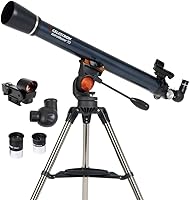
What Is Coma in a Telescope? The Technical Answer
On this page (3 sections)
Coma in a telescope is a type of optical aberration. It causes points of light to appear as fuzzy blobs, especially near the edge of your view. You’ll see this effect most often with wide-field eyepieces or when looking at bright stars. It’s not a flaw in your telescope, but rather a limitation of how light bends through lenses.
This optical issue affects how sharply you can see details. It’s particularly noticeable when you’re trying to observe faint objects or planetary surfaces. Understanding coma helps you choose the right eyepieces for your telescope and your observing goals. Many astronomers consider it a common challenge in observational astronomy. It’s a key factor in what astronomers call optical quality.
- Coma is an optical error in telescopes.
- It makes star points look like fuzzy comets.
- It’s often seen at the edge of the lens.
- It’s a common issue, not a broken telescope.
- Choosing the right eyepiece can minimize its effect.
Ready to understand coma better? Let’s look at what causes it and how you might deal with it in your own stargazing sessions.
Understanding Telescope Coma: A Technical Dive
Coma is a common optical flaw. It affects how sharp your telescope views appear. We’ll explain what causes this effect. We’ll also touch on how it impacts what you see in the night sky. Think of it like a tiny distortion in a camera lens. It can make your photos look a bit off, especially around the edges. Telescope coma is similar, but for your stargazing experience.
What Exactly is Coma?
In simple terms, coma makes point-like sources of light, like stars, look stretched out. They don’t appear as perfect little dots. Instead, they resemble tiny comets or teardrops. This happens more noticeably as you look further away from the center of your view. It’s not that your telescope is broken. It’s more about how the light rays are bent by the optical elements.
The main culprit behind coma is the shape of the mirrors or lenses. Especially in telescopes that use parabolic mirrors, like Newtonian reflectors. When light rays hit these surfaces off-axis (meaning not perfectly straight on), they don’t converge at a single point. This leads to that fuzzy, comet-like shape. Many telescope designs try to minimize this effect, but it can still be present.
Coma vs. Astigmatism: What’s the Difference?
You might wonder how coma differs from other optical issues. Astigmatism is another common aberration. Astigmatism makes point sources of light look like crosses or lines. It’s caused by light rays not focusing at the same point in either horizontal or vertical planes. Coma, on the other hand, affects the shape more like a comet’s tail.
Research indicates that both coma and astigmatism can reduce the overall sharpness of an image. However, they manifest differently. Coma is often more pronounced towards the edge of the field of view. Astigmatism can be present across the entire view. Understanding these differences helps when you’re evaluating your telescope’s performance. It’s like knowing if your car’s alignment is off or if the tires are unbalanced.
The Science Behind Coma: How Light Behaves
To really grasp coma, let’s look at how light works with curved mirrors or lenses. When light rays enter a telescope, they are bent or reflected to a focal point. In an ideal system, all rays from a single point in space would meet at a single point on your sensor or in your eye. This creates a sharp image.
However, in real-world optics, this ideal scenario rarely happens perfectly. With coma, off-axis rays from a point source tend to form a shape that’s wider on one side than the other. Imagine shining a flashlight at a curved mirror from an angle. The reflection won’t be a perfect circle. It will be distorted.
Why Parabolic Mirrors Are Prone to Coma
Many popular telescopes, especially Newtonian reflectors, use parabolic primary mirrors. Parabolic mirrors are excellent at bringing on-axis (light directly in the center) rays to a perfect focus. They do this without introducing spherical aberration. Spherical aberration is another type of optical flaw.
However, parabolic mirrors are not as good at focusing off-axis rays. These rays, coming from objects away from the optical axis, get spread out. This spreading is what we see as coma. The further off-axis a star is, the more pronounced the coma effect becomes. Many astronomy guides suggest this is why wide-field views can sometimes look softer at the edges. Many astronomy guides suggest this is why wide-field views can sometimes look softer at the edges, especially with a fast focal ratio telescope.
How Coma Affects Your Views
So, what does this mean for your stargazing sessions? When you look at a bright star near the edge of your field of view, it might not look like a tiny diamond. Instead, it might appear as a fuzzy streak, pointing away from the center of the image. This can be particularly disappointing if you’re trying to capture high-quality images or observe fine details on planets.
Coma directly impacts the resolution and sharpness of your observations. It can make faint objects harder to distinguish from the background sky. For astrophotography, coma can lead to distorted star shapes in your images. This often requires correction in post-processing. Many experienced astronomers consider it a key factor when choosing a telescope for deep-sky viewing.
Identifying Coma in Your Telescope
How can you tell if you’re seeing coma? A good test is to observe a bright star near the edge of your telescope’s view. If it looks like a comet with a tail pointing towards or away from the center of the field, that’s likely coma. You might notice this more with higher magnifications or wider field eyepieces.
You can also compare views of the same star at the center of the field versus the edge. If the stars at the edge are distinctly misshapen while those in the center are sharp points, coma is probably the cause. Many resources suggest trying a star at the 80% mark of the field radius to see the effect clearly (American Astronomical Society).
Minimizing the Effects of Coma
While you can’t completely eliminate coma in many telescope designs, you can certainly minimize its impact. The easiest way is often through your eyepiece choice. Some eyepieces have built-in field flatteners. These are optical elements designed to counteract aberrations like coma.
Another approach involves using a coma corrector. These are specialized accessories that you insert into the light path of your telescope. They are particularly popular with astrophotographers using Newtonian reflectors. A coma corrector bends the light rays in a way that brings them to a sharper focus, even off-axis. Many reviews suggest these can make a dramatic difference in image quality.
Eyepieces and Coma Correctors: What to Look For
When selecting eyepieces, look for descriptions that mention field flatness or coma correction. Wide-field eyepieces (those with a large apparent field of view) are more prone to showing coma. If sharp stars across the entire view are important to you, a narrower field eyepiece might show less coma. Or, opt for a premium eyepiece designed to minimize aberrations.
For coma correctors, compatibility is key. You need to ensure the corrector works with your specific telescope’s focal length and f-ratio. Researching specific models and reading user reviews is highly recommended. Many manufacturers offer different versions for various telescope types. We found that proper setup is vital for these devices to work effectively.
Telescope Designs and Coma
Not all telescopes are equally susceptible to coma. Different optical designs handle off-axis light differently. For instance, refractor telescopes, which use lenses instead of mirrors, generally suffer less from coma. This is because their light path is less prone to the type of distortion that causes coma.
Reflecting telescopes, especially those using parabolic mirrors, are the most common culprits. A Schmidt-Cassegrain telescope uses mirrors and a corrector plate. However, advanced designs like the Schmidt-Cassegrain and Maksutov-Cassegrain often incorporate corrector plates or lenses. These elements help to correct for aberrations, including coma, providing a sharper image across a wider field. It’s a trade-off in design and cost. It’s a trade-off in design and cost, and understanding a slow focal ratio telescope can help you choose the best instrument for your needs.
Common Telescope Types and Their Coma Tendencies
Here’s a quick look at how common telescope types tend to perform regarding coma:
| Telescope Type | Coma Tendency | Notes |
|---|---|---|
| Refractor (Apochromatic/Achromatic) | Very Low | Lenses are generally very good at correcting coma. |
| Newtonian Reflector (Parabolic Mirror) | Moderate to High | Most common type where coma is noticeable, especially at edges. |
| Schmidt-Cassegrain (SCT) | Low | Corrector plate helps reduce coma and other aberrations. |
| Maksutov-Cassegrain (Mak) | Very Low | Thick corrector lens provides excellent aberration correction. |
| Dobsonian (Parabolic Mirror) | Moderate to High | Similar to Newtonian; coma is present but often managed with eyepiece choice. |
This table shows that while coma is a concern, it’s not an issue for every telescope. If you’re looking for a wide, flat field of view with sharp stars all the way to the edge, you might lean towards a refractor or an SCT/Mak design. For Newtonian users, focusing on eyepieces and correctors is key.
The Bottom Line on Coma
Coma is an optical reality in many telescopes. It’s a natural consequence of how light interacts with curved optical surfaces. You’ll see it as fuzzy, comet-shaped stars, especially off-center. It’s not a defect in your equipment, but a characteristic of the design. Many amateur astronomers learn to live with it.
Understanding coma helps you make informed decisions. You can choose eyepieces or accessories that minimize its effect. This allows you to get the best possible views your telescope can offer. Don’t let it discourage you; it’s a normal part of the journey in astronomy. It’s a challenge many astronomers have learned to manage for clearer skies.
Quick Checklist for Managing Coma
- Observe stars at the edge of your field of view.
- Note if they look stretched or comet-like.
- Consider eyepieces with good field flattening.
- Explore coma correctors for Newtonian telescopes.
- Check your telescope type’s typical coma performance.
- Understand it’s a common optical trait, not a defect.
Conclusion
Coma is a common optical characteristic in many telescopes, not a sign of damage. You’ll see it as fuzzy, comet-shaped stars, especially near the edges of your view. This happens because of how light bends through curved lenses and mirrors. Understanding coma helps you choose the right eyepieces or accessories. This way, you can get the sharpest possible views from your telescope. Don’t let it deter you; it’s a normal part of enjoying the night sky. Your next step should be to observe stars at the edge of your view to see if coma is affecting your images.
Frequently Asked Questions
Is coma always bad for my telescope?
Coma itself isn’t necessarily “bad.” It’s an optical trait present in many designs, particularly Newtonian reflectors. While it affects sharpness off-axis, many astronomers find it manageable. For visual observing, it might be less noticeable than in astrophotography.
Can I fix coma if my telescope has it?
You can’t fundamentally change the optical design of your telescope. However, you can effectively minimize coma’s appearance. Using a coma corrector or choosing eyepieces designed for field flatness can greatly improve your views.
Will a more expensive telescope have less coma?
Not always. While higher-end telescopes often incorporate better designs to reduce coma, some simpler designs (like refractors) naturally have very little. It’s more about the optical design type than just the price tag.
How does coma affect planetary viewing?
Coma can make planetary details appear less sharp, especially if the planet is near the edge of your field of view. Since planets are bright, the fuzzy, comet-like stars caused by coma can be quite distracting.
Is coma worse at higher magnifications?
Generally, yes. While coma is present at all magnifications, it becomes more noticeable at higher power. This is because higher magnification spreads out the image more, making any aberrations, including coma, more apparent.