How to Collimate a Newtonian or Dobsonian Telescope
To collimate a Newtonian or Dobsonian telescope, align the secondary mirror, then adjust the primary mirror with a collimation cap, Cheshire, or compatible laser tool. Make small changes and check the alignment again before observing.
On this page (7 sections)
- What do you need to collimate a Newtonian telescope?
- How do you collimate a Newtonian reflector step by step?
- What should you do if the collimation view looks wrong?
- How can you check collimation on a star?
- Does collimation work differently on a Dobsonian?
- When should you stop adjusting the mirrors?
- How can you keep a Newtonian or Dobsonian in alignment?
To collimate a Newtonian or Dobsonian telescope, align the secondary mirror first, then adjust the primary mirror with a collimation cap, Cheshire, or a laser tool made for your telescope. Make small adjustments, check the view through the tool again, and finish with a star test if the sky is steady.
A Dobsonian is a Newtonian reflector on a simple alt-azimuth mount, so the mirror-alignment steps are shared. If the image stays blurry after collimation, check other causes in why your telescope is blurry.
What do you need to collimate a Newtonian telescope?
You need a collimation tool that fits your focuser, the telescope's manual, and a stable place to set the tube. A collimation cap or Cheshire is enough for many beginners; use a laser only if it is aligned and suitable for your telescope.
Work in daylight or a well-lit room so you can see the mirror clips and tool markings. Keep the telescope pointed away from the Sun, and don't touch the mirror surfaces.
If you're learning how lenses and mirrors guide light, the EISCO set includes 3 double convex and 3 double concave lenses in several focal lengths for classroom optics demonstrations.
This set is for learning basic lens behavior, not for aligning telescope mirrors. For collimation, use a tool designed to register in the focuser.
How do you collimate a Newtonian reflector step by step?
Center the secondary under the focuser, align its tilt to the primary mirror, then adjust the primary mirror. This order helps each adjustment build on the one before it.
- Remove the eyepiece and fit the collimation cap, Cheshire, or compatible laser into the focuser.
- Look through the tool and check whether the secondary mirror appears centered beneath the focuser.
- Adjust the secondary's position only if needed, following the telescope manual.
- Adjust the secondary tilt until the primary mirror's reflection is centered in it.
- Adjust the primary mirror until its center mark aligns with the reference in your tool.
- Recheck both mirrors, then secure any locks gently if your telescope has them.
Turn adjustment screws a little at a time. If the view gets less centered, reverse that small change instead of turning several screws at once.
How do you center the secondary mirror?
The secondary mirror should appear centered under the focuser, with the primary mirror's edge and clips visible in a balanced view. Use the tool's sight line and your manual's diagram to judge the position.
If the secondary looks off-center, check whether its holder has a separate position adjustment. Don't use the tilt screws to fix every apparent offset; those screws aim the secondary toward the primary.
How do you aim the secondary at the primary mirror?
Adjust the secondary tilt until the primary mirror's center mark appears centered in the reflection. Use the screws specified in your telescope manual, making small turns and watching the view through the tool.
Some designs use a center mark or reflective triangle on the primary. If yours has no mark, use the maker's method rather than guessing at the mirror's center.
How do you align the primary mirror?
Adjust the primary mirror's collimation screws until its center mark aligns with the reference circle or crosshair in your tool. The view should stay centered when you gently move your eye within the tool's sight hole.
If the telescope has locking screws, tighten them lightly and check alignment again. Locks can shift the mirror, so make a small correction with the collimation screws if the mark moves.
What should you do if the collimation view looks wrong?
Pause and identify which part is off before turning screws. The secondary's position, secondary tilt, and primary tilt do different jobs, and changing the wrong one can make alignment harder.
Check that the tool sits squarely in the focuser and that the focuser is not loose. Confirm that you can see the full primary mirror and its center mark before judging alignment.
If a laser beam seems centered but the return beam does not, reseat the tool and rotate it in the focuser to see whether the beam shifts. A poorly aligned laser can give a misleading result, so compare it with a cap or Cheshire if available.
For reflector background and design details, see what a Newtonian telescope is. A focuser that shifts or tilts can also complicate alignment; our guide to the best focuser for a Newtonian telescope explains what to consider.
How can you check collimation on a star?
A centered star should come to a small, even point when focus is sharp, under steady air and with the telescope cooled to the outdoor temperature. A star test is a final check, not a replacement for aligning the mirrors with a tool.
Choose a bright star high in the sky, center it, and use a moderate magnification. If the star is steady, move slightly inside and outside focus; the rings should look centered around the star's dark center.
Don't make major mirror changes based on a star that is low, twinkling, or moving in turbulent air. Atmospheric distortion and warm telescope parts can mimic optical problems.
The SVBONY SV135 zoom eyepiece adjusts from 7 mm to 21 mm and fits telescopes that accept a 1.25 in eyepiece, so it can provide different magnifications for a visual check.
An eyepiece helps you inspect the image, but it does not collimate the mirrors. Use a dedicated alignment tool for the adjustments.
Does collimation work differently on a Dobsonian?
No, the mirror-alignment sequence is the same on a Dobsonian and other Newtonian reflectors. The difference is the mount: a Dobsonian mount supports and points the tube, while collimation aligns the optics inside it.
Keep the tube supported while adjusting screws, and avoid pushing on the primary mirror or its cell. If the telescope has spring-loaded or locking hardware, follow the manual so the mirror remains supported.
A refractor uses lenses rather than a Newtonian's secondary and primary mirrors, so its alignment process differs. The refractor and reflector telescope comparison outlines the design differences, and this guide explains how to collimate a refractor telescope.
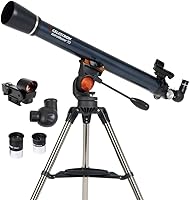
The Celestron AstroMaster 70AZ is a refractor for Moon, planet, star-cluster, and land viewing. Its lens-based design makes it a comparison example, not a tool for collimating a Newtonian.
When should you stop adjusting the mirrors?
Stop when the alignment tool shows the secondary and primary centered, the hardware is secure, and a steady star comes to a sharp point. Repeated tiny changes under poor seeing can make a good setup worse.
If you can't get the mirrors aligned, return the screws to a safe position and consult the telescope manual or maker's support. Avoid removing the primary mirror or dismantling the secondary assembly for routine collimation.
Some telescopes can also be checked with an artificial star, especially when weather makes a real star test difficult. See how to collimate a telescope with an artificial star.
For other optical designs, use the matching procedure: how to collimate an SCT telescope covers Schmidt-Cassegrain telescopes. Those instructions do not replace the Newtonian mirror sequence.
How can you keep a Newtonian or Dobsonian in alignment?
Check collimation after transport and whenever high-magnification views lose sharpness. Carry the tube securely, avoid knocks to the mirror cell, and store the telescope so the optical tube cannot roll or strike nearby objects.
A quick tool check before observing is usually easier than troubleshooting after a session begins. Once alignment holds, leave the screws alone until another check shows a real shift.
For a Newtonian or Dobsonian, use the cap or Cheshire to set the mirrors, then use a star test as a final visual check. Choose an artificial-star method when you need an indoor check, and consult the manual if your telescope's hardware differs from the steps above.
Frequently asked questions
How often should you collimate a Newtonian telescope?
Check collimation before a session when you move the telescope, after transport, or when stars look soft at higher magnification. A well-secured telescope may hold alignment between sessions, but a quick check helps catch shifts.
Follow the telescope maker's instructions if they differ from a general guide.
Can you collimate a Dobsonian telescope without a laser?
Yes. A collimation cap or Cheshire eyepiece can help you align a Dobsonian's mirrors without a laser.
A star test can provide a final check under steady skies, but it is less convenient for making the initial adjustments in daylight.
Which mirror do you adjust first on a Newtonian?
Center the secondary mirror under the focuser first, then align its tilt so the primary mirror's reflection is centered. Adjust the primary mirror last.
The exact screws and locking steps vary by telescope, so use the manual for your model.
Does a Dobsonian telescope need collimation?
Yes. A Dobsonian is a Newtonian reflector on a Dobsonian mount, so its mirrors need the same optical alignment as other Newtonian reflectors.
The mount style does not change the collimation process, though transport and handling can shift alignment.