What Is Chromatic Aberration in a Telescope?
On this page (6 sections)
Chromatic aberration in a telescope is a color fringing effect. A separate focusing flaw is spherical aberration. For more on this topic, see our guide to telescope aberrations. It happens when a telescope’s lens doesn’t focus all colors of light to the exact same spot. This causes unwanted colored halos around bright objects like stars or planets. You might see it as purple, blue, or red edges. It’s a common optical issue.
Think of it like a prism splitting white light into a rainbow. Different colors bend at slightly different angles. A telescope’s lenses can do this, especially cheaper ones. It can make your views look less sharp and colorful than they should be. Many telescope makers work hard to minimize this problem.
- Chromatic aberration causes color fringes around bright objects.
- It happens because lenses don’t focus all colors perfectly.
- You’ll see purple, blue, or red edges on stars and planets.
- It’s an optical issue that affects image clarity.
- Better telescope designs help reduce this effect.
Ready to see what causes it and how you can deal with it? Let’s take a closer look at this colorful quirk of telescopes.
Understanding How Telescopes Show Colors (and Sometimes Get Them Wrong)
You’re looking at the night sky through your telescope. Suddenly, you notice a bright star or planet has a strange colored edge. It might be a little bit purple, blue, or red. This isn’t a cosmic phenomenon; it’s likely chromatic aberration. It’s a common optical issue that affects many telescopes, especially those with simple lens designs.
Think of a lens like a magnifying glass. When light passes through it, the light bends. Different colors of light bend at slightly different angles. This is the same principle that makes a prism show a rainbow. When a telescope’s lens isn’t perfectly designed, these differently bent colors don’t all meet at the same point. This means your image won’t be as sharp as it could be.
The Science Behind the Color Fringing
So, why does this color bending happen? It all comes down to how light works and how lenses are made. White light, like sunlight or starlight, is actually a mixture of all the colors of the rainbow. When this light hits a lens, each color bends differently as it passes through. This effect is called dispersion. Red light bends the least, while violet light bends the most. Blue light sits somewhere in between.
How Lenses Focus Light
A simple telescope lens, called an achromatic lens, is designed to bring two colors of light into focus at the same point. For more on this topic, see our guide to achromatic telescope lenses. This helps reduce chromatic aberration significantly. However, it doesn’t perfectly focus all the colors. Often, blue and red light are brought into focus, but green light might be slightly off. Or, it might focus two colors well and leave others slightly blurred, causing that colorful halo.
Refractor Telescopes and the Color Problem
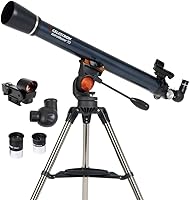
This issue is most common in refractor telescopes. These telescopes use lenses to gather and magnify light. The bigger and simpler the lens, the more prone it can be to chromatic aberration. You might see it more on the edges of bright objects. Imagine looking at a white fence against a dark sky; you might see a purple or blue edge on one side and a red or yellow edge on the other.
It’s important to know that this is a physics problem, not a defect in your telescope. Even very expensive refractors can show some level of chromatic aberration. The goal of telescope makers is to minimize it as much as possible. They use special glass and designs to combat this. Many modern telescopes have advanced designs that greatly reduce this effect.
What Does Chromatic Aberration Actually Look Like?
You’ve seen it, but what does it really mean for your view? Chromatic aberration creates an unwanted color fringe around bright objects. This can make them look less sharp and detailed. Instead of a crisp white star, you might see a small halo of color. For planets, like Jupiter or Saturn, you might see color creeping in around their bright disks or rings. This can make it harder to see subtle details on their surfaces.
Impact on Image Quality
The main impact is on image clarity. When colors aren’t focused together, your eye perceives a blurrier image. The brighter the object and the larger the aperture (the main lens or mirror size) of your telescope, the more noticeable chromatic aberration can be. While it doesn’t damage your telescope, it can detract from the beauty of the night sky. It’s like looking at a photo where the colors aren’t quite aligned.
Comparing Different Telescope Types
It’s interesting to note how different telescope designs handle chromatic aberration. Reflector telescopes, which use mirrors instead of lenses, do not suffer from chromatic aberration at all. Mirrors reflect all colors of light equally. This is why many deep-sky observers prefer reflector telescopes. However, reflectors have their own optical challenges, like coma, which can distort star shapes.
Here’s a quick look at how common telescope types deal with color:
| Telescope Type | Uses | Chromatic Aberration? |
|---|---|---|
| Refractor (Simple Achromat) | Planets, Moon, general viewing | Yes, noticeable on bright objects. |
| Refractor (Apochromat) | Planets, Moon, deep-sky objects, astrophotography | Very low to none; uses special glass. |
| Reflector (Newtonian) | Deep-sky objects, galaxies, nebulae | No. Mirrors don’t cause color issues. |
| Catadioptric (Schmidt-Cassegrain, Maksutov-Cassegrain) | All-around viewing, planets to deep-sky | Very low to none; uses corrector plates and mirrors. |
Minimizing and Managing Chromatic Aberration
Can you get rid of chromatic aberration? Not entirely, if your telescope has it. But you can certainly minimize its impact. Many telescope manufacturers have developed sophisticated ways to deal with this. Higher-end refractors often use special lens elements and types of glass to correct for color fringing.
Advanced Lens Designs
Telescopes called apochromatic refractors (or ‘apos’) use multiple lens elements made from exotic glasses. These are specifically engineered to bring all colors of light to a single focus point. While they are more expensive, they offer incredibly sharp and color-accurate views. Many astrophotographers prefer apos for their pristine images. They aim for almost zero chromatic aberration, as it’s very noticeable in long-exposure photos (NASA).
Filters to Help
For telescopes that do show chromatic aberration, certain filters can help reduce the perceived effect. A light-pollution filter or a nebula filter can sometimes cut down on the distracting colors. These filters block specific wavelengths of light. This can make the residual color fringing less apparent on your target object. They don’t fix the optical issue, but they can improve the visual experience.
Here’s a quick checklist to remember about dealing with chromatic aberration:
- Understand it’s a common optical effect.
- Note where you see color fringes (bright objects, edges).
- Consider telescope type: refractors are more prone.
- Look for ‘apochromatic’ or ‘ED’ glass in refractors for better color.
- Filters can sometimes help mask the distracting colors.
- Don’t expect perfection from every telescope.
When to Worry (and When Not To)
If you have a basic department-store telescope, you will likely see some chromatic aberration. This is perfectly normal for that type of equipment. Don’t let it discourage you from enjoying the stars. As you look at more advanced telescopes, you’ll notice designs that specifically address this issue. For planetary viewing, especially, a telescope with minimal chromatic aberration will give you a clearer, more detailed view. It’s a factor to consider when upgrading your gear.
Conclusion
Chromatic aberration is a common optical effect where different colors of light don’t focus perfectly in your telescope. This causes noticeable color fringing around bright objects, reducing image sharpness. While it’s a physics limitation, especially in simpler refractor telescopes, advancements like apochromatic designs and special glass greatly minimize it. Even reflector telescopes avoid this issue entirely. Understanding chromatic aberration helps you appreciate your current views and make informed choices when considering future telescope upgrades for clearer, more vibrant celestial observations.
Frequently Asked Questions
Will chromatic aberration damage my telescope?
No, chromatic aberration will not damage your telescope. It’s a normal optical characteristic, not a defect. It simply affects the quality of the image you see, especially around bright objects. You can continue to use your telescope without concern for any physical harm.
How can I tell if my telescope has chromatic aberration?
Look for colored halos, usually purple, blue, or red, around bright celestial objects like the Moon, bright stars, or the edges of planets. This color fringing is most noticeable on high-contrast boundaries. If you see these colored edges, your telescope is likely exhibiting chromatic aberration.
Are all refractor telescopes bad for chromatic aberration?
Not all refractor telescopes are equally affected. Simple achromat refractors are more prone to chromatic aberration. However, more advanced apochromatic (APO) refractors use special glass and multiple lens elements to correct for this issue very effectively, offering excellent color accuracy.
Do reflector telescopes have chromatic aberration?
No, reflector telescopes do not suffer from chromatic aberration. They use mirrors to gather and focus light, and mirrors reflect all colors of light equally. This is why many observers choose reflector designs when they want to avoid color fringing entirely.
Is chromatic aberration worse on brighter or dimmer objects?
Chromatic aberration is most noticeable on brighter objects or areas of high contrast. This includes the Moon, planets, and bright stars against a dark sky. Dimmer objects or smoother areas of nebulae are less likely to show the distinct color fringing caused by this optical effect.