What Is an Aberration in Telescope Optics?
On this page (4 sections)
An aberration in telescope optics is any optical flaw that distorts or blurs an image. These imperfections make celestial objects appear fuzzy instead of sharp. Telescopes aim for perfect light capture, but aberrations prevent this ideal. Understanding them helps you improve your view.
Optical aberrations are common in all kinds of lenses and mirrors, not just telescopes. They can affect the clarity and color of what you see through your telescope. Sometimes, these flaws are minor and barely noticeable. Other times, they can really ruin a good stargazing session. We’ll help you spot them.
- Aberrations are optical flaws in telescopes.
- They cause image distortion and blurriness.
- Common types include chromatic and spherical aberration.
- Good optics minimize these defects for sharper views.
- Identifying them helps in choosing better equipment.
Let’s dive into the different kinds of aberrations and how they might be showing up in your telescope.
Here is the main body content for your blog post:Understanding Optical Imperfections in Telescopes
You’ve probably heard that telescopes are supposed to give you crystal-clear views of the night sky. That’s the goal, anyway! But sometimes, what you see can look a bit fuzzy or have weird colors. These aren’t always because the telescope is bad or you’re not looking hard enough. Often, it’s due to something called optical aberrations. These are basically tiny flaws in the telescope’s lenses or mirrors that mess with the light. They can make even the brightest stars look like blurry blobs. We’re here to help you figure out what’s going on with your view.
The Main Culprits: Common Telescope Aberrations
When we talk about aberrations in telescope optics, we’re looking at specific ways the light gets distorted. Think of it like looking through a warped window. Light is supposed to travel in a perfectly straight line and focus to a single, sharp point. Aberrations are what happen when that doesn’t quite happen. They can affect how sharp an image is, its colors, and even its shape. Let’s break down the most common types you might encounter.
Chromatic Aberration: Seeing Colors You Shouldn’t
Have you ever looked at a bright object, like the Moon or a planet, and seen a colored fringe around it? That’s likely chromatic aberration. This happens when a telescope’s lenses bend different colors of light at slightly different angles. White light, like sunlight, is actually made up of all the colors of the rainbow. When it passes through a lens, each color bends a little differently. Red light bends the least, and violet light bends the most.
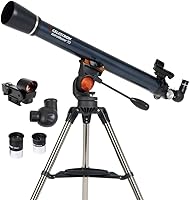
Your telescope’s lens tries to bring all these colors to the same focal point, but it’s not always perfect. This results in some colors focusing slightly in front of or behind the others. You might see a purple or blue halo around bright objects. It can make details seem washed out and less defined. This is especially common in refracting telescopes, which use lenses.
How to Spot Chromatic Aberration
Look at the edge of a bright object against a dark background. The Moon’s craters or the bright disk of Jupiter against space are good places to check. Do you see a distinct purple, blue, or even green edge? If so, you’re likely seeing chromatic aberration. It’s like a tiny rainbow smear that shouldn’t be there.
What About Different Telescope Types?
Refracting telescopes, which use lenses, are most prone to chromatic aberration. An achromatic lens helps reduce color fringing. This is because light has to pass through the glass. Reflecting telescopes, which use mirrors, don’t suffer from chromatic aberration. Mirrors reflect all colors of light equally. So, if you’re seeing color fringing, it’s usually in a refractor.
Spherical Aberration: Blurriness When It Should Be Sharp
Spherical aberration is another common issue, especially in telescopes that use spherical mirrors or lenses. A separate focusing flaw is spherical aberration. Imagine a perfectly round ball. Light rays hitting the outer edges of a spherical lens or mirror are bent more sharply than light rays hitting the center. This means light from the edges focuses at a different point than light from the center.
The result? The image isn’t sharp all over. You might find the center of the image is in focus, but the edges are blurry, or vice-versa. Even if you try to focus perfectly, the entire image can’t be sharp simultaneously. This aberration can make stars look like fuzzy points instead of tiny, crisp dots. It can also reduce contrast, making faint details harder to see.
Detecting Spherical Aberration
The best way to see spherical aberration is to focus on a star. If the star doesn’t snap into a tiny, sharp point of light when you focus, you might have this problem. When you slightly de-focus a star, instead of seeing a perfect, symmetrical circle of light, you might see a blurry patch with an uneven brightness. Sometimes the center is brighter, and sometimes the outer ring is brighter. It can make the entire image look a little soft or hazy.
Minimizing Spherical Aberration
Manufacturers try to correct for spherical aberration by shaping the lenses and mirrors in specific ways. For lenses, this might involve using a combination of different glass types. For mirrors, they often use a parabolic shape instead of a simple sphere. A parabolic mirror focuses all light rays, regardless of where they hit, to the same point. This is why many good reflecting telescopes use parabolic mirrors.
Other Optical Flaws to Be Aware Of
While chromatic and spherical aberrations are the most common, there are other imperfections that can affect your view. You might not see these as often, but they can still pop up.
Coma: The Off-Center Blurriness
Coma is an aberration that affects off-axis (not in the center) parts of the image, especially in reflecting telescopes with parabolic mirrors. For more on this topic, see our guide to coma correctors. Stars near the edge of your field of view might look like little comets or teardrop shapes, with a bright head and a blurry tail pointing away from the center of the image. It’s a bit like looking at a shooting star, but the star itself isn’t moving!
Coma is more noticeable the further you look from the center of the view. The comet-shaped edge distortion is called coma in a telescope. Wide-field eyepieces that offer large magnification can make coma more apparent. Some telescope designs, like the Newtonian reflector, are more prone to coma than others, especially in faster focal ratios (which are shorter telescopes relative to their aperture). Some telescope designs, like the Newtonian reflector, are more prone to coma than others, especially in faster focal ratios.
Astigmatism: The Stretched Star
Astigmatism is another defect that affects off-axis images. Instead of looking like a comet, stars at the edge of the view might appear stretched or elongated in one direction. If you slightly de-focus a star with astigmatism, it might look like a cross shape instead of a uniform circle. This is less common than coma in most modern telescopes but can occur.
Field Curvature: The Edge of Focus Problem
Field curvature means the focal plane isn’t flat. Another off-axis issue is field curvature. For more on this topic, see our guide to telescope field flatteners. Imagine trying to get a photograph where everything is sharp, but the edges are always blurry, or the center is sharp and the edges are blurry. That’s field curvature. In a telescope, this means you might get the center of your view perfectly in focus, but the stars at the edge of your field of view are out of focus, or vice-versa.
Many eyepieces can introduce or worsen field curvature. Some telescope designs are also more susceptible than others. It can be frustrating because you might have to constantly refocus as you pan across the sky.
How Aberrations Affect Your Viewing Experience
So, what does all this mean for your stargazing? Aberrations can really take away from the beauty of the cosmos. When an image is blurry or has strange colors, you miss out on the fine details. Crisp images make planets look more defined and galaxies appear more structured. Fuzzy views can make even the most stunning celestial sights look disappointing.
It’s not just about sharpness, either. Some aberrations can reduce the contrast of an image. This means faint details get lost in the haze. Imagine trying to see subtle cloud bands on Jupiter; if contrast is low, those bands just won’t be visible. Ultimately, aberrations limit how much detail and clarity you can get from your telescope, no matter how big its aperture is.
Choosing a Telescope with Good Optics
When you’re looking to buy a telescope, understanding these aberrations helps you make a smarter choice. You want a telescope that has been designed and manufactured to minimize these optical flaws. High-quality optics are key to a great viewing experience.
Look for telescopes that explicitly mention their optical corrections. For refractors, this often means an “apochromatic” or “ED” (Extra-low Dispersion) design. These use special glass or multiple lens elements to significantly reduce chromatic aberration. For reflectors, a well-made parabolic mirror is essential for minimizing spherical aberration and coma.
What to Look For in Product Descriptions
Pay attention to terms like “apochromatic,” “ED glass,” “parabolic mirror,” and “multi-coated optics.” These terms generally indicate that the manufacturer has taken steps to reduce aberrations. Avoid telescopes that are vague about their optical quality. A good telescope will be transparent about how it achieves good image quality.
When to Worry and When Not To
It’s important to remember that almost all telescopes have some level of aberration. Even the most expensive ones aren’t 100% perfect. The goal is to minimize them to a point where they don’t detract from your viewing pleasure. A tiny bit of chromatic aberration on a bright object might be acceptable, for instance.
However, if you notice significant blurring, color fringing, or distorted shapes, especially on brighter celestial objects, it might be time to investigate. Sometimes, it’s simply a matter of learning how to focus properly. Other times, it could indicate a defect in the optics. Don’t let minor imperfections ruin your hobby. Understanding them is the first step to enjoying the universe more clearly.
A Quick Checklist for Identifying Aberrations
Here’s a quick way to think about what you might be seeing
Conclusion
You’ve learned that optical aberrations are flaws in your telescope’s optics that can blur or distort images. We covered the most common types like chromatic aberration (color fringing) and spherical aberration (general blurriness). Understanding these imperfections helps you appreciate what you’re seeing. It also guides you toward choosing better equipment for clearer views of the cosmos. Don’t let a little blur stop you. Your next step is to examine your current telescope or research models that advertise advanced optical corrections for sharper, more enjoyable stargazing.
Frequently Asked Questions
Will my telescope have any aberrations?
Almost all telescopes have some level of optical aberration. Even very expensive instruments aren’t perfectly flawless. The key is that the aberrations are minimized to a point where they don’t significantly harm your viewing experience. Minor imperfections are normal.
Can I fix aberrations in my telescope?
You usually can’t “fix” aberrations in the optics themselves. However, you can minimize their impact. For example, using a specialized filter can help with chromatic aberration on very bright objects. Ensuring your telescope is properly aligned and focused is also crucial for getting the best possible image quality.
Which type of telescope is best for avoiding aberrations?
Reflecting telescopes, which use mirrors, do not suffer from chromatic aberration because mirrors reflect all colors of light equally. However, they can be prone to other aberrations like coma. Apochromatic or ED refracting telescopes are specifically designed to minimize chromatic aberration, offering excellent color correction.
How do aberrations affect viewing planets versus deep-sky objects?
Chromatic aberration is usually more noticeable on bright planets and the Moon due to their high contrast. Spherical aberration and coma can affect the sharpness of both planets and faint, distant galaxies or nebulae, making them appear fuzzy or less defined.
Is it worth paying more for a telescope with “apochromatic” or “ED” optics?
If your main goal is to see planets and the Moon with the best possible color and detail, then paying extra for apochromatic or ED (Extra-low Dispersion) optics is often worth it. These designs significantly reduce color fringing, providing sharper and more natural-looking views of bright celestial objects.